Gendered Pronouns in Early 20th Century Fiction: A Simple Quantitative Study

Gendered Pronouns in Early 20th Century Fiction: A Simple Quantitative Study

The following short essay is a work in progress -- I am exploring the uses of a corpus of early 20th century literature I have been developing for a few months. The study below represents an attempt to make use of that corpus to query a topic that has been of interest in quantitative DH in recent years. 


I have long been fascinated by a DH paper published in 2018, “The Transformation of Gender in English-Language Fiction” (link here; authors were Ted Underwood, David Bamman and Sabrina Lee) that has suggested strong statistical evidence that men were increasingly dominating the world of fiction in late 19th and early 20th centuries – that between 1850 and 1950 the percentage of published novels that were authored by women dropped dramatically (from near parity to more like a third or a quarter). Thus, at the exact period when we might have expected women to be gaining visibility and influence – associated with the early 20th-century suffrage movement and the appearance of important feminist voices like Virginia Woolf – they were actually losing position on the whole in the publishing world. 


According to the authors, the pattern only started to reverse in the second half of the twentieth century (and today, the publishing industry would of course look very different). Also, within their fiction, “The Transformation of Gender” authors indicate that men writers tend to write more about men, while writers who are women might be closer to gender parity in the amount of time given men and women in the social world represented in the story. The authors suggest that particular tendency hasn’t improved or changed as much.


Source: Underwood, Bamman, and Lee (2018)

Incidentally, the concern with the growing marginalization of writers who were women alluded to above is not a new one. The authors of “The Transformation of Gender” cite a 1989 study, Edging Women Out: Victorian Novelists, Publishers, and Social Change (Gaye Tuchman and Nina Fortin), where the authors did quantitative (but not digital!) scholarship with similar findings. Tuchman and Fortin counted and classified entries in Leslie Stephen’s Dictionary of National Biography to compare how women writers were talked about versus men writers. They found that while books by men were reviewed more frequently on the whole, the gender disparity in the more recent authors (late 19th century) became especially sharp with respect to works of nonfiction.  The authors of “The Transformation of Gender” used a very large corpus of tens of thousands of novels from HathiTrust (and checked against the smaller University of Chicago novel corpus) as well as sophisticated modeling techniques built around Natural Language Processing (NLP) to infer gender within a text and derive percentages. Some years ago, I finally gained enough confidence in basic Python to explore some of these methods on my own, using David Bamman’s BookNLP software (sadly, that software does not appear to be working at present, so I will not be using it for the results below).


One other bit of background: in the revised version of the essay published in his book, Distant Horizons, Ted Underwood mentions the Gendered Language Visualizer, a simple but deceptively powerful tool that tracks the association between non-gendered words and gendered pronouns in works of fiction. The technique behind that led to the beautifully illustrative image below (from the jointly written 2018 essay)


Source: Underwood, Bamman, and Lee (2018)

What it shows: women in fiction tend to "smile" and "laugh"; men tend to "grin" and "chuckle." (Though note that the divergence diminishes over time -- so in contemporary fiction that 'gendering of mirth' would be much less pronounced than it was at the peak of the divergence, around 1950.) 


Earlier studies: I should say that this is a more complex version of a type of analysis scholars have been doing in stylistics for many years; there are studies that go back to the 1990s that aimed to predict the gender of a writer based on characteristics of function words and articles. Koppel et al. (2002) used sophisticated statistical techniques with a fairly straightforward counting to find that writers who are men tend to use a higher proportion of noun specifiers (a, the, that), and numbers in their fiction. They also claim women tend to use more pronouns (she, herself), negation (not), and certain prepositions (for, with) and conjunctions (and). By lining up counts of these various parts of speech, the authors claim to be able to predict the gender of an author of an anonymized text with 80% accuracy. (Note: for what it’s worth, I tried to replicate their results with my own small, early 20th-century corpus, and failed. The only place where I saw a clear correlation was with gendered pronouns -- which might explain how I got to the design of the present study below.)


Moving past binarized gender thinking: Admittedly, I am not so interested in this particular application for my own research – it’s almost never the case with 20th-century fiction that the gender identity of an author is unknown. I also tend to be interested in writers who pushed against conventional gender roles and expectations in any case, many of whom might be understood as LGBTQIA+ today – writers like Virginia Woolf, E.M. Forster, D.H. Lawrence, Radclyffe Hall, or Wallace Thurman. Today, most scholars would find the "predict the gender" type of analysis overly restrictive and as essentially reinforcing binarized gender thinking. If E.M. Forster, for example, breaks with the expected pattern in novels that feature women protagonists (spoiler: he does!), that would be a more interesting finding than simply that reconfirming that 80% of men are from Mars, as it were.  


A simplified method for the present study: What if we drastically simplified the query with a corpus of early 20th-century fiction? As a starting point for thinking about patterns with respect to gendered socialization, why not simply look at gendered pronouns: he/him/his and she/her/hers? If the conclusions by Underwood et al. are correct, we should expect to see a lopsided homosocial tendency in fiction by men (men mostly talking to and about other men, and only occasionally mentioning a woman), and maybe a more balanced gender representation in fiction by women. We might also see some interesting anomalies in the patterns that might be worth exploring.  


Before doing this at a mid-range scale, I was curious to see how authors I know would shake out. Over the past few months, I’ve been developing a custom corpus of early 20th-century texts. I have described the basic design of the corpus here; it contains about 1000 total texts, including about 100 texts that might be thought of as canonical high modernist texts, 130 texts by African American authors, and about 90 texts associated with colonial South Asia. It also contains a substantial amount of genre fiction. The results below only reference works of fiction, though there are works of poetry, drama, and nonfiction in the corpus. 


With a little help from generative AI coding assistants, I devised a simple bit of code to count the use of gendered pronouns (he, him, his vs. she, her, hers), first, in a single novel, then in a batch of files, and then derive a percentage from the total word length of the file. I then took those gendered pronoun percentages, and compared them to one another to get a ratio. Rather than overwhelm the reader with a vast array of raw data, I’ll start with some smaller findings, initially focused on gendered pronoun ratios in a small set of ‘high modernist’ works of fiction, mainly by white British and American authors. I’ll then expand the conversation to other authors and consider broadly why any of this might be significant. 


From my limited high modernist collection, what are some texts that are especially lopsided towards men? (If you expected to see Ernest Hemingway on this list, you would be right!)


Text Ratio of masculine to feminine pronouns
Ernest Hemingway: Men Without Women 11.4 to 1
Hemingway: In Our Time 9.4 to 1
James Joyce: Portrait of the Artist as a Young Man 9.2 to 1
John Dos Passos: Three Soldiers 7.3 to 1
D.H. Lawrence: Kangaroo 4.2 to 1
Hemingway: The Sun Also Rises 3.5 to 1
James Joyce: Ulysses 3.0 to 1
James Joyce: Dubliners 2.2 to 1
E.M. Forster: A Passage to India 2.2 to 1
F. Scott Fitzgerald: The Great Gatsby 2.0 to 1

What to make of the lopsided nature of some of these texts? I should say, off the bat, that I don’t think the lopsidedness necessarily serves as an indictment of someone like Hemingway. The relative absence of women in his various short stories is partly due to their settings (several in Men Without Women deal with soldiers and World War I, and “The Undefeated,” about an aging Spanish bullfighter out for a last hurrah, is a pretty marvelous critique of dysfunctional masculinity). Moreover, A Portrait of the Artist as a Young Man is a coming-of-age narrative for Stephen Dedalus at schools that only admit boys and men with teachers who are also only men, so it’s not a huge surprise that the social world represented in the text is also pretty lopsided. (The imbalance might have been less if Joyce had kept in more of the love interest/romantic sections that were in the original Stephen Hero version of his manuscript.) The lopsidedness of other writers (and other Joyce texts) is less extreme, though it’s striking to see novels by D.H. Lawrence and E.M. Forster here (especially since Forster, with Howards End, is also on my second list below). 


Again, I don’t see it as an indictment per se, or as a reason to drop Hemingway or Joyce from my syllabus, though it is still worth knowing. (Do readers want or need to see characters that match their own gender identity or expression in order to connect with a text? Probably not, but my hunch is that it might help...) Still, the pattern does appear to show that there is a pretty limited role for women in the social worlds we find in these texts. It is not as if the authors don’t know it, either: the title Men Without Women can be read as self-critique of a symptomatic nature. These are men without women, and perhaps that’s why they are so broken.


And what about woman-centered texts by writers of literary fiction typically associated with high modernism? 


Text Ratio of feminine to masculine pronouns
Dorothy Richardson: Pilgrimage 1Pointed Roofs 13.1 to 1
Bryher: Development 9.9 to 1
Richardson: Pilgrimage (other volumes) varies between 5 to 1 and 2 to 1
Nella Larsen: Passing 4.9 to 1
Radclyffe Hall: The Unlit Lamp 3.9 to 1
Radclyffe Hall: The Well of Loneliness 2.8 to 1
Wallace Thurman: The Blacker the Berry 2.8 to 1
Gertrude Stein: Three Lives 1.6 to 1
Virginia Woolf: Mrs. Dalloway 1.6 to 1
Katherine Mansfield: The Garden Party And Other Stories 1.6 to 1
Mansfield: Bliss and Other Stories 1.5 to 1
Virginia Woolf: The Voyage Out 1.5 to 1
Woolf: Night and Day 1.4 to 1
Woolf: Orlando 1.4 to 1
Woolf: To the Lighthouse 1.3 to 1
Forster: A Room With a View 1.2 to 1
Forster: Howards End 1.2 to 1
It was not hugely surprising to see Pilgrimage: Pointed Roofs as the most lopsided she/her centered text in the high modernist selection from my text corpus. Pointed Roofs is the story of a young woman teaching at a girls’ boarding school, so, as with Portrait of the Artist above it is not surprising that it reflects a homosocial world with largely girls and women as characters. 


Also, anyone who has read Passing recently would not be surprised to see how prevalent she/her/hers pronouns are there: it really is a novel focused on the relationship between two women. (If anything, this finding only reconfirms readings that have stressed the homoerotic subtexts of that relationship.)


I was intrigued to see a book by a man, Wallace Thurman, come out fairly high on this list (2.8 to 1). I am not entirely sure what to make of it; the novel in question is a thoughtful and often bitter account of colorism within the Black community with a woman protagonist. 


The bigger takeaway might be that the pattern described by Underwood et al. appears to be in evidence with this small group of high modernist writers – writers who were women were, on the whole, less lopsided than were their peers who were men. Instead of a ratio of 10 to 1 or 4 to 1 or even 2 to 1, the median here for writers like Woolf and Mansfield – two of the core authors in the modern feminist canon – is closer to 1.5 to 1. 


Expanding the Range of Authors: Genre Fiction Writers


Now, let’s move to the broader dataset. The first discovery might be that the gendered pronoun disparity can be wildly lopsided in adventure fiction and westerns: 


Text Ratio of masculine to feminine pronouns


Zane Grey, The Young Pitcher 630 to 1

Zane Grey, Ken Ward in the Jungle 433 to 1

G. K. Chesterton, The Man Who Was 

Thursday 139 to 1

H. G. Wells, The First Men in the Moon 104 to 1

John Buchan, Prester John 101 to 1

Lord Dunsany, The Gods of Pegana 57 to 1

L. Frank Baum, The Master Key 47 to 1

Dhan Gopal Mukerji, Kari the Elephant 44 to 1

G. K. Chesterton, The Man Who Knew 

Too Much 43 to 1

Jack London, The Call of the Wild 18 to 1

John Buchan, The Thirty-Nine Steps 15 to 1

Dorothy Sayers, Lord Peter Views 

The Body 5.8 to 1

Agatha Christie, The Big Four 4.0 to 1


The scale of lopsidedness is pretty vast – and consistent – with early 20th century men who wrote westerns, science fiction, and detective fiction all showing a highly lopsided, man-centered social world. (I ran hundreds of titles for this study, and am only including a few noteworthy titles on these tables; readers who want to see the raw data can find it here; note that it contains texts that are not works of fiction--I've been disregarding those in the present study) Even women who wrote detective fiction tended to show a version of it, though Dorothy Sayers’ Lord Peter Views the Body (at 5.8 to 1) is still much less imbalanced than something like The Young Pitcher (another narrative of a young man at school, with no girls or women about). 


And what about woman-centered genre fiction / popular fiction? 


Text Ratio of feminine to masculine pronouns


Rokeya Hossain, Sultana’s Dream 10.8 to 1

Vita Sackville-West, The King’s Daughter 5.7 to 1

Edith Wharton The Old Maid 5.4 to 1

Elinor Glyn, Man and Maid 5.0 to 1

Gertrude Atherton, The Living Present 3.8 to 1

L. M. Montgomery, Anne of Green 

Gables 3.2 to 1

Somerset Maugham, Liza of Lambeth 2.9 to 1

Louis Bromfield, The Green Bay Tree 2.4 to 1

Edith Wharton, The House of Mirth 2.4 to 1

Zane Grey, The Call of the Canyon 2.4 to 1

Temple Bailey, Judy 2.0 to 1

H.G. Wells, Ann Veronica 1.8 to 1


Again, while there are some texts that are highly woman-centered (Sultana’s Dream is, famously, a feminist utopia with men kept in enclosures, while women run the world), the imbalance for romance fiction writers like Elinor Glyn or girl-oriented children’s fiction writers like L.M. Montgomery (Anne of Green Gables) is considerably less pronounced than with their counterparts who were men. 


Given how lopsided Zane Grey generally is, it is interesting to see one of his novels here (a shell-shocked World War I veteran moves to Arizona and has to choose between two different women). It’s also noteworthy to see an instance of H.G. Wells’ “new woman” fiction here. (Again, if anyone would like to see the full / raw data, it is here.) 


Quick conclusions; Next steps in the analysis?

Admittedly, this is a fairly crude method. At most, it shows some general patterns and trends, and confirms (albeit with a very small sample of texts) what Underwood/Bamman/Lee claimed using a much larger statistical model. Here is Underwood in Distant Horizons: 

“It turns out that women are consistently under-represented in books by men. On average, only a third of the words men use in characterization are used to describe feminine characters. Women writers, on the other hand, spend equal time on fictional men and fictional women. This difference remains depressingly constant across two centuries, and it may help explain why books by men tend to have more stereotyped gender roles.” (Distant Horizons, 127)

For me, the next steps might not be more quantitative queries. Rather, I am curious to look at the anomalies and exceptions in the early 20th-century corpus to try and learn more about what might have been going on, perhaps the old-fashioned way (i.e., actually reading the novels in question). For instance, for a writer who was so dramatically lopsided towards men otherwise, how did Zane Grey's  The Call of the Canyon feature women's voices in a 2:1 ratio? What was he doing differently here? (Especially curious since for someone like Hemingway, fiction responding to the psychic effects of World War I was often overwhelmingly oriented to men.)

Also, for writers like E.M. Forster and Wallace Thurman, both writers of literary fiction who lived their lives as closeted gay men, it is intriguing to see they both wrote novels with women protagonists who scored fairly high on the second table above. It might be interesting to gather together other novels written by cis-identified men with women as protagonists. Are there any patterns that can be gleaned from them? 

Finally, I'm curious about the representations of animals in the corpus. It's striking that a big part of the reason Hemingway's "The Undefeated" and Jack London's The Call of the Wild appear so lopsided in terms of gendered pronouns is that the vast majority of the animals are gendered male in both texts (alongside the human protagonists of those stories, of course). It might be interesting to make a small corpus of animal-oriented fiction from this fiction and study how animals are gendered (perhaps adding in more emphasis on non-gendered pronouns...).


Association for Asian Studies Conference 2026: A Few Highlights and Notes

I was at the AAS conference in Vancouver over the weekend, to be part of a panel on Colonial Archives and Digital Humanities in South Asia. 

I also took the opportunity to listen in on some conversations I might normally get to hear at literature conferences. 

I was just there for Friday and Saturday, and I was able to attend the following panels:


I'll do brief summaries of some takeaways from the various sessions below.

* * * 


1. The Asian Smart Cities panel was something I went to on a lark, mainly out of curiosity. Here's a bit from the panel description: 

The concept of smart city is linked to futuristic scenarios made of images, symbols and concepts that became part of collective imagination and memory: cities should not only be efficient, productive and accessible; they also need to be beautiful, sustainable and socially inclusive.  

At present, the smart city designation means things like: real-time traffic monitoring, with cameras and censors; CCTV cameras everywhere, observed either by humans or (increasingly) by AIs; weather and threat warnings (i.e., flood sensors). 

By and large, I was not surprised to hear Singapore discussed on the panel as embracing the smart city approach. But I was interested in the presentation on the panel dealing with the Smart City approach in Jakarta. There, it has been only partially successful since there are so many people in the city who are in informal settlements... it's hard to use high-tech cameras and monitors when people are living in shacks and improvised settlements... There was also an interesting paper here on the rise and fall of the cycle rickshaw (Bejak, in Jakarta) as a mode of transportation and as a symbol of the Indonesian working-class "everyman" that continues to be invoked by politicians even as the city modernizes. 

(Side comment: I do wonder whether before planners invest billions of dollars making smart cities in the Global South, they should make cities where everyone has access to affordable housing, power grids and sewage systems that work, and roads and public transportation.)

Some of the papers alluded to other dissents from the Smart City model, especially the growing emphasis on using AI instead of human monitoring. AI-powered smart city technology is expensive; it's often strongly promoted by companies selling monitoring systems and other tech companies; and it can lead to a sense of being constantly policed that might be good for preventing street crime, but that's not good for overall social well-being or urban discovery or spontaneity. 

Along those lines I came across this Op-Ed by Richard Sennett in the Guardian that spoke to those dissents: "No One Likes a Smart City That's Too Smart": 

Uniform architecture need not inevitably produce a dead environment, if there is some flexibility on the ground; in New York, for instance, along parts of Third Avenue monotonous residential towers are subdivided on street level into small, irregular shops and cafes; they give a good sense of neighbourhood. But in Songdo, lacking that principle of diversity within the block, there is nothing to be learned from walking the streets. [...]

A great deal of research during the last decade, in cities as different as Mumbai and Chicago, suggests that once basic services are in place people don't value efficiency above all; they want quality of life. A hand-held GPS device won't, for instance, provide a sense of community. More, the prospect of an orderly city has not been a lure for voluntary migration, neither to European cities in the past nor today to the sprawling cities of South America and Asia. If they have a choice, people want a more open, indeterminate city in which to make their way; this is how they can come to take ownership over their lives.

(This wasn't mentioned on the panel; just something I read and thought was on point.)

* * * 


2. The Cultural Revolution panel I attended was really well-attended -- standing room only, with a number of people turned away at the door due to the overflow crowd. The speakers were all very senior academics, some with several books on the history of post-revolution China. Here's a bit from the program copy.

Yiching Wu will argue that in May of 1966, Mao’s intention was to initiate a targeted purge within education institutions, but the campaign soon escalated into a generalized attack on “capitalist roaders” inside the party. Andrew Walder will examine how the unintended consequences of Mao’s moves shaped the course of factional conflicts, particularly in the context of failed truce negotiations among rival rebel groups. Patricia Thornton will focus on the dynamics of the mass movement and the question of representation, raising critical questions about Mao’s ability to direct or contain the grassroots movement he had unleashed. Daniel Leese will assess the quality and structure of information that reached Mao, drawing on the party’s internal reporting systems to interrogate the limits of central knowledge and decision-making during the Cultural Revolution. Felix Wemheuer will chair the discussion.  

Essentially, what I took away from the discussion was the sense that the opening of the Cultural Revolution was a lot less organized than one might think. Mao himself initiated some of the new policies, but the extremity of what followed was not really his intent, nor were the actions of party officials in towns and villages outside of Beijing fully under his control. The panelists discussed a number of key events in 1966-1967 in pretty granular detail (see the Wikipedia page for the Cultural Revolution, and scroll down to 1966: Outbreak)

* * * 


3. The "Beyond the Visual: Gender, Queerness, and Media Margins" panel I attended had some really interesting papers thinking about sound and voice in Japanese popular culture. 

The paper I found most interesting was Haruki Segicuchi's paper a 1988 Japanese film called Summer Vacation 1999, about a homoerotic relationship between teen boys where the actors were actually all cis-gendered women! 

I also really enjoyed Minori Ishida's paper on "Gender Deviance in the Bodies of Anime Characters." The panelist mentioned anime series I mostly hadn't seen, like Fena: Pirate Princess and The Land of the Lustrous. There's some really interesting stuff going on here with representations of gender identity (including non-binary and gender non-conforming characters) in both art design and in voicing in these series. While traditional anime featured a highly stylized and binarized approach to gender (soft / feminine women and girls; tough/masculine boys & men), some newer series are exploring queer and nonbinary aesthetics both in visual character design and voicing. 

* * * 


4. The Film, Media, and Gender panel I attended was a bit of a hodge-podge. I especially enjoyed the two papers dealing with South Asian film studies. 

Rebecca Peters of Florida State University gave a paper on Kiran Rao's film Laapata Ladies, focused on how the film uses costume design and clothing to mount a critique of conservative gender norms and expectations. It's part of a dissertation she's writing on women film directors in Bollywood, which sounds like it will be pretty impactful. 

Arpit Gaind of UCLA gave a rich talk summarizing his research based on his field experience in Jharkhand working with Adivasi filmmakers. 

Here's a bit from his abstract: 

Drawing on ethnographic fieldwork and film analysis, this study demonstrates how Indigenous collectives such as Akhra Ranchi have pioneered what Raheja (2007) theorizes as "visual sovereignty"—the space wherein Indigenous filmmakers critique and reconfigure dominant media conventions while operating within their constraints. By repurposing technologies from analog VHS to digital drones, Adivasi filmmakers parallel global Indigenous movements in asserting what Barry Barclay conceptualized as "Fourth Cinema"—media controlled by Indigenous communities rather than cultural colonizers.

Links for further exploration:

Akhra Ranchi main page

Akhra Ranchi Facebook page

Scholarly chapter on Adivasi Dance in Jharkhand that alludes to Akhra Ranchi

* * * 


5. As I suggested above, the panel "Sitting in the Tension: Caste in the South Asian Diaspora" was a highlight for me. 

Speakers were Sharanjit Kaur Sandhra (University of Fraser Valley), Neha Gupta (UBC), Sasha Sabherwal (Northeastern University), Anita Lal (Poetic Justice Foundation), and Manmit Singh (grad student at UBC). 

I was especially interested in the stories told about a recent exhibit that has appeared at various universities in British Columbia called Overcaste, which has been controversial in the Sikh community. (See coverage in the Vancouver Sun). 

Anita Lal is a Dalit (Chamaar) Sikh whose family has been in British Columbia for four generations. Her great-grandfather Maya Ram Mahmi was the first Dalit migrant to arrive in Canada. The community was small, but over time they established their own institutions; today, there are several Ravidasia Gurdwaras that have been founded by Dalit Sikhs. 

The Overcaste exhibit has a nice digital version that can be accessed here.

More relevant links: Punjabi Sikh and Dalit (article at SAADA)

Poetic Justice Foundation

Account of the Exhibit at Community Wire, with a quote from Anita Lal that contains a mention of Maya Ram Mahmi:

“In 1906, my great-grandfather Maya Ram Mahmi became the first recorded Dalit immigrant to Canada, seeking a brighter future and escape from the social and economic oppressions he faced in India. Yet, he and his descendants, including myself, have faced ongoing caste discrimination, an issue that persists over a century later. Through the OVERCASTE exhibit, we aim to highlight the often-ignored problem of caste bias in Canada. This initiative seeks to amplify the Dalit Canadian narrative, which has been historically sidelined and ignored,” says Anita Lal, Co-Curator of the exhibit and Co-Founder of the Poetic Justice Foundation. 

* * * 

6. I was surprised by the generally optimistic tone of the next panel I attended, "AI in Action: Best Practices for Research, Publishing, and Teaching in Asian Studies." Two of the speakers here, Joseph Alter and Elise Huerta, were journal editors. 

Alter described how the submission rate for the Journal of Asian Studies has increased by 150% in the past five years. The reason is not so much AI-assisted writing as AI-assisted translation, as many potential contributors who are not native speakers of English are writing up their research in their own languages and then using Gen-AI translation to render their work in smooth, idiomatic English. 

The editor was not especially bothered by this, and I can see why -- it has the potential to democratize scholarship in Asian Studies. (However, it does mean that reviewers have to be found to handle all those new submissions, and policies have to be developed to handle the use of AI...) 

The editors also mentioned the growing problem of peer reviewers being tempted to use generative AI to create overviews or summaries of submitted articles, or even to write assigned reviews. 

Along those lines, in the Q&A I asked the following question: 

[Me] This question is first for the editors on the panel but others might also have things to say about it. I’m a little surprised that the overall tone of this panel is a lot less apocalyptic than I would have expected. In literature and writing, the mood is a lot darker – I taught first-year writing recently, and it was really tough to get through to students about the importance of the process we’re asking them to engage in. Some students are having trouble resisting the temptation to cheat with AI, while others wish it would just go away. 

Perceived audience and reward matter a lot. People tend to work hard when they know there’s a reward for their effort. People tend to write more thoughtfully and carefully when they know there is a reader who will care what they say. I'm worried about academics also being tempted to cheat using gen-AI for peer-review. 

We should mention that peer-review is by and large unpaid labor. It’s also work that doesn’t really have the same level of professional reward as our primary research. Most likely our reviews will be read by an editor who knows our name but will go back to the author who doesn’t know who we are. And while we can claim the review on our CVs it doesn’t count for much in university professional activities reports, so our department chairs and Deans don’t really pay much attention either. So our audience of human readers is tiny; it seems hard to imagine people will not start to cheat when they write anonymous peer-reviews. 

So it's a structural problem. Can there be structural solutions? 

Perhaps open-peer review?  So if we do a review of an essay, it is and can be known by others...?

In their responses, the editors of the two journals and others on the panel were not terribly concerned with this problem. Their sense is that peer-reviewing is voluntary writing, so people who don't want to do the work will turn down the request to review. And they feel that most if not all of what they currently get in terms of peer-review evaluations are written by humans even if the readership is largely anonymized.  And they feel that people are by and large sticking to the honor system & often writing really compelling, constructive reviews that help other scholars and that help the field overall. 

Overall, a lot less apocalyptic than one would expect! 

* * * 

7. Finally, my own panel. 

Margaret Schotte and Christina Welsch have collaborated on an impressive DH project called Sailing With the French, which aims to "visualize and analyze more than 1300 voyages of the French East India Company during the 18th century, uncovering patterns and stories from archival records of the era." They're finding some really fascinating stuff about the demographic backgrounds of the sailors who sailed for the French Indies Company in the 18th century. Alongside Frenchmen, there were also Lascars and enslaved people, some of them from Africa, who were on these ships. 

I would also recommend people interested in these topics check out Christina Welsch's book, The Company's Sword: The East India Company and the Politics of Militarism, 1644–1858. 

For my part, I posted the text of my own talk and slides here.

Dhanashree Thorat's talk on telegraph and internet infrastructures overlapped with her 2019 article in South Asian Review, which you can see here.

* * * 

After my panel I chatted with Nicole Ranganath of UC-Davis. She mentioned the Pioneering Punjabis Digital Archive (1300 items) and the Punjabi and Sikh Diaspora Archive. The latter has some impressive material related specifically to early Punjabi women settlers in California (see Women's Gallery).

African American Poetry: Website Updates

At the end of Black History Month for 2026, I was impressed to see a new high in monthly traffic for the digital collection I edit on African American Poetry: 40,000 users in February! 

Chart showing user traffic for African American Poetry: A Digital Anthology February 2026. 40,000 users for 30 days

40,000 users in a month is a jawdropping number that is a little hard to comprehend, especially considering most academic articles I might otherwise publish would be read by 100 people or less. Even for other digital collections I have edited, I would consider 5% of that traffic -- 2000 users a month -- to constitute success, so this is really a different scale. Admittedly, at least some of the new traffic might be bots and generative AI scrapers; I've seen a significant uptick in users in China, though I would be surprised to learn that African American literature in English has suddenly appeared on university syllabi there. 

Of course all credit really goes to the amazing writers whose works are collected on the site -- there is clearly a large number of folks out there looking for these materials, both inside and outside of academia. Writings by Nella Larsen, Zora Neale Hurston, Langston Hughes, and Claude McKay are the most in demand.  

Chart showing usage statistics for African American Poetry a Digital Anthology. Nella Larsen, Zora Neale Hurston, Alain Locke's The New Negro, Langston Hughes, Claude McKay

I have also been making some regular updates and additions to the site.

1. A simple digital edition of the volume, "Four Lincoln University Poets" (1930). It includes poems by Langston Hughes, Edward Silvera, and Waring Cuney. All three influential Harlem Renaissance poets were undergrads at Lincoln at the same time! (Admittedly, Hughes was a little older than most other students -- he had spent several years in the early 1920s wandering the world as a sailor even as his literary career was taking off in the pages of magazines like The Crisis. When he decided to back to college in 1926, he landed on Lincoln, then a fairly modest but well-reputed HBCU outside of Philadelphia.)  

2. An author page for Harlem Renaissance poet Waring Cuney. 

Cuney's best-known poem is the free verse "No Images"; it was widely anthologized at the time: 

She does not know
Her beauty
She thinks her brown body
Has no glory

If she could dance
Naked
Under palm trees
And see her image in the river
She would know

But there are no palm trees
On the street
And dish water gives back no images


3. A stub author page for poet Azalia E. Martin (active 1900-1910). Sadly, I couldn't find much biographical information on her. 

However, see her powerful 1906 poem "A Protest": 

"Ye who would stop the progress of a race,
Give ear; that race would question thee." 


4. Improved author pages for Harlem Renaissance poets Edward Silvera and Lewis Alexander. I tracked down the only publicly available photo of Edward Silvera from a Lincoln University yearbook. (I've asked the Lincoln U. library for a higher-res version...) Once I can track down a better / higher res. version of a photo, I might take a stab at making a Wikipedia page for Edward Silvera. 

5. Added new poems by Lucian Watkins, mostly discovered in the Richmond Planet newspaper, via the Library of Virginia's website. Watkins served in the Army and was stationed in the Philippines during the Spanish-American War (1898-1900) and the war against Filipino independence fighters that followed (early 1900s). Based on an entry in the Planet, it seems like we can confirm that he remained enlisted in the Army all the way through the World War I years (1918). 

New Essay in Print: "Banning Toni Morrison"

I have a short essay in a new Bloomsbury volume just published, Banning Books in America: Not a How-To, edited by Samuel Cohen. Other authors include Lydia Millett, Leonard Cassuto ("Is It Ever Ok To Ban a Book?"), Emily Harris, ("Why It's Ok to Call It a Ban"), Lopamudra Basu ("Banned Books in Transnational Contexts"), Annie Abrams ("Illiberal Education") and several others. 

My essay is called “‘Amputate the Problem, Band-Aid the Solution’: Censoring Toni Morrison.”

The first two paragraphs are as follows: 

The most commonly censored speakers and writers in the U.S. are people from marginalized groups whose voices and arguments threaten state authority or the status quo.  Books by Toni Morrison, especially The Bluest Eye and Beloved, regularly appear on the American Library Association’s annual “10 Most Challenged” Lists, with The Bluest Eye in particular catching the attention of ban-oriented groups over the past few years. The Bluest Eye, a book published in 1970, was on the 10 most challenged books of 2022 and 2023, alongside very contemporary books like Gender Queer and All Boys Aren't Blue. As of this writing, the ALA does not yet appear to have published the most challenged books of 2024, but it is fully expected that Toni Morrison will again make an appearance.

As I have been teaching courses on Toni Morrison's fiction to undergraduates at my university, I have wanted to bring the library challenge campaigns to their attention, and possibly construct assignments inviting students to investigate the claims against Morrison's novels. The English paper prompt essentially writes itself: what is the argument against Morrison in these complaints, and how would you respond? Unfortunately, responding to this prompt has proved to be difficult, as the complainants don't actually present arguments as such. One of the people who filed a complaint against The Bluest Eye, Amber Crawford of the St. Charles Parents’ Association in Wentzville, Missouri, simply listed “pediphilia [sic], incest, rape” as a sufficient reason. 

It would be too generous to call this list of words an actual argument. 


One of the chapters, by author Lydia Millett, has been published on Lithub, here.


South Asian Americans: Time To Toughen Up

There’s a great research- and reporting-driven opinion essay by Lydia Polgreen in the New York Times  about how Indian Americans have found themselves flat-footed after the surge in anti-South Asian rhetoric and policy from the right. There are two prongs of this – one is the expansion of policies designed to reduce immigration, and the other being a more insidious cultural turn towards xenophobia and open, unapologetic racism.

The Trump administration, led by Trump himself but also J.D. Vance and Stephen Miller, has been dead-set on reducing both legal and illegal immigration from all non-European countries. The administration can apparently act on this single-handedly – virtually eliminating asylum options, adding onerous fees and paperwork to H-1B visa processes, and making it more difficult and less appealing for Indian students to come study in the U.S. (Indian student enrollment at U.S. universities was down 44% this year.) The good news is that at least some of that may be at least partially reversible the next time there’s a Democrat in the White House. Then again, it is certainly possible that future Democrats, having seen how unpopular Joe Biden’s approach to immigration was, may be reluctant to look “soft” on immigration and keep at least some of the Trump policies in place. (The ICE raids, we can hope, will stop once Trump is out of office.) Without comprehensive immigration reform, it is not clear there is a way to fix everything that’s been broken in the immigration system.

That leaves the racism; this is something we can fight, but first we have to understand it. Some right-wing Indian Americans have been surprised to discover the rapid acceleration of racialized hostility on social media. After encountering an overwhelming array of hostility to his benign Diwali post on social media (choice example: “Go back home and worship your sand demons”), Vivek Ramaswamy asked his peers on the right to “cut the identity politics.” Even Dinesh D’Souza, a commentator who built a long career on anti-Black race-baiting, has finally decided to be a little bit offended (“In a career spanning 40 years, I have never encountered this type of rhetoric. The Right never used to talk like this. So who on our side has legitimized this type of vile degradation?”) To these folks, I would absolutely say, you made your bed, now lie in it.

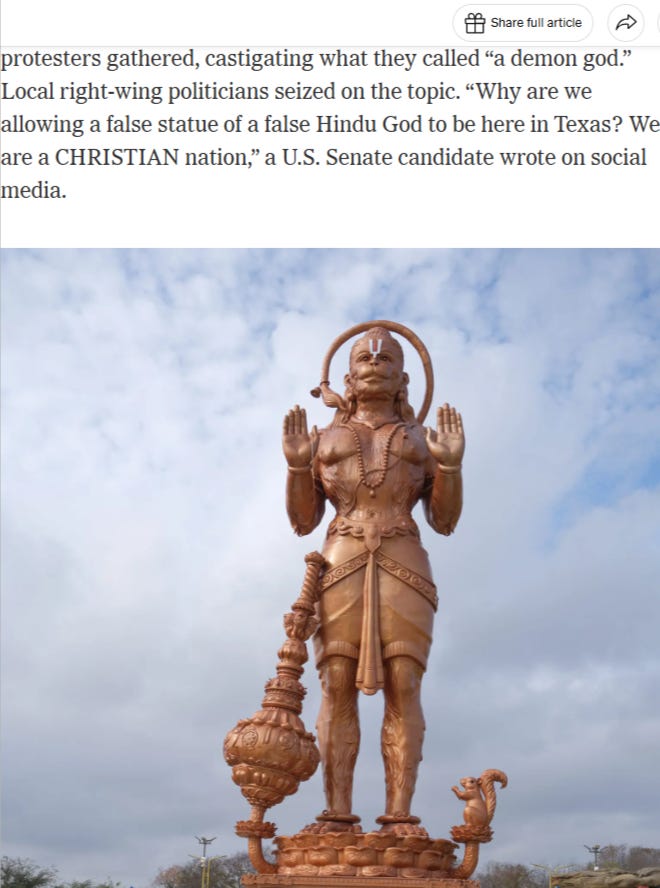
Photo of the “Statue of Union” in Sugar Land, Texas. From the New York Times. Perhaps we could spend a little less on statues and temples, and a little more on institutions to protect South Asian American civil rights?

Others, like the retired doctor in Texas in Polgreen's story whose community built a 90 foot Hanuman statue at their local Mandir only to discover evangelical Christians in their town protesting at the temple gates, need to wake up to the new realities of American life. Below I have a couple of strategies for how South Asian Americans might toughen up a bit.

Some of what I have to say is hinted at in Polgreen’s piece itself. I would recommend reading through to the second half, where she has some helpful quotes from Suketu Mehta about the delusions some Indian Americans have harbored about how others really feel about them:

But Mehta also wondered whether Indian Americans had become a bit smug about their spectacular success in America over the past six decades, trusting that their wealth and status would shield them from the kind of bigotry that once barred them from entry and citizenship. Indian Americans, he said, tell themselves: “We are the richest, best educated people. We don’t commit crimes. We go to good schools. We came here legally. We’re not like the Mexicans.”

Mehta finds this exceptionalism both understandable and dangerous. The Indians who come to the United States are not just the most ambitious and educated. They also are mostly the beneficiaries of the durable hierarchies of caste, class and religion that stratify Indian life.

Following Mehta’s insightful comments above, it seems to me that the goal for South Asian Americans has to be to build generation-spanning institutions and spend both cultural capital as well as real capital on investments that benefit American society as a whole.

Nobody is impressed by “model minority” rhetoric, and some communities are actively hurt by it. A surprising number of South Asian Americans, especially of the older generation, blithely cite success statistics and low crime rates as if those all happened in a vacuum. And as if other communities haven’t been on the receiving end of generational institutional racism, cyclical poverty, and over-incarceration. 

Nor is there much going to be much benefit in complaining about racism that mysteriously just appeared. Newsflash: it was always there; it’s just more visible now that there are politicians at the top who are willing to exploit it and mobilize it. The kinds of demonization that have been directed against Black folks and Latinos can also be directed against privileged brown immigrants. Indeed, it should not surprise us that this would happen.

So what can we do?

1. South Asian Americans could work together with other minoritized communities to fight anti-Black and anti-Latino racism, all forms of xenophobia, anti-Semitism, and anti-Muslim rhetoric wherever any of these may crop up. We need to learn to see those fights as our fights. (Note: this is why "South Asian American" – including immigrants from Muslim-majority South Asian countries as well as Nepal and Sri Lanka – is a better framework for organizing than “Indian American.”)

2. South Asian Americans could use our economic clout to build lobbying groups and PACs to advance South Asian community interests. If a politician running for the U.S. Senate starts posting about Hindu deities as “demons” on social media (as happened with the Hanuman statue in Texas), a strategic offer of a political donation if they can tone it down could do wonders. Otherwise, make a donation to their primary opponent and announce why we’re doing that to the media. Indian Americans have been happy to spend their money building massive, showy temples. In politics, they’ve been somewhat inclined to stay on the sidelines. It’s time for that to change.

3. South Asian Americans need to rally behind politicians who support South Asian communities -- and civil rights and secularism more generally -- and unify against those who don’t. Anyone who talks like Stephen Miller or J.D. Vance should not have a chance of getting our vote. I was not hugely surprised to see that in the 2024 election there was a small but noticeable shift in the Indian American community towards Trump – even at a time when Trump’s opponent was an Indian-American woman! (61% of Indian Americans still voted for Harris in 2024, but one might have expected that number to be higher.) Some of the interest in Trump, admittedly, was due to social media misinformation (see point #4 below), as well as the “economic message.” But some of the softness in support was due to lack of clarity and confusion about what the different parties actually stood for.

4. South Asian Americans probably need to invest in social media influence campaigns to correct falsehoods, misinformation, and out-of-context stories.

In conversations leading up to the 2024 campaign, a surprising number of my friends and acquaintances were citing an old story about Kamala Harris that had been circulating on social media about Kamala Harris’ role as Attorney General in a case in 2011, where a Sikh man with turban and beard sued to be able to hold a job as a prison guard, which requires people to be clean-shaven; Harris supported the state of California’s position on prison guards being clean-shaven to wear gas masks. This is apparently a real story, but it is hardly a reason to say that “Kamala Harris is anti-Sikh.” Again, if we were comparing Harris – a Black and South Asian candidate with a long history of supporting civil rights – to Trump, it should be clear to everyone who is likely more sympathetic to South Asian communities, including Sikh Americans.

Similarly, a number of my family members and friends were duped by the idea – again, popular on WhatsApp – that “Modi and Trump are best buddies, so nothing bad could happen with respect to India or Indians.” They seemed not to realize that Trump meant what he was saying on the campaign trail about radical changes to the immigration system, and what that might entail.

How exactly this might get fixed is not so easy. Some of it could be solved by the platforms themselves. But probably advocacy groups should be thinking about corrective social media influence campaigns to respond to out-of-context stories. These can be tricky to do well, but the incredible success of Zohran Mamdani on social media in the 2025 NYC mayoral campaign might be a model to emulate. Humor, wit, and charismatic messengers could go a long way here.

2025: My Year in Books


1. General Interest Recommendations


Arundhati Roy, 
Mother Mary Comes to Me. This was a standout for me this year -- Roy's beautifully written memoir of her rocky relationship with her mother. It is also a compelling intellectual autobiography that follows the arc of Roy's career, from her early days (training as an architect; acting in and then writing for films and television), to her more contemporary social justice interventions. The God of Small Things was a work of fiction, but every major character was based on a real person, and many of the difficult things that happened to the children in the novel are based on events experienced by Roy and her family. I especially appreciated the section in Mother Mary Comes To Me on the architect Laurie Baker, someone I'd not heard of before. 

Even now -- and after many, many years of teaching books like The God of Small Things -- I've still never seen Roy's early films (Massey Sahib, directed by Pradip Krishen; In Which Annie Gives It Those Ones, which Roy wrote; and Electric Moon, which, frankly, I'd never even heard of!)

Massey Sahib (1989) is a kind of loose adaptation of Joyce Cary's Mister Johnson transposed to India; there's a version of it on up on YouTube here.

There's a version of In Which Annie Gives It Those Ones (1990) here. (This film, which is based on Roy's experience in a school of architecture in Delhi in the 1970s, seems like the place to start)

I don't see any versions of Electric Moon (1992) online. (Probably ok; in her account of it in the memoir, Roy suggests that this film, a hybrid British-Indian production made with BBC funding, was a bit of a misfire.)

Caoilinn Hughes, The Alternatives. File under: thoughtful climate fiction. A readable but somewhat idiosyncratic novel of ideas; what would it really mean to move to rural Ireland and drop off the grid? What sacrifices would it require, especially in terms of your personal relationships and your family? At the center of this smart novel are four sisters, each with a Ph.D. -- one a philosopher, one a geologist, one a caterer, and the fourth a political scientist. The debates between the sisters form the core of the novel. Some of the philosophy might be a little abstruse for readers (Kant!), though Hughes does find ways to make it accessible enough and relevant to the core ethical dilemmas she wants to explore. 

Charlotte McConaghy, Wild Dark Shore. File under: climate fiction + thriller. A novel set on a remote island outpost near Antarctica (Shearwater Island), with a group of caretakers whose main job is to protect a doomsday seed bank. The novel has the stylized language and lyricism of literary fiction, though in the second half it turns more into a thriller plot. Overall, it made me curious to visit the place itself, though given its remoteness that seems far-fetched. (Let's start by getting ourselves to Australia or New Zealand first...)

Percival Everett, James. I'm guessing most people in my circle have read this brilliant rewriting of Huckleberry Finn from Jim/James' point of view -- it was on everybody's top ten lists last year. I finally read it this year; it's very good. I especially liked the investment in James' interest in writing his own story: "With my pencil, I wrote myself into being. Wrote myself to here." Also: "I can tell you that I am a man who is cognizant of his world, a man who has a family, who loves a family, who has been torn from his family, a man who can read and write, a man who will not let his story be self-related, but self-written." This theme of the novel reminded me of other 'postcolonial' texts that write back to the Anglo-American Canon -- and that thematize the act of writing as a central part of coming to own one's subjectivity (see: J.M. Coetzee's Foe). I've never taught Uncle Tom's Cabin, but if I were to do that in the future, I would do it alongside James. 

2025: Year in Review

Publications

I've had a pretty productive couple of years. Between 2024-2025 I have seven publications either in print or likely to be published. You'll see a pattern -- quite a lot on African American literature! 

"African American Poetry of World War I" (completed, under submission to a Cambridge anthology as of November 2025). (Relevant slides here)

"'Brown Skin' Beauty and Black Identity in the Harlem Renaissance." (completed, under submission to a journal as of November 2025)

“Frances E.W. Harper’s Afropessimist Poetics.” Book chapter in a volume edited by P. Gabrielle Foreman and Sherita Johnson of Penn State University. For University of Pennsylvania Press. (Forthcoming, 2026)

“Anthology, Archive, Corpus: The Design and Implications of African American Poetry: A Digital Anthology.” For Archiv Journal, February 2025. Published Fall 2025. (Abstract here)

“Amputate the Problem, Band-aid the Solution: Censoring Toni Morrison.” Chapter in Sam Cohen, Ed. Banning Books in America: Not a How-To. Bloomsbury, Forthcoming February 2026. (Based on a talk given at MLA 2024)

"The Modernist Archive Gap: Black Writers and Canonicity in the Digital Era." In Jamie Callison, Ed. Bloomsbury Handbook of Modernist Archives. Bloomsbury Press, 2024. (Introduction here)

"Catachresis at the Origin: Names and Power in Toni Morrison's Fiction.” South Central Review 41:1, Spring 2024, pp. 28-45. (Abstract here; Project Muse link here)


Of these, "The Modernist Archive Gap" and "Anthology, Archive, Corpus" are essays that will probably find their way in some form into a book on DH, digital collections, and canoncity that I'm working on. All of the essays except the two pieces on Toni Morrison are connected to my digital collections and digital humanities scholarship. 

The piece on censoring Toni Morrison and the piece on Frances E.W. Harper both started as conference papers. 

New Digital Projects; Update on ongoing projects

I have two new digital projects I'm excited about this fall. One is Adivasi Writers: An Introduction to India's Indigenous Literature. This is a project I worked on in collaboration with Srishti Raj, a graduate student in English. We worked on it through much of the summer of 2025, with support from a small internal grant from the English department that paid Srishti a stipend. 

I have also been working on a Textual Corpus of Early 20th Century literature (or a "modernism corpus"). That's still in progress, though I posted some comments on the project here. I'll have more to say about this project as it continues to grow and mature, probably next year. Essentially, I started with the corpora on African American literature and Colonial literature of South Asia I started building back in 2020, and added a substantial quantity of writings by mainstream Euro-American modernists as well as genre fiction (detective fiction, science fiction, westerns, adventure fiction, romance fiction, etc.). 

The actual collection of texts in the corpus might not be that important by itself (most have already been digitized in one way or another), though I think the metadata should be of interest to other scholars. I think I will have to explain why and how that is next year...

African American Poetry: A Digital Anthology has some new additions this year, the most notable of which might be a digital edition of Nella Larsen's Passing I put together as the book went out of copyright this past January. Analytics tells me that that page is one of the most often visited pages on the site, with more 30,000 users for the year. Overall, usage of the site as a whole has been strong, with 25,000-30,000 users per month during the academic year. 

Work with the University Press of Florida

I have been working with the University Press of Florida as a series editor for a new book series on Queer Feminist Modernities. It's been an exciting new chapter for me; I'll probably have more to share about this as the series begins to publish some books! 

Conference Talks

For 2025 alone, I gave ten conference talks and scholarly presentations; I also did an invited talk at the University of Washington. 

I have gotten in the habit of posting slides for my various talks on the blog, so if you just scroll the main feed of the blog you'll see a lot of them. I spoke at the MLA, NAVSA, MSA, SALA, The Space Between, the ALA, the Toni Morrison conference at Cornell, and the Frances E.W. Harper Conference at Penn State. There was also a Humanities AI conference at Lehigh where I gave a talk. So I got around quite a bit! Happily, a number of these events were within driving distance and a couple were online, so in some cases I could just hop in my car and go.

I also posted some brief reflections on some of these conferences; you might want to check out my reflections on the Humanities AI conference here and the MSA here. My notes on MLA back in January were also pretty extensive; you can find them here.

Both my MSA talk on Richard Bruce Nugent and Wallace Thurman and my talk at the ALA on The Saturday Evening Quill could probably become publishable essays with some additional work. 

Next year is probably going to be quieter in terms of conferences. I'm not going to MLA in January, and probably will only attend the MSA in the UK in early summer virtually. 

Teaching

I have been on sabbatical this fall, so I haven't been teaching anything new. In the spring of 2025, I taught a first-year writing course (Writing 011) and a digital humanities graduate seminar.

I posted the detailed syllabus for the course here with links. 

The main novelty in the DH class was the attempt to introduce students to coding in Python, using Melanie Walsh's Cultural Analytics With Python online textbook in the Google Colab environment. The results of this were a bit mixed; if I do it again, I'll probably have students do all quantitative work using Python packages, and spread the 'coding' component throughout the term -- so it doesn't feel quite so strange. 

For my Writing class, I used two textbooks. One is an online textbook called How Arguments Work: A Guide to Writing and Analyzing Texts in College, by Anna Mills. I also used Samuel Cohen's 50 Essays: A Portable Anthology, which contains a really good sampling of examples of effective writing in different modes. The coupling seemed to work pretty well and I would probably do a version of it again. 

It was the first time I was teaching first-year writing after the advent of generative AI platforms, and I was aware of how the availability of those tools poses a challenge to students in the class as well as to me as a teacher. For this iteration of the course, I focused a lot on scaffolding -- what are the elements of effective writing? Let's build it one piece at a time. If you do that, the thinking is, students will have less incentive to ask the machine to write it for them, and in any case the machine won't do as good a job doing an annotated bibliography with my exact specifications. I will have to continue to evolve how I respond to generative AI as the culture around the technology changes. 


New Article: "Anthology, Archive, Corpus: the Design and Implications of African American Poetry: a Digital Anthology"

I have a new essay out in a German journal called Archiv. It summarizes my thought process as I've been developing a large-scale digital collection, African American Poetry: A Digital Anthology, over the past few years. Thanks to Louise Kane for inviting me to participate in the special issue she put together, "Archives and the Global Turn."

The link for the article online is here. If your institution does not subscribe to the journal, please contact me for a PDF copy; I would be happy to send one along. (I am not presently permitted to post it publicly online)


"Anthology, Archive, Corpus: the Design and Implications of African American Poetry: a Digital Anthology" Archiv, 2/2025. 

By Amardeep Singh (Lehigh University)

Abstract:

This essay considers how a digital collection of African American poetry from the late nineteenth and early twentieth centuries might transform our understanding of the shape of African American literary history. The vehicle is a digital project called African American Poetry: a Digital Anthology, which aims to serve as both a comprehensive textual corpus and a tagged and annotated collection – a project that combines elements of the anthology, the archive, and the corpus. The goal of the project as a whole is to bring together well-known and widely anthologized figures like Claude McKay, Georgia  Douglas Johnson, Langston Hughes, and Countee Cullen, alongside a large body of poets whose names and writings have today fallen off the critical radar. The present essay will describe the methods and goals of the project in some detail, beginning with historically-informed definitional accounts of each of the three keywords in our title: the “Anthology,” “Archive,” and “Corpus.” Since the meaning of each term is, we find, rather fluid in the digital context, a functionalist approach is adopted. African American Poetry: a Digital Anthology, we argue, can be seen as using the affordances of the Scalar digital platform to perform all three functions. 

Keywords: Digital Archive; Anthology; Corpus African American Literature; Canonicity


DOI: https://doi.org/10.37307/j.1866-5381.2025.02.05
Lizenz: ESV-Lizenz
ISSN: 1866-5381
Ausgabe / Jahr: 2 / 2025
Veröffentlicht: 2025-11-21

Slides for NAVSA 2025: British Proto-Zionism, Colonialism, and the Alternatives

I'm giving a talk at this year's NAVSA conference on a panel called "Victorian Palestine and the Emergence of Zionism." I'm using it as an opportunity to reopen some ideas I talked about in chapter 2 of my first book, Literary Secularism, while updating the work with some more recent scholarship and especially in light of Judith Butler's 2012 book, Parting Ways: Jewishness and the Critique of Zionism  

For convenience, I posted my earlier chapter online here.


New Essay: "What Zohran Mamdani Learned From His Mother's Films "

 I have a new short essay in the Pittsburgh Review of Books on Zohran Mamdani as viewed through his mother Mira Nair's films. 

The opening paragraphs are as follows: 

Zohran Mamdani, as most readers know by now, is the son of a filmmaker, Mira Nair. His parents met while she was working on Mississippi Masala (1992); his father, Mahmood Mamdani, is a professor of international affairs and anthropology who had lived through the events from the 1970s described in the film.

Zohran was born 34 years ago (October 1991), and his mother’s film was released only a few months afterwards (in the U.S., February 1992). Obviously, one shouldn’t read the politics of one person through the lens of their parents, as some pro-Israel groups have been attempting to do. And in a New York Times interview with both parents from June, Mahmood Mamdani made it a point to differentiate his own ideas and beliefs from his son’s: “He’s his own person,” he said. Strikingly, Mira Nair immediately jumped in to express a contrary point of view: “I don’t agree… Of course the world we live in, and what we write and film and think about, is the world that Zohran has very much absorbed.” I’m curious about what might happen if we take that seriously: What can we learn about Zohran’s approach to politics through his mother’s approach to filmmaking?

Admittedly, what Mamdani has done as a politician in his brief career really has no template or precedent, though he has often cited Michelle Wu in Boston as a model for the kind of Mayor he wants to become; one can also look at the insurgent, social-media fueled candidacy of Alexandria Ocasio-Cortez in 2019 as a model as well. And in recent campaign videos, we have seen Zohran appearing with other senior role models like Senators Bernie Sanders and Elizabeth Warren. But despite the novelty of Zohran’s impressive political campaign, I believe there are certain core ideas about ethics and life in multicultural societies in Mira Nair’s film that circulate in Zohran’s own approach to politics. To understand where he’s coming from, I would propose readers take some time and watch these two films.

The two films I’m going to talk about are Mississippi Masala (1992) and The Reluctant Fundamentalist (2012). There are, of course, many other films of Nair’s I love, including Monsoon Wedding and The Namesake; I wrote a whole book about her films a few years ago! But these are the two that seem to speak the most to the moment we’re living in, as many of us are struggling to make sense of extreme anti-immigrant policies from the Trump administration leading to widespread ICE crackdowns, families being broken up, and subtle and not-so-subtle changes in the fabric of American society. Alongside that, many are grappling with the question of how to respond to the ongoing horror and tragedy in Gaza, including the Hamas attack of October 7th as well as the two years of vast killing and destruction by the Israeli army, funded and supported by the American military under both Biden and Trump.

Read the rest here.