I'm giving a talk at the Space Between / FIMA conference in Greensboro, NC, this week. This is a new project exploring writings from the Ghadar party. There is also a thread following the American writer Agnes Smedley, who worked closely with both Ghadarites and the Young India activists in New York in the late 1910s, and later published an autobiographical novel, Daughter of Earth.
Showing posts with label Poetry. Show all posts
Showing posts with label Poetry. Show all posts
African American Poetry: Website Updates
At the end of Black History Month for 2026, I was impressed to see a new high in monthly traffic for the digital collection I edit on African American Poetry: 40,000 users in February!

40,000 users in a month is a jawdropping number that is a little hard to comprehend, especially considering most academic articles I might otherwise publish would be read by 100 people or less. Even for other digital collections I have edited, I would consider 5% of that traffic -- 2000 users a month -- to constitute success, so this is really a different scale. Admittedly, at least some of the new traffic might be bots and generative AI scrapers; I've seen a significant uptick in users in China, though I would be surprised to learn that African American literature in English has suddenly appeared on university syllabi there.
Of course all credit really goes to the amazing writers whose works are collected on the site -- there is clearly a large number of folks out there looking for these materials, both inside and outside of academia. Writings by Nella Larsen, Zora Neale Hurston, Langston Hughes, and Claude McKay are the most in demand.

I have also been making some regular updates and additions to the site.
1. A simple digital edition of the volume, "Four Lincoln University Poets" (1930). It includes poems by Langston Hughes, Edward Silvera, and Waring Cuney. All three influential Harlem Renaissance poets were undergrads at Lincoln at the same time! (Admittedly, Hughes was a little older than most other students -- he had spent several years in the early 1920s wandering the world as a sailor even as his literary career was taking off in the pages of magazines like The Crisis. When he decided to back to college in 1926, he landed on Lincoln, then a fairly modest but well-reputed HBCU outside of Philadelphia.)
2. An author page for Harlem Renaissance poet Waring Cuney.
Cuney's best-known poem is the free verse "No Images"; it was widely anthologized at the time:
She does not know
Her beauty
She thinks her brown body
Has no glory
If she could dance
Naked
Under palm trees
And see her image in the river
She would know
But there are no palm trees
On the street
And dish water gives back no images
3. A stub author page for poet Azalia E. Martin (active 1900-1910). Sadly, I couldn't find much biographical information on her.
However, see her powerful 1906 poem "A Protest":
"Ye who would stop the progress of a race,
Give ear; that race would question thee."
4. Improved author pages for Harlem Renaissance poets Edward Silvera and Lewis Alexander. I tracked down the only publicly available photo of Edward Silvera from a Lincoln University yearbook. (I've asked the Lincoln U. library for a higher-res version...) Once I can track down a better / higher res. version of a photo, I might take a stab at making a Wikipedia page for Edward Silvera.
5. Added new poems by Lucian Watkins, mostly discovered in the Richmond Planet newspaper, via the Library of Virginia's website. Watkins served in the Army and was stationed in the Philippines during the Spanish-American War (1898-1900) and the war against Filipino independence fighters that followed (early 1900s). Based on an entry in the Planet, it seems like we can confirm that he remained enlisted in the Army all the way through the World War I years (1918).
2025: My Year in Books
1. General Interest Recommendations

Even now -- and after many, many years of teaching books like The God of Small Things -- I've still never seen Roy's early films (Massey Sahib, directed by Pradip Krishen; In Which Annie Gives It Those Ones, which Roy wrote; and Electric Moon, which, frankly, I'd never even heard of!)
Massey Sahib (1989) is a kind of loose adaptation of Joyce Cary's Mister Johnson transposed to India; there's a version of it on up on YouTube here.
There's a version of In Which Annie Gives It Those Ones (1990) here. (This film, which is based on Roy's experience in a school of architecture in Delhi in the 1970s, seems like the place to start)
I don't see any versions of Electric Moon (1992) online. (Probably ok; in her account of it in the memoir, Roy suggests that this film, a hybrid British-Indian production made with BBC funding, was a bit of a misfire.)
Caoilinn Hughes, The Alternatives. File under: thoughtful climate fiction. A readable but somewhat idiosyncratic novel of ideas; what would it really mean to move to rural Ireland and drop off the grid? What sacrifices would it require, especially in terms of your personal relationships and your family? At the center of this smart novel are four sisters, each with a Ph.D. -- one a philosopher, one a geologist, one a caterer, and the fourth a political scientist. The debates between the sisters form the core of the novel. Some of the philosophy might be a little abstruse for readers (Kant!), though Hughes does find ways to make it accessible enough and relevant to the core ethical dilemmas she wants to explore.
Charlotte McConaghy, Wild Dark Shore. File under: climate fiction + thriller. A novel set on a remote island outpost near Antarctica (Shearwater Island), with a group of caretakers whose main job is to protect a doomsday seed bank. The novel has the stylized language and lyricism of literary fiction, though in the second half it turns more into a thriller plot. Overall, it made me curious to visit the place itself, though given its remoteness that seems far-fetched. (Let's start by getting ourselves to Australia or New Zealand first...)
Percival Everett, James. I'm guessing most people in my circle have read this brilliant rewriting of Huckleberry Finn from Jim/James' point of view -- it was on everybody's top ten lists last year. I finally read it this year; it's very good. I especially liked the investment in James' interest in writing his own story: "With my pencil, I wrote myself into being. Wrote myself to here." Also: "I can tell you that I am a man who is cognizant of his world, a man who has a family, who loves a family, who has been torn from his family, a man who can read and write, a man who will not let his story be self-related, but self-written." This theme of the novel reminded me of other 'postcolonial' texts that write back to the Anglo-American Canon -- and that thematize the act of writing as a central part of coming to own one's subjectivity (see: J.M. Coetzee's Foe). I've never taught Uncle Tom's Cabin, but if I were to do that in the future, I would do it alongside James.
Claude McKay: New Site, Expanded Project (w/Network Diagrams)
Harlem Shadows: Claude McKay's Early Poetry
http://scalar.lehigh.edu/mckay/
I've recently been working on rebuilding a collaborative class project on Claude McKay's Harlem Shadows in the Scalar platform. As I've been putting the new site together, I've also been adding fresh material to the project, including a number of McKay's early political poems. (I've also been using Scalar for my Kiplings and India project.) It's a powerful platform, especially with regards to metadata, annotations, and tagging. It's also designed to allow you to create multiple "paths" through overlapping material. In McKay's case the Paths feature comes in particularly handy as he tended to publish the same poems in different venues; it's revealing to see which poems he tended to republish and which he quietly "put away."
The new site can be accessed here. I would particularly recommend readers play around with the Visualizations options on the menu at the top corner of the screen.
Here is the text of some new material I've added to the site, analyzing, in a very preliminary and informal way, a couple of network diagrams I generated using Scalar's built-in visualization tools.
* * *
Below I'll present two different network diagrams I've derived from Scalar's built-in visualization feature. One looks at the clusters created by thematic tags, the other looks at the relationship between poems published in different venues.
http://scalar.lehigh.edu/mckay/
I've recently been working on rebuilding a collaborative class project on Claude McKay's Harlem Shadows in the Scalar platform. As I've been putting the new site together, I've also been adding fresh material to the project, including a number of McKay's early political poems. (I've also been using Scalar for my Kiplings and India project.) It's a powerful platform, especially with regards to metadata, annotations, and tagging. It's also designed to allow you to create multiple "paths" through overlapping material. In McKay's case the Paths feature comes in particularly handy as he tended to publish the same poems in different venues; it's revealing to see which poems he tended to republish and which he quietly "put away."
The new site can be accessed here. I would particularly recommend readers play around with the Visualizations options on the menu at the top corner of the screen.
Here is the text of some new material I've added to the site, analyzing, in a very preliminary and informal way, a couple of network diagrams I generated using Scalar's built-in visualization tools.
* * *
Skeptics of Digital Humanities scholarship sometimes see objects like network diagrams and wonder what they might tell us that we don't already know. And indeed, even here, to some extent, the diagrams below do show us visually some things we might have been able to intuit without the benefit of this tool. I should also acknowledge that the thematic tags we have been using are somewhat subjective. We have the poem "A Capitalist at Dinner" tagged by "Class" but not by "Labor." Others might structure these tags differently and end up with diagrams that look different.
That said, there are some surprises here. In McKay's poetry I'm especially interested in thinking about the connections between the two streams of his writing from this early period, which we might loosely divide into a) political poems (including race-themed poems and Communist/worker-themed poems) and b) nature-oriented, pastoral and romantic poems. At least in terms of publication venue, there is quite a bit of overlap between these two broad categories. McKay excluded the most directly Communist poems from his book-length publications, but he included—often at the urging of his editors—poems expressing decisive anger at racial injustice in American society. And even in the body of poems published in magazines like Workers Dreadnought there are hints of the nature themes in poems like "Joy in the Woods "and "Birds of Prey." The network diagrams show us a series of other poems as well at the "hinge" between the two clusters. These poems might be particularly worthy of special attention and study in the future.
A. Thematic Tags.
Take a look at the following network diagram showing the relations between a limited set of thematic tags, generated by Scalar using the built-in visualization application. The image below is a static image, but if you click on VISUALIZATIONS > TAG on the menu in the corner of this site, you'll get a "clickable" diagram that is also live and manipulable. The body of poems included here is comprised of all of the poems from Harlem Shadows as well as about fifteen of the early poems not included in Harlem Shadows.

(See the full-size version of this diagram here)
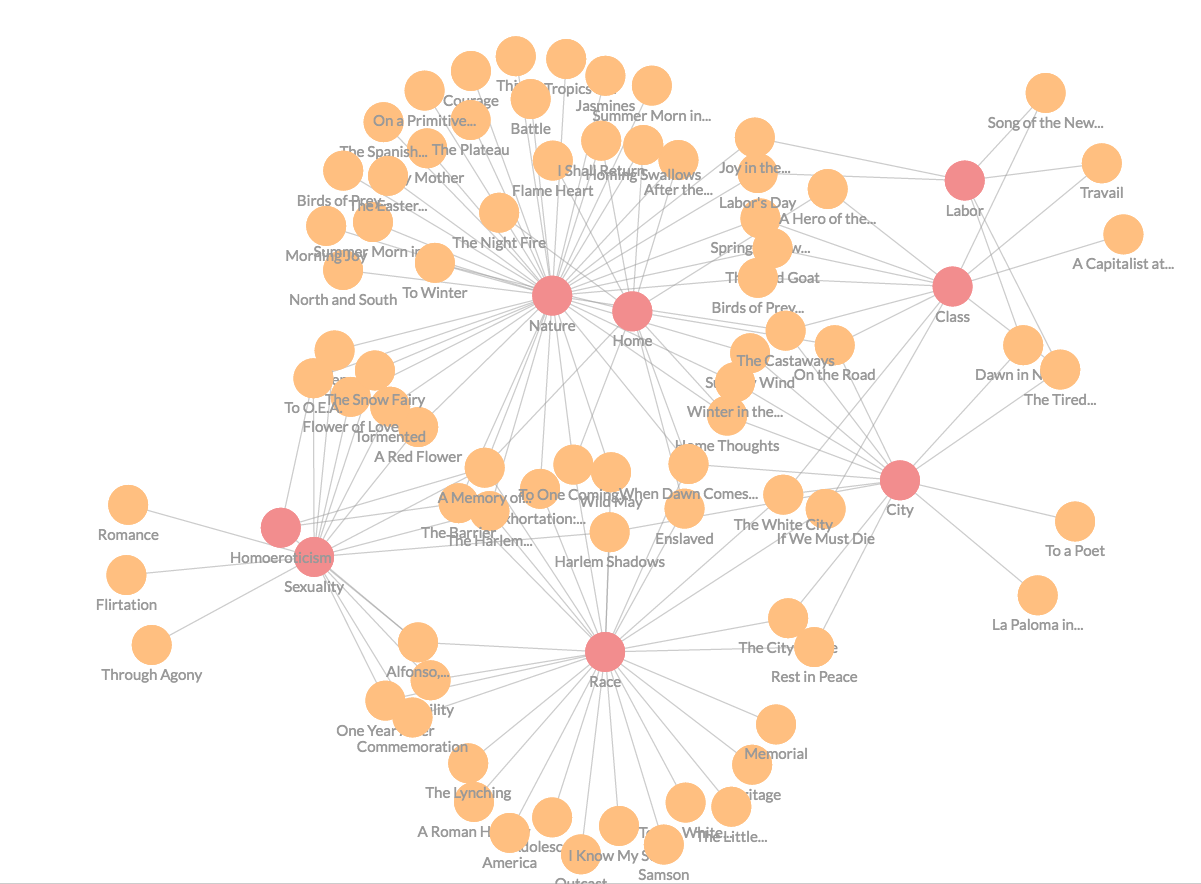
What does this diagram show? First, we should note that the red dots show tags, while the orange dots show poems. As of November 2016, only eight thematic areas have been tagged: Race, Class, City, Nature, Home, Sexuality Homoeroticism, Labor. (More Tag information from the earlier, Wordpress version of this site is currently in the Metadata for individual poems, and is discoverable using the search function on this Scalar site. Try searching for "Birds," for instance.)
What Can We Learn?
1. Thematic Clusters. First and most obviously, certain themes are "clustered" together. Nature and Home have many overlaps, and thus appear clustered. Sexuality and homoeroticism also form a cluster. And finally, the tags focused on Class, Labor, and city life also form a natural cluster, though the clustering is significantly less tight than the others.
2. Centrality of Nature. An obvious discovery is that "Nature" is one of the most common tags in McKay's early poetry. This was a surprise to the students in the Digital Humanities class (given that we think of McKay as a black poet with militant/leftist politics, we might expect those themes to be more dominant). Of course, many of the poems marked "Nature" also overlap with race, class/labor, or sexual/queer themes. The surprise in finding so much discussion of Nature—and specifically McKay's interest in writing about birds—might remind us that we actually need to read a poet's poems before rushing to narrowly define them (i.e., as a black, political poet). (I would encourage visitors to look at Joanna Grim's essay exploring the "bird" theme in Harlem Shadows)
3. Home. Many of McKay's poems in this period thematize his memory of life in Jamaica. Thus, a few of the poems (for instance, "The Tropics in New York") reflect McKay's nostalgia for his pastoral upbringing from the vantage point of someone now living in a much larger, modern urban setting.
4. Poems with three or more tags. I'm interested in the poems that presently have three or more tags: "The Barrier," "The Castaways," and "On the Road." These are poems that scholars may not have paid very attention to in the past, but diagrams like the one above might lead us to think of them as newly important as they bridge some of McKay's most important themes from this period. (Again, the number of tags is a bit arbitrary and at present an artifact of the way metadata has been tagged. At most this information might nudge readers to pay a bit more attention to some poems rather than others, not to make any sweeping conclusions about the poems as a whole.)
I would encourage users of this site to play with the live visualization tool and send me (Amardeep Singh) any screen captures that seem interesting or telling.
B. Publication Venues
This diagram is a bit more messy. It contains nodes for publication venues (which are organized on this Scalar site using "Paths"). These appear in light blue in the diagram below. Users can access a "live" version of the diagram using VISUALIZATIONS > CONNECTIONS in the menu in the corner above.

(See the full size version of this diagram here)
What do we see here? (Note: the blue dots represent publication venues. The red dots represent thematic tags. The orange dots represent individual poems. The green dots are media files uploaded to this site. Readers should probably try and ignore the green dots.)
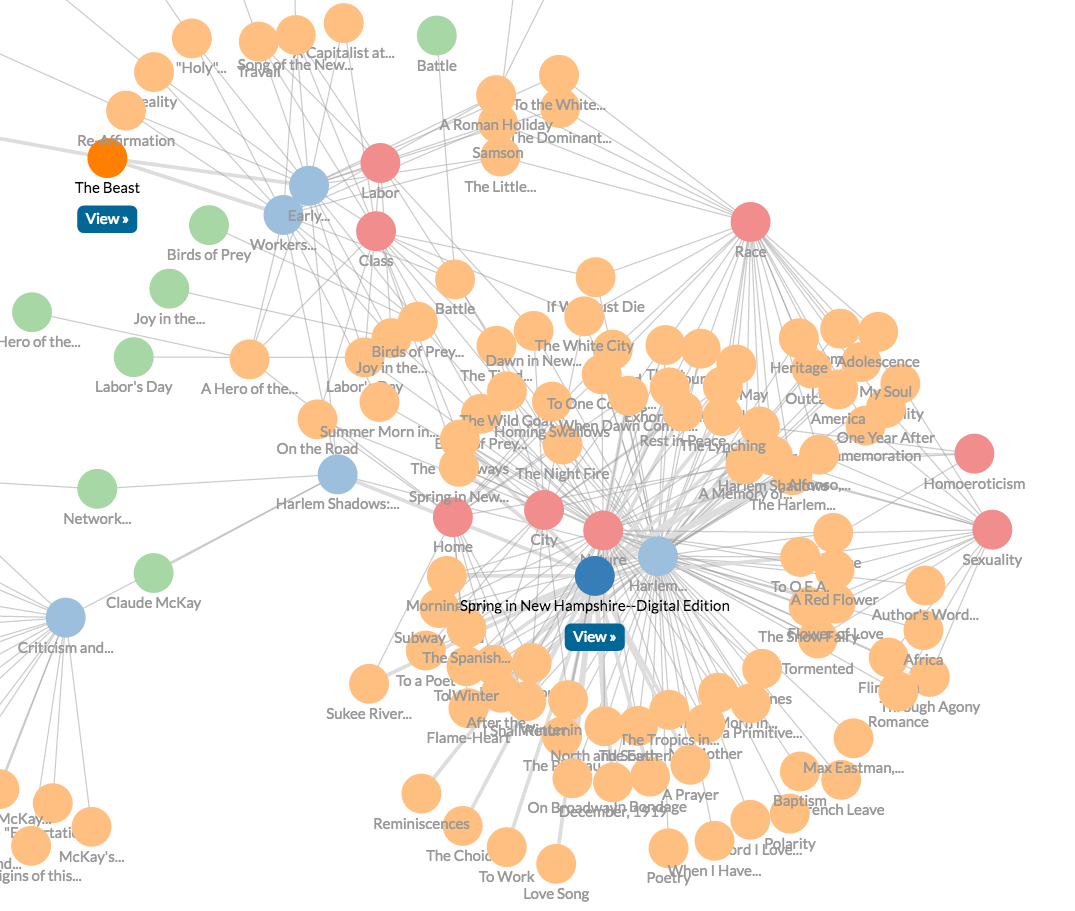
Essentially there is a larger cluster around Spring in New Hampshire and Other Poems and Harlem Shadows, and a smaller cluster around the Workers Dreadnought path and the Early Uncollected Poetry path I've constructed on this site. Perhaps not all that surprisingly, the sexuality and homoeroticism tags are mostly entirely disconnected from the labor & class oriented poetry published in magazines like Workers Dreadnought. But there are some poems right in the middle between the two clusters that seem especially interesting to consider -- poems like "Joy in the Woods," "The Battle," "Summer Morn in New Hampshire," "Birds of Prey," and "Labor's Day" that appear with strong connections both to the "Nature" tag and to "Class" and "Labor" tags. Though few of these poems have been looked at closely by critics, they are in some ways the key to understanding the two major aspects of Claude McKay's poetry in this period.
Group Project: Sentiment Analysis of Poetry in Python (DHSI 2016)
I took a one-week course on Coding Fundamentals at DHSI 2016 with Dennis Tenen (Columbia University) and John Simpson (University of Alberta). You can see the syllabus for the course here
Let me start with a quick plug for Dennis Tenen's group
Let me start with a quick plug for Dennis Tenen's group
part of the project involved teaching all of the young people in the class the coding they would need to build a Twitter bot. The Bot is currently not active, but the stream it produced over several months is well worth a look.
*
Why coding? I wanted to get started with coding because it seems to be one of the major dividing lines between people who can chart their own independent course through the digital humanities and people who work with ideas and tools developed by others. It's not the be-all, end-all, of course (as I've said before, you can do so much now with off-the-shelf tools), but some experience with coding seems like it could be really helpful for projects that don't quite fit the mold of what's come before.
The class itself was intense, frustrating, and sometimes really fun. I'm not going to lie: learning how to code is hard. I can't say that I will readily be able to start spitting out Python scripts after four days of working with the language, but I might at least be able to figure out how to a) do some simple scripts to process batches of text files that otherwise require repetitive, laborious work, and b) use libraries of code developed by others in Python to do more advanced things.
*
*
Why coding? I wanted to get started with coding because it seems to be one of the major dividing lines between people who can chart their own independent course through the digital humanities and people who work with ideas and tools developed by others. It's not the be-all, end-all, of course (as I've said before, you can do so much now with off-the-shelf tools), but some experience with coding seems like it could be really helpful for projects that don't quite fit the mold of what's come before.
The class itself was intense, frustrating, and sometimes really fun. I'm not going to lie: learning how to code is hard. I can't say that I will readily be able to start spitting out Python scripts after four days of working with the language, but I might at least be able to figure out how to a) do some simple scripts to process batches of text files that otherwise require repetitive, laborious work, and b) use libraries of code developed by others in Python to do more advanced things.
*
Digital Teaching Notes: The "Harlem Shadows" Collaborative Project
This fall, students in the Intro to DH class that Ed Whitley and I co-taught produced a pretty wonderful collaborative digital project they
decided to call “Harlem Echoes,” a version of Claude McKay’s Harlem Shadows oriented
to a broad, public readership. This project was produced
in response to an assignment that I generated for them with help and feedback from Chris Forster and Roopika Risam along the way. The students had some technical
help from staff members in Lehigh’s Center for Digital Scholarship.
This is the
project the students in the class produced:
Major features of the site include:
--Two presentations of the poems in
Harlem Shadows, one version that corresponds to the poems in the order in which they were originally printed, and another version that presents the poems thematically.
--All of the poems are thematically
tagged based on a set of tags agreed upon collaboratively by students in the
class. The site includes a clickable “Wordcloud” of student-generated tags that
leads users to lists of poems oriented around specific tags.
--A substantial number of
contextual and biographical essays that help bring the poems in Harlem
Shadows to life for today’s readers.
--Students built the site
themselves, including menus, graphics, and text. I directed them to use a
public domain, “dirty OCR” version of Harlem Shadows derived from the
Internet Archive. They proofread and corrected the OCR and produced unique
pages for each poem in Harlem Shadows.
Digital Humanities and Social Justice; DH Projects and
their Audience
Why Harlem Shadows?
I am relatively new to formal involvement with Digital
Humanities as a field, though I have been floating around the edges of Digital
scholarship for many years. As I’ve been studying DH more intensively in recent
months I’ve had two distinct observations about the field that I wanted this
assignment to speak to:
1) While there is quite a bit of scholarship in Digital Humanities that does deal with social justice oriented themes, in its early period the field seemed to be largely oriented towards digitization and analysis of canonical, Anglo-American texts (see my essay from earlier in the fall on “The Archive Gap”). Scholars like Alan Liu have pointed out the strangeness of the fact that while DH ideas and tools were being pioneered in the 1990s, many important scholars in the field seemed not to be very engaged in the intense conversations about gender, race, and sexuality (queer theory, postcolonial theory, and critical race theory) that were also occurring in parallel during that same period of time.
As a result of my own training and orientation as a scholar, I wanted this assignment to explicitly speak to social justice issues in some way. I believe that minority authors in the Anglo-American tradition as well as non-western authors are underrepresented or overlooked in prominent digital archives, so I had a strong interest in asking students to do a digitization project with an author in that category.
2) It’s been noted that many digital archives and digital thematic collections that tend to be posted online can have very small readerships. Is that because the texts being digitized are too obscure (I doubt it), or is it rather because we haven’t been thinking enough about issues of access and audience in designing our digital projects? What is it that the average web user might be looking for when searching online for particular texts?
My hunch is that the average reader isn’t that preoccupied with a precise digital recreation of the original printed texts they are encountering online. Rather, the interest is much more likely to be thematic (“poems about the resistance to racism”), contextual (“early black poets”), and presentist (“how does this matter today?”). In designing this assignment, I nudged students to consider these issues and build a site that might have an expansive and somewhat revisionist approach to the original material. In our DH class, we did present students with examples of digital archives that were invested in a textualist methodology (foremost being the Whitman Archive), but I at least made it a point to suggest that there might be other models for presenting digital collections to consider.
My Background
I should start by saying that I’m not an expert on the
Harlem Renaissance, and indeed for most of my career teaching modernism I have
focused on British and Irish modernists rather than American modernism (in my
department the teaching of American materials has generally been the province
of my colleague Seth Moglen). However, in recent years I have grown more
interested in the transatlantic contexts of the early modernist movement
(1910-1925), and one especially interesting site along those lines is the
Harlem Renaissance – many of whose most important figures spent significant
amounts of time abroad.
One upshot of my relative newness to these materials is that
I don’t have a ‘set’ approach to teaching Harlem Renaissance literature.
Indeed, this assignment emerged out of a process of exploration that I’ll
briefly describe before going deeper into the assignment itself.
Genesis
The genesis for this project was my first experience
teaching Claude McKay’s poetry in the spring of 2014 in an undergraduate seminar on Transatlantic Modernism. In addition to McKay, in that class I
assigned Nella Larsen’s Quicksand for its depiction of Harlem cultural
life in a transatlantic context (the biracial protagonist of Quicksand travels
to Denmark in the middle of the novel and returns to Harlem with a clearer idea
of what her black identity means to her, but without clear answers to the
central quandary facing her regarding her love life and career).
As an accompaniment to Quicksand, I had initially
assigned McKay’s novel Home to Harlem (1928), only to decide that
emphasizing that novel was somewhat of a mistake in this class setting, for two
reasons. One problem is that the novel really isn’t “transatlantic.” It does
give us an example of a Caribbean intellectual and activist figure who emerges
once the novel is well underway, but the novel’s primary protagonist is
actually a “street” character rather unlike McKay himself. Secondly, Home to
Harlem’s emphasis on street culture, slang, and nightlife could be seen as
opportunistic and salacious rather than documentary. I should also add that the
novel isn’t exactly a page-turner; it begins to drag around the mid-point,
though the depictions of African American porters working on a railroad are
interesting in part because we can assume they are derived from McKay’s own
time exploring different American cities while working on the Pennsylvania
Railroad in the 1910s. Some of McKay’s peers wondered at the time about whether
the novel helped or hurt the cause of black literature, and we still need to raise
those questions today.
A better bet seemed to be McKay’s rarely-read books of
poetry, Harlem Shadows (70 poems; published in New York in 1922) and its
shorter predecessor text, Spring in New Hampshire (31 poems; published
in London in 1921). We did spend a session in that class looking at some of the
poems from Harlem Shadows, and I was struck by both their quality and
their potential relevance to a course on transatlantic modernism. Going
forward, I expect that I will probably always assign these poems in future
versions of Transatlantic Modernism classes I teach, rather than Home to
Harlem.
The Assignment in the Context of an “Introduction To Digital
Humanities” Course
Ed Whitley and I began planning the department’s first
graduate level introduction to Digital Humanities in spring of 2015, and we
worked on it much more intensively during the summer.
We knew that we wanted to do a unit on digital archives and
thematic collections, and we also knew that this unit should have a hands-on
component – a project that involved the students either contributing to an
existing digital archive project, or doing a certain amount of work on
something new. Because of the intense labor involved in digitizing print texts,
we knew we couldn’t ask our students to do too much since we only
intended to dedicate about four weeks to this topic.
I had the idea of asking all of the students in the class to
produce a collaborative digital edition of Harlem Shadows as an
assignment, and in the summer I discovered that Chris Forster (Syracuse U.) and
Roopika Risam (Salem State U.) had already produced an elegant digital edition
(though it admittedly took me awhile to find it; their site does not show up on
the top of Google searches for “Harlem Shadows”). I began corresponding with
these two scholars with the idea that students in our course might add
materials that could eventually be added to their existing site, or perhaps
build a parallel site that might look quite different. This is their site:
I have been especially interested in including biographical,
historical, and literary context on any site the students might produce to help readers understand better
what it is they are looking at. Thanks to projects like Google Books, the
Internet Archive, the Project Gutenberg and the widespread interest in digitization amongst digital humanists, we now have a truly formidable array
of digital texts available to us online -- though we still often don’t have very good ways
to navigate those texts. Google Books has virtually no metadata and is actually
difficult to search. As a result, we now have access to millions of texts, but we
need much more infrastructure to help us know what we might actually want to
read.
As my reading and preparatory work took shape, I began to
generate a list of possible contextual short essays students could research and
write, for upload to the site. Eventually, I presented these suggestions to
them:
--We should think about the front
page and the entry to the site. Perhaps a student could write an “About” page,
which introduces McKay and this book of poems and also has a summary of the new
contents we are adding with links to the new content.
--Perhaps a student could write a
short bio-critical essay that links to and quotes from specific poems. In order
for the links to work, we first need to build a Page for each poem that has a
unique Permalink.
--Perhaps students could think
about a presentation of the poems in Harlem Shadows that focuses on their historical importance
and influence (esp. “If We Must Die” but also “America,” “Mulatto,” etc) rather
than recreating the original presentation of the text itself (in any case, the
Internet Archive edition and the Forster/Risam edition already do that).
--I would encourage students to
generate tags for each of the poems that might allow visitors to the site to
approach poems that focus on certain themes that are of interest to them. So we
could create tags for each poem (“Race,” “Harlem street life,” “Gender,”
“Capitalism,” “Lynching,” “Jamaica,” “Violence,” “Personal life,” “Family,”
“Taboo Love,” “Migration” [or “Exile”], “Possible Queer Subtext,” and so on).
We could then display all of the Tags on a column in the right; if the user
clicks on a keyword they see a list of poems that match that tag. It may even
be possible to build a widget that might dynamically arrange all poems on a
given topic for the user: here are the 20 (?) poems McKay published in this
period that deal with race. This could be especially useful for students or
colleagues who are just looking for the poems dealing with race…
--Max Eastman’s preface to Harlem
Shadows is problematic. Do we think it adds value to have the preface
presented without editorial comment? Or perhaps we could add a short essay
about just the Preface – including the language that some might find
patronizing / insulting ? Would we prefer to jettison the preface entirely?
(This would constitute a radical departure from the 1922 edition! But we are
allowed to do it if we want to.) Between the two prefatory documents in the
original Harlem Shadows, I prefer McKay’s own “Author’s Note”; perhaps
one option might be to structure the site so that text is more prominently
displayed.
--Perhaps a student might write a
short essay offering a close reading of the poems that seem to allude to the
complexity of McKay’s personal life – specifically his relationships with men
(and often white men).
--Perhaps a student might write a short
essay offering a close reading of the poems as reflective of an immigrant’s
outlook. (Quite a number of the poems are reflections on McKay’s status as
effectively a foreigner on American shores, still trying to digest the
strangeness of American racism.)
--A student might write a short
essay discussing McKay’s often tense relationship to the Modernist movement. He
saw himself as a political radical who strongly embraced modernity and progress
as leading to liberation and justice. But he was not interested in
“modernizing” or radicalizing literary language or literary form. He liked the
sonnet form.
--A student might write a short
essay describing McKay’s relationship to the Harlem Renaissance movement. (He
is considered one of the core members of the Harlem Renaissance group, but he
is actually an outlier in some ways. A bit older than other core figures, and
different in that he was an immigrant who left Harlem fairly quickly. He
actually wrote Home to Harlem while
living in Marseille, France!). This essay might also mention a few other major
figures and benchmark’s in the advent of the Harlem Renaissance (Alain Locke’s
“The New Negro,” etc).
--Images and multimedia. (There are
numerous audio recordings of McKay reading poems like “If We Must Die.” We
could embed those links into our own site.) Have to consider permissions and
copyright.
--And in correspondence with me,
Chris Forster had this suggestion:
I would add perhaps one more that folks may wish
to explore. Do the poems of Harlem
Shadows represent a “toning
down” of McKay’s politics? The poems that once appeared alongside the poems of Harlem Shadows in periodicals but which
disappear when McKay collects the poems of Harlem
Shadows (which themselves are
largely a rehash of poems that were first in Cambridge
Magazine and then as Spring in New Hampshire… I
wrote a bit about those here) are often more
radical. “To the White Fiends” disappears; and where is “The Capitalist at
Dinner” (a poem which is not anywhere mention in the edition right now—to my
horror)? These poems strike a very different note from those published in the
collection—and very, very different from the universalist
spin McKay puts on “If We Must Die” when he later reflects in the reading here. (Chris Forster)
As you might see from looking at the final product, the students took
me up on some of my suggestions (though not all of them); they also had their own quite fascinating
ideas for topics to cover. One student focused on the different contexts and
uses to which “If We Must Die” has been put (divided into three shorter essays; start here). Another focused on the possiblerelevance of McKay’s poetry to the present-day, Black Lives Matter movement.
Yet another student decided to write about McKay’s use of bird imagery,
especially with reference to migration and movement. Another wrote about the queer subtext in McKay’s poem, “Alfonso, Waiting at Table.” I also found the essay another student wrote on "spatial poetics" in McKay's poem "On the Road" quite compelling.
Helping the Students Out: a Bibliography and
Scanned Critical and Biographical Materials
To facilitate student research, I gave them my introductory
lecture notes on McKay’s early career, with a fair amount of biographical
material about McKay drawn from Wayne Cooper’s biography (these were notes I
had developed for the earlier course I taught). I also scanned quite a bit of recent scholarship about McKay and made
those PDFs available on CourseSite (the courseware platform we use at Lehigh).
I decided to do this because this was not, in fact, going to
be a class that was centrally ‘about’ the Harlem Renaissance. I had to operate
on the assumption that students would have had little or no background working
with McKay prior to taking this course (this proved correct). In a class that
was more focused on, say, “Digitizing African American Literature,” I might
have asked the students themselves to generate these materials.
Here is the preliminary annotated bibliography that I
included in the assignment as well:
Wayne Cooper, Claude McKay, Rebel
Sojourner in the Harlem Renaissance. 1987 (new edition 1996). This
remains the definitive biography of Claude McKay. It suffers at times from a
somewhat judgmental attitude to McKay, but the bibliography is invaluable.
Chapter 3 deals with McKay’s early years – and his relationships with editors
like the Eastmans (which led to his breakthrough publication in The
Liberator in 1919). Chapter 7 has a considerable amount of material on Harlem Shadows, including background and
context (many of the poems in the collection were first printed either in
McKay’s earlier book of poetry, Spring in
New Hampshire, or in other magazines). There are also brief summaries and
discussions of several reviews of the book that appeared at the time in both
the mainstream press as well as in Afro-American magazines and newspapers.
Claude McKay, A Long Way From Home.
(1938). McKay’s own memoir of these years. There’s a good deal of
introductory material from the editor, Gene Andrew Jarrett, including a
detailed timeline of McKay’s life, as well as a helpful biographical note.
You might also consider taking a
look at various early chapters from A Long Way From Home, including Chapter
2 (“Other Editors” sets the stage for the publication of McKay’s poems in The
Liberator in 1919). Chapters 7-13 (very short chapters) deal with the time
period leading up to the publication of Harlem
Shadows. Chapter 9 has an intriguing anecdote of McKay’s encounter with
Frank Harris (editor of Pearson’s), who criticized McKay for not
including “If We Must Die” in the (British-published) Spring in New
Hampshire: “You are a bloody traitor to your race, sir!” Chapter 9 also has
accounts of McKay’s first encounters with peers like W.E.B. DuBois. Chapter 13
has a brief account of the publication of Harlem Shadows in 1922. It was
well-received, but didn’t earn very much money. Soon McKay would be off to Russia
and France…
Gary Edward Holcomb, Claude McKay,
Code Name Sasha: Queer Black Marxism and the Harlem Renaissance (2007). This is
the first book I know of to really explore the complexity of McKay’s identity
as a (closeted, at least to the public) gay black man and a Communist and apply
that understanding to a close reading of his poetry and fiction. Readings of
poems from the Harlem Shadows collection
are scattered throughout the book. The Introductory chapter and chapter 1 might
be important as an intervention in a tradition of McKay scholarship that has
tended to see him as first and foremost a “heroic” Harlem Renaissance figure.
Kottis Sree Ramesh and Kandula Nirupa Rani, Claude McKay: The Literary Identity from Jamaica to Harlem and Beyond.
(2006) Chapter 3 deals with McKay’s immigration to the United
States and how his status as a West Indian immigrant shaped his writing and
outlook. This is valuable mainly because it focuses on McKay’s status as a
“colonial subject.”
Tyrone Tillery, Claude McKay: A
Black Poet’s Struggle for Identity (1992). Chapter 3,
“The Problems of a Black Radical,” deal with McKay’s writing during the years
that led to the publication of Harlem
Shadows.
Terence Hoagwood on the poem “Harlem Shadows” Brief essay in The Explicator
(2010). Hoagwood talks about McKay’s appropriation of conventions
from Elizabethan poetry – though this poem is actually not a regular sonnet but
a “deviant” sonnet.
Adam McKible and Suzanne Churchill,
“In Conversation: The Harlem Renaissance and the New Modernist Studies”
(Modernism/Modernity 2013). This essay will mainly be of interest to people (if
there are any) who are looking into McKay’s relationship to modernism – and the
theoretical problems we tend to encounter if we think of African American writing
from the 1920 and 30s in the context of transatlantic modernism.
David Krasner, review of The
Scene of Harlem Cabaret: Race, Sexuality, Performance (Modernism/Modernity
2010). This is a review of a book that looks at McKay’s
representation of race in Home to Harlem in light of the rather
different strategy we see in WEB DuBois’s writing from the same period.
James Smethurst, “The Red is East:
Claude McKay and the New Black Radicalism of the Twentieth Century” (American
Literary History 2009) Largely a review essay – looking at Gary Holcomb’s book. Smethurst also
summarizes the three novels that Holcomb focuses on. Not a lot here on Harlem
Shadows. That said, there is a lot here for people interested in McKay’s
relationship to international communism / socialism / Marxism.
Outcomes: What We Learned from Working with the Students and Listening to their Feedback
Surprise #1: The students seemed to find the assignment
highly interesting and involving, and spent far more time on it than we had
anticipated they would.
Some students in the class initially expressed concerns
about the technical aspects of producing a serious website (as opposed to just
a blog). We were able to arrange a visit from skilled digital scholars and
library staff just around the time students were beginning to work on the
project. This gave them a bit more confidence to start working with WordPress,
though only a couple of the students in the class had used WordPress in the
past. (I should also note that we decided to use WordPress for this assignment
rather than something like Scalar precisely because it is so easy to use.)
I had strongly encouraged them to meet outside of class at
least once, and as the students began to work they ended up meeting several
times (five times in fact!) to make decisions about the intention and design of
the site. It became clear that they had truly entered into the spirit of
collaboration, often helping each other out with various tasks. One student
took special responsibility over site design and technical features. Another
student helped get the ball rolling by going through and creating her own list
of thematic tags to all of the poems on her own.
Even after completing the first draft of the project, the
students continued to talk about the project later, making it clear to me they
were still pretty involved in the work of the project. I hope that this early
experience with collaborative work will come back and pay dividends for some of
the students later in their careers.
Surprise #2: They renamed it. At some point
the students decided to rename the project from “Harlem Shadows” to “Harlem
Echoes.” This was completely within the parameters of the assignment, though I
had not suggested any such change to them nor did I expect them to do it.
I can see two advantages to the decision to change the name
of the project. One is that it frees the project from the responsibility of
prioritizing a digital approximation of the original text of Harlem Shadows.
Harlem Shadows still forms the core of the site, but as the menu design
and ordering indicates, the presentation of the poems is only one of the goals
of the site the students produced.
The second advantage of the renaming might be that it
allowed the students in the class to differentiate their project from the
existing Forster/Risam project.
Surprise #3: They decided to orient the project to student users
rather than specialist scholars. This
made sense to me since the students themselves are not specialists in either
modernism or the Harlem Renaissance, but I still hadn’t quite expected the extremely helpful background essay one student would write describing McKay’s use of the
sonnet form in Harlem Shadows.
Surprise #4: Claude McKay talks more often about “nature”
than about “race.” The thematic tags
the students produced led to a pretty startling observation: the largest word
in the word cloud is actually "Nature” – not “Race.” Admittedly, his discussion of
nature is not in a vacuum – many of those “nature” poems are also thematizing
social issues such as race and migration – but it still tells us something
important nonetheless, and reminds us to be careful in slotting McKay
unthinkingly into the ready category of “black activist poet.”
Future Directions
We have yet to make any final decisions about what to do
with the project. There is still a hope we might coordinate with Roopika Risam
and Chris Forster more intensively. There is also a real idea of continuing to
expand the site, possibly by adding further works ourselves (I have a couple of
short essays I myself would like to contribute), and possibly by soliciting
contributions from scholars who work on Mckay.
There’s also a question about how we might revise the
assignment for future iterations of this class. As I mentioned, students put
this all together in the space of a couple of weeks; we had only allocated
about four weeks to digital archives and collections towards the beginning of
the term. We were using a final portfolio structure for the class and asked
students to revise their individual essays as much as possible for that final
project. But their subsequent work in the course was on different topics; in
the subsequent unit, for instance, we asked them to work with data (text
analysis, visualization, mapping, data mining, network diagrams, topic
modeling, etc).
In our wrap-up conversation at the end, several students
suggested we might coordinate the digital archive hands-on project with the
hands-on project related to data. Perhaps the data segment could ask students
to apply data and analytical tools to the text that they had earlier digitized
and annotated? This sounded like an excellent idea in principle, though
practically with such a small text (70 short poems), many data analysis tools and
methods simply aren’t very useful or relevant. (Topic modeling, for instance,
requires large scale corpora to produce meaningful results.) If we repeat a
version of this assignment with a much more substantial primary text, however, some
of those data-oriented tools could be relevant.
On "The Essential Tagore"
Just a quick note to say Happy New Year, and announce that I have a medium-length essay reviewing the new Harvard UP anthology of Tagore, The Essential Tagore.
The essay is up at Open Letters Monthly, and you can read it here.
Besides the usual reviewing and synopsis of Tagore's life and career I make a particular kind of argument regarding how I think Tagore should be read -- as someone who used three literary voices, (1) that of a lyric poet, (2) novelistic realism, and (3) satire. Some of his most interesting stories, poems, and plays are the ones where he shifts voices within the work, or uses more than one voice. The story "The Broken Nest" is one such example. I also talk about a particular poem by Tagore called "The Poet," which isn't widely cited in English. And finally, I look briefly at one of the satirical Tagore plays included in the anthology, "The Kindgom of Cards."
The essay is up at Open Letters Monthly, and you can read it here.
Besides the usual reviewing and synopsis of Tagore's life and career I make a particular kind of argument regarding how I think Tagore should be read -- as someone who used three literary voices, (1) that of a lyric poet, (2) novelistic realism, and (3) satire. Some of his most interesting stories, poems, and plays are the ones where he shifts voices within the work, or uses more than one voice. The story "The Broken Nest" is one such example. I also talk about a particular poem by Tagore called "The Poet," which isn't widely cited in English. And finally, I look briefly at one of the satirical Tagore plays included in the anthology, "The Kindgom of Cards."
"Over and Over He Said 'Survive'": the Poetry of Khaled Mattawa in Light of Libya
I was lucky, at Duke in the mid-1990s, to overlap for a few years with the Libyan poet and translator Khaled Mattawa, then enrolled in Duke's Ph.D. program. I don't think I really grasped the extent to which Khaled's experience as an expatriate (really, exile) would end up impacting me at the time. And I was also a bit too young to be able grasp the level of accomplishment and power of Khaled's first published book of poetry, Ismailia Eclipse. (Sheep Meadow Press, 1995. The book is difficult to find now, though Khaled has helpfully put many of the important poems online here.)
Since the recent uprising in Libya began, I've been slowly revisiting Khaled's work and using the poems, where possible, to help process the incredibly stirring -- but also distressing -- events that are taking place in that country. As one of very few Libyan intellectuals fluent in English living in the United States, Khaled has of course been in demand in the U.S. media in the past two weeks. He did a great interview on PBS's NewsHour, and another on NPR in the past few days. But the most moving statement he's made in light of the rebellion is to write a personal account of growing up in Libya (Benghazi) at the beginning of Qadhafi's rule: "Rising to Shake Off the Fear in Libya". (The essay has appeared as an Op-Ed in several newspapers today.)
Here is an excerpt from that Op-Ed:
Reading this, I couldn't help but think of Khaled's early poem, published in Ismailia Eclipse, describing the very same event, "Fifty April Years". Here is an excerpt from that poem, which Khaled has posted in its entirety on his website:
Since the recent uprising in Libya began, I've been slowly revisiting Khaled's work and using the poems, where possible, to help process the incredibly stirring -- but also distressing -- events that are taking place in that country. As one of very few Libyan intellectuals fluent in English living in the United States, Khaled has of course been in demand in the U.S. media in the past two weeks. He did a great interview on PBS's NewsHour, and another on NPR in the past few days. But the most moving statement he's made in light of the rebellion is to write a personal account of growing up in Libya (Benghazi) at the beginning of Qadhafi's rule: "Rising to Shake Off the Fear in Libya". (The essay has appeared as an Op-Ed in several newspapers today.)
Here is an excerpt from that Op-Ed:
A few months earlier on April 7, 1977, members of the revolutionary committees had plastered a poster of Gadhafi’s image on my father’s car. On that same day they had, under the dictator’s direct supervision, publicly hanged several dissidents in Benghazi.
On the day of the execution, the Ghibli winds blowing from the desert filled the air with dust and turned the sky into a reddish-gray canopy. I’d taken a bus with a friend to catch a movie downtown. Nearing Shajara Square, the bus simply turned around and took us back to where we had come from. Later that evening, state television repeatedly broadcast the hangings. I went to our garage to peel the dictator’s poster off our car. It took an interminably long time.
Along with millions of other Libyans, I have never stopped trying to peel Gadhafi’s image from my life. Even after I came to the United States in 1979 to continue my education, the dictator seemed to follow me. He was the one Libyan most people had heard of, and they wanted to talk about him. I used to be enraged when women told me how handsome he was. To me he was the face of evil itself, the face of separation, exile, thuggery, torture and lies.
(Source: http://www.miamiherald.com/2011/03/03/2096377/rising-to-shake-off-the-fear-in.html#ixzz1FeVTVOts )
Reading this, I couldn't help but think of Khaled's early poem, published in Ismailia Eclipse, describing the very same event, "Fifty April Years". Here is an excerpt from that poem, which Khaled has posted in its entirety on his website:
Poetry in the Protests -- Abu Al-Qasim Al-Shabi
[Cross-posted at Guernica]
Protest poetry and music sometimes rises to the surface during popular uprisings, crystallizing popular sentiments -- one thinks of Victor Jara in Chile, Nazim Hikmet in Turkey, Faiz Ahmed Faiz in Pakistan, or Woody Guthrie in the United States. At times like these, the right poetry and song doesn't merely describe how people are feeling; it can actually act as an intensifier that guides a protest movement, helping it spread and solidify. (Needless to say, such poetry does not need to be written by professional poets. Martin Luther King's "I have a dream..." was an act of poetry as much as anything else.)
Along those lines, it seems worthwhile to note the role played by Arabic poetry in the uprisings. One particular poet, Abu Al-Qasim Al-Shabi (whose name can also be rendered in English as Aboul-Qasem Echebbi), was widely cited on the streets and even in the Tunisian news-media during the uprising against Ben Ali, and according to reports coming in from Aljazeera, is now being cited by protestors on the streets of Cairo and Alexandria.
The key poem is rendered in English as "To the Tyrants of the World," and unfortunately I cannot find a great translation of it online anywhere. There is one version at a blog called Arabic Literature in English, here. Interestingly, a better translation is actually available via a radio story on NPR.
Oppressive tyrant, lover of darkness, enemy of life
Wait -- don't be fooled by the spring
As I mentioned, "To the Tyrants of the World" was recited on the streets during the protests in Tunisia, and it is now being recited in Cairo and Alexandria by the millions who have taken to the streets to demand democratic reforms and the ouster of Hosni Mubarak. One line whose meaning comes across with unmistakable force in this translation comes near the end: "He who grows thorns will reap wounds." One does not forget a line like that.
Another poem by al-Shabi is a short verse that is actually part of the Tunisian national anthem, "If the people one day aspire to life" (also referred to variously as "The Will to Life" or "The Will to Live"). Here the Arabic Literature blog does have three very good translations available on their site here. My favorite, at least in terms of the quality of the English, is by a commenter at another site, called YankeeJohn:
Again, for the original Arabic, I would suggest taking a look at the bottom of the post here. You can also see Al-Shabi's poetry being recited in Arabic in a video at the website of UT-Austin here.
Another powerful political Arab poet I know of is Abd al-Wahhab al-Bayyati, an Iraqi who spent much of his adult life in exile. One of his famous poems, "The Dragon," is available in translation here. Below are the opening lines of the poem (it's worth reading in full):
There are of course many other contemporary poets from Egypt and Tunisia, and I will be looking them up in the days and weeks ahead to see if I can find more writing like al-Shabi's -- writing that seems to crystallize what is going on, even if it might have been written at a different time or in a different context. One place to look might be the collection, Language for a New Century: Contemporary Poetry from The Middle East, Asia, and Beyond. Egyptian poets included in the volume include Andree Chedid (writing in French), Amal Dunqul, Ahmad Abd al-Mu'ti Hijazi, Fatma Kandil, Abd el-Monem Ramadan, Salah 'abd al-Sabur, and Himy Salem. Some Tunisian poets whose Muhammad al-Ghuzzi, Amina Said (writing in French), and al-Munsif al-Wayhabi.
*
[UPDATE: Read this incredibly informative essay by Elliott Cola on the role of poetry in the Arab protest movements... Thanks Kitabet.]
Protest poetry and music sometimes rises to the surface during popular uprisings, crystallizing popular sentiments -- one thinks of Victor Jara in Chile, Nazim Hikmet in Turkey, Faiz Ahmed Faiz in Pakistan, or Woody Guthrie in the United States. At times like these, the right poetry and song doesn't merely describe how people are feeling; it can actually act as an intensifier that guides a protest movement, helping it spread and solidify. (Needless to say, such poetry does not need to be written by professional poets. Martin Luther King's "I have a dream..." was an act of poetry as much as anything else.)
The key poem is rendered in English as "To the Tyrants of the World," and unfortunately I cannot find a great translation of it online anywhere. There is one version at a blog called Arabic Literature in English, here. Interestingly, a better translation is actually available via a radio story on NPR.
To the Tyrants of the World
(Translated by Abdul Iskander for NPR)
You have ridiculed the size of the weak people
Your palm is soaked with their blood
You have deformed the magic of existence
And planted the seeds of sorrow in the fields
Wait -- don't be fooled by the spring
The clearness of the sky or the light of dawn
For on the horizon lies the horror of darkness,
Rumble of thunder, and blowing of wind
Beware, for below the ash there is fire
And he who grows thorns reaps wounds
Look there, for I have harvested the heads of mankind
And the flowers of hope
And I have watered the heart of the earth with blood
I soaked it with tears until it was drunk
The river of blood will sweep you
And the fiery storm will devour you
Translated by Abdul Iskander (Source. Original Arabic)
As I mentioned, "To the Tyrants of the World" was recited on the streets during the protests in Tunisia, and it is now being recited in Cairo and Alexandria by the millions who have taken to the streets to demand democratic reforms and the ouster of Hosni Mubarak. One line whose meaning comes across with unmistakable force in this translation comes near the end: "He who grows thorns will reap wounds." One does not forget a line like that.
Another poem by al-Shabi is a short verse that is actually part of the Tunisian national anthem, "If the people one day aspire to life" (also referred to variously as "The Will to Life" or "The Will to Live"). Here the Arabic Literature blog does have three very good translations available on their site here. My favorite, at least in terms of the quality of the English, is by a commenter at another site, called YankeeJohn:
Should the people one day truly aspire to life
then fate must needs respond
the night must needs shine forth
and the shackles must needs break
Those who are not embraced by life’s yearning
shall evaporate in her air and vanish. (Source)
Again, for the original Arabic, I would suggest taking a look at the bottom of the post here. You can also see Al-Shabi's poetry being recited in Arabic in a video at the website of UT-Austin here.
Another powerful political Arab poet I know of is Abd al-Wahhab al-Bayyati, an Iraqi who spent much of his adult life in exile. One of his famous poems, "The Dragon," is available in translation here. Below are the opening lines of the poem (it's worth reading in full):
A dictator, hiding behind a nihilist's mask,This is usually interpreted as the poet's commentary on Saddam Hussein, but at various points in the poem al-Bayyati expands his meaning to refer to the dictator-dragons who are being "cloned" acround the world.
has killed and killed and killed,
pillaged and wasted,
but is afraid, he claims,
to kill a sparrow.
His smiling picture is everywhere:
in the coffeehouse, in the brothel,
in the nightclub, and the marketplace.
Satan used to be an original,
now he is just the dictator's shadow.
The dictator has banned the solar calendar,
abolished Neruda, Marquez, and Amado,
abolished the Constitution;
he's given his name to all the squares, the open spaces,
the rivers,
and all the jails in his blighted homeland. (Source)
There are of course many other contemporary poets from Egypt and Tunisia, and I will be looking them up in the days and weeks ahead to see if I can find more writing like al-Shabi's -- writing that seems to crystallize what is going on, even if it might have been written at a different time or in a different context. One place to look might be the collection, Language for a New Century: Contemporary Poetry from The Middle East, Asia, and Beyond. Egyptian poets included in the volume include Andree Chedid (writing in French), Amal Dunqul, Ahmad Abd al-Mu'ti Hijazi, Fatma Kandil, Abd el-Monem Ramadan, Salah 'abd al-Sabur, and Himy Salem. Some Tunisian poets whose Muhammad al-Ghuzzi, Amina Said (writing in French), and al-Munsif al-Wayhabi.
*
[UPDATE: Read this incredibly informative essay by Elliott Cola on the role of poetry in the Arab protest movements... Thanks Kitabet.]
Another look at P. Lal -- With a Focus on the Poetry
A few weeks ago I did a post on the Calcutta Writers' Workshop. Just about two weeks later, P. Lal, the founder of the Writers Workshop, passed away, at the age of 81.
It seems like a good time to say a bit more about P. Lal (Purushottama Lal), who originated from Punjab but spent his entire adult life in Calcutta, and who was the founder of what was quite literally the Cottage Industry of Indian Writing in English beginning in the 1950s and 60s. In the weeks since his death, some very perceptive, solid obituaries have come out. Here are a few links to some of the obits. I would recommend:
--In The Economist
--by Nilanjana Roy, in the Business Standard
--by Shahnaz Habib, in The Guardian
--by Shashi Deshpande, in The Hindu
--by K.N. Daruwalla, in The Hindu
In the post below, I'm going to quote from, and discuss briefly, some of P. Lal's poetry. The achievement for which Lal will be best known will undoubtedly be his tireless management of the Writers Workshop publishing house, but for many years he was also the editor of an important Indian-English literary journal, called The Miscellany, where he often published his own work alongside that of many other writers. He was also an author in his own right (mostly poetry, some stories), and a committed translator of Indian devotional texts, mainly from Sanskrit (though his translation of the Punjabi/Sikh Jap Ji Sahib is actually quite strong as well).
It seems like a good time to say a bit more about P. Lal (Purushottama Lal), who originated from Punjab but spent his entire adult life in Calcutta, and who was the founder of what was quite literally the Cottage Industry of Indian Writing in English beginning in the 1950s and 60s. In the weeks since his death, some very perceptive, solid obituaries have come out. Here are a few links to some of the obits. I would recommend:
--In The Economist
--by Nilanjana Roy, in the Business Standard
--by Shahnaz Habib, in The Guardian
--by Shashi Deshpande, in The Hindu
--by K.N. Daruwalla, in The Hindu
In the post below, I'm going to quote from, and discuss briefly, some of P. Lal's poetry. The achievement for which Lal will be best known will undoubtedly be his tireless management of the Writers Workshop publishing house, but for many years he was also the editor of an important Indian-English literary journal, called The Miscellany, where he often published his own work alongside that of many other writers. He was also an author in his own right (mostly poetry, some stories), and a committed translator of Indian devotional texts, mainly from Sanskrit (though his translation of the Punjabi/Sikh Jap Ji Sahib is actually quite strong as well).
Translation Workshop: Prabhjot Kaur's "Bewildered" (UPDATED)
My first attempt a couple of months ago at translating from Punjabi was humbling, but I'm back to give it another shot. As readers may remember, with help from a couple of friends, I put forth an attempt at a translation in the earlier post, only to find that Jasdeep of Parchanve did a much better job of it in the comments.
I'm still looking at the same anthology of Experimental Punjabi Poetry from 1962 (Prayogashil Punjabi Kavita), though this time I'm looking at a poem by Prabhjot Kaur, "Pashemaan Haan," or "Bewildered." This time, with humility in mind, I'll just translate the first three verses today, and put out a call for help from our friend in Chandigarh (Jasdeep) as well as anyone else who might wish to help. The poem is on the theme of corruption....
I'm still looking at the same anthology of Experimental Punjabi Poetry from 1962 (Prayogashil Punjabi Kavita), though this time I'm looking at a poem by Prabhjot Kaur, "Pashemaan Haan," or "Bewildered." This time, with humility in mind, I'll just translate the first three verses today, and put out a call for help from our friend in Chandigarh (Jasdeep) as well as anyone else who might wish to help. The poem is on the theme of corruption....
Translating from the Punjabi -- K.S. Duggal
I have been looking at an obscure volume of Punjabi poetry published in 1962, as part of a project I'm doing on South Asian progressive and modernist writing. The volume, Prayogashil Punjabi Kavita ("Experimental Punjabi Poetry," edited by Jasbir Singh Ahluwalia), has never been translated as far as I can tell.
One poem I've found particularly challenging, owing in part to the vocabulary, is by Kartar Singh Duggal. Duggal is a writer whose short stories I know well & have worked on over the years; this is the first time I've seen any of his poetry. Below are three renditions of the poem, the Gurmukhi/Punjabi, the Roman Punjabi, and finally an attempt at an English version. In some cases I had trouble getting Google's "Transliterate/Punjabi" site to render certain Gurmukhi letters, so I left those words in Roman.
Incidentally, I don't necessarily know that I love the message of this poem yet; I'm more interested in the kinds of ideas and the style of the poetry from this period.
ਫਿਰ ਆਈ ਹੈ
ਫਿਰ ਆਈ ਹੈ
ਮੁਸ ਮੁਸ ਕਰਦੀ ਹੋਈ
ਲਿਬੜੀ ਹੋਈ ਵਿਸ਼ ਨਾਲ
ਕੱਜੀ ਹੋਈ, ਢਕੀ ਹੋਈ
ਫਿਰ ਆਈ ਹੇਇ,
ਚਘ੍ਲੀ ਹੋਈ, ਚਟੀ ਹੋਈ
ਕੁਤਰੀ ਹੋਈ, ਛਿਜੀ ਹੋਈ
ਗੰਢੀ ਹੋਈ, ਤ੍ਰਪੀ ਹੋਈ.
ਫਿਰ ਈ ਹੈ
ਫੁਲਿਆ ਹੋਇਆ ਅੰਗ ਅੰਗ,
ਸੁਜ਼ਿਆ ਹੋਇਆ ਬੰਦ ਬੰਦ,
ਅਕ੍ਰੀ ਹੋਈ, ainthee ਹੋਈ
ਫਿਰ ਆਈ ਹੈ
ਪੂਰੇ ਦਿਨਾ ਦੇ ਨੇਰੇ,
ਆਲਸੀ ਹੋਈ, ਹਫੀ ਹੋਈ
ਢਾਹਿ ਢਾਹਿ ਪੈਂਦੀ ਪਈ
ਫਿਰ ਆਈ ਹੈ,
ਝਗ ਝਗ ਬੁਲੀਆ ਤੇ,
ਮੈਲ ਮੈਲ ਦੰਡੋ-ਦੰਡ,
ਕੂੜ ਦੀ ਪੰਡ ਨਿਰੀ.
ਫਿਰ ਈ ਹੈ ਫਾਈਲ
ਹਾਜਾਈ ਔਰਤ ਦੀ ਤਰਾ.
Phir Aaee Hai (written in 1962)
by Kartar Singh Duggal
phir aaee hai
mus mus karde hoee
libRee hoe vish naal
kajee hoee, DHakee hoee.
phir aaee hai,
chaghlee hoee, chaTee hoee
kutree hoee, chhajee hoee
gandhee hoee, trappee (?) hoee
phir aaee haie,
phuliaa hoyaa ang ang,
sujiaa hoeaa band band,
akRee hoee, ainTHee hoee
phir aaee hai,
pure dina de neRe
alsaaee hoee, haphee hoee
dhahi dhahi paindee pei
phir aaee hai,
jhag jhag buleeaa te,
mail mail dando-dand,
kooR dee panD niree
phir aaee hai phaaeel
harjaaee aurat dee taraa
Still She Comes
Assuming that the meaning as rendered above is roughly correct, what is this poem actually about? What is Duggal's "message"?
One poem I've found particularly challenging, owing in part to the vocabulary, is by Kartar Singh Duggal. Duggal is a writer whose short stories I know well & have worked on over the years; this is the first time I've seen any of his poetry. Below are three renditions of the poem, the Gurmukhi/Punjabi, the Roman Punjabi, and finally an attempt at an English version. In some cases I had trouble getting Google's "Transliterate/Punjabi" site to render certain Gurmukhi letters, so I left those words in Roman.
Incidentally, I don't necessarily know that I love the message of this poem yet; I'm more interested in the kinds of ideas and the style of the poetry from this period.
ਫਿਰ ਆਈ ਹੈ
ਫਿਰ ਆਈ ਹੈ
ਮੁਸ ਮੁਸ ਕਰਦੀ ਹੋਈ
ਲਿਬੜੀ ਹੋਈ ਵਿਸ਼ ਨਾਲ
ਕੱਜੀ ਹੋਈ, ਢਕੀ ਹੋਈ
ਫਿਰ ਆਈ ਹੇਇ,
ਚਘ੍ਲੀ ਹੋਈ, ਚਟੀ ਹੋਈ
ਕੁਤਰੀ ਹੋਈ, ਛਿਜੀ ਹੋਈ
ਗੰਢੀ ਹੋਈ, ਤ੍ਰਪੀ ਹੋਈ.
ਫਿਰ ਈ ਹੈ
ਫੁਲਿਆ ਹੋਇਆ ਅੰਗ ਅੰਗ,
ਸੁਜ਼ਿਆ ਹੋਇਆ ਬੰਦ ਬੰਦ,
ਅਕ੍ਰੀ ਹੋਈ, ainthee ਹੋਈ
ਫਿਰ ਆਈ ਹੈ
ਪੂਰੇ ਦਿਨਾ ਦੇ ਨੇਰੇ,
ਆਲਸੀ ਹੋਈ, ਹਫੀ ਹੋਈ
ਢਾਹਿ ਢਾਹਿ ਪੈਂਦੀ ਪਈ
ਫਿਰ ਆਈ ਹੈ,
ਝਗ ਝਗ ਬੁਲੀਆ ਤੇ,
ਮੈਲ ਮੈਲ ਦੰਡੋ-ਦੰਡ,
ਕੂੜ ਦੀ ਪੰਡ ਨਿਰੀ.
ਫਿਰ ਈ ਹੈ ਫਾਈਲ
ਹਾਜਾਈ ਔਰਤ ਦੀ ਤਰਾ.
Phir Aaee Hai (written in 1962)
by Kartar Singh Duggal
phir aaee hai
mus mus karde hoee
libRee hoe vish naal
kajee hoee, DHakee hoee.
phir aaee hai,
chaghlee hoee, chaTee hoee
kutree hoee, chhajee hoee
gandhee hoee, trappee (?) hoee
phir aaee haie,
phuliaa hoyaa ang ang,
sujiaa hoeaa band band,
akRee hoee, ainTHee hoee
phir aaee hai,
pure dina de neRe
alsaaee hoee, haphee hoee
dhahi dhahi paindee pei
phir aaee hai,
jhag jhag buleeaa te,
mail mail dando-dand,
kooR dee panD niree
phir aaee hai phaaeel
harjaaee aurat dee taraa
Still She Comes
[UPDATE: I decided to remove my own attempt at a translation, as Jasdeep, in the comments put forward a much better rendering of the poem, which I'm now copying and pasting.]
again, she has come
smiling coyly
doused in venom
veiled, concealed
again, she has come
disgraced, decrepit
clipped , smacked
sewn, stitched
again, she has come
puffed up body
swollen limbs
numbed, stiffened
again, she has come
in the last days
slumberous, exhausted
collapsing
again, she has come
frothing mouth
begrimed teeth
like a pile of trash
agin, the file has come
like a fallen woman
smiling coyly
doused in venom
veiled, concealed
again, she has come
disgraced, decrepit
clipped , smacked
sewn, stitched
again, she has come
puffed up body
swollen limbs
numbed, stiffened
again, she has come
in the last days
slumberous, exhausted
collapsing
again, she has come
frothing mouth
begrimed teeth
like a pile of trash
agin, the file has come
like a fallen woman
Assuming that the meaning as rendered above is roughly correct, what is this poem actually about? What is Duggal's "message"?
Subscribe to:
Posts (Atom)