Showing posts with label Diaspora. Show all posts

Association for Asian Studies Conference 2026: A Few Highlights and Notes

I was at the AAS conference in Vancouver over the weekend, to be part of a panel on Colonial Archives and Digital Humanities in South Asia. 

I also took the opportunity to listen in on some conversations I might normally get to hear at literature conferences. 

I was just there for Friday and Saturday, and I was able to attend the following panels:


I'll do brief summaries of some takeaways from the various sessions below.

* * * 


1. The Asian Smart Cities panel was something I went to on a lark, mainly out of curiosity. Here's a bit from the panel description: 

The concept of smart city is linked to futuristic scenarios made of images, symbols and concepts that became part of collective imagination and memory: cities should not only be efficient, productive and accessible; they also need to be beautiful, sustainable and socially inclusive.  

At present, the smart city designation means things like: real-time traffic monitoring, with cameras and censors; CCTV cameras everywhere, observed either by humans or (increasingly) by AIs; weather and threat warnings (i.e., flood sensors). 

By and large, I was not surprised to hear Singapore discussed on the panel as embracing the smart city approach. But I was interested in the presentation on the panel dealing with the Smart City approach in Jakarta. There, it has been only partially successful since there are so many people in the city who are in informal settlements... it's hard to use high-tech cameras and monitors when people are living in shacks and improvised settlements... There was also an interesting paper here on the rise and fall of the cycle rickshaw (Bejak, in Jakarta) as a mode of transportation and as a symbol of the Indonesian working-class "everyman" that continues to be invoked by politicians even as the city modernizes. 

(Side comment: I do wonder whether before planners invest billions of dollars making smart cities in the Global South, they should make cities where everyone has access to affordable housing, power grids and sewage systems that work, and roads and public transportation.)

Some of the papers alluded to other dissents from the Smart City model, especially the growing emphasis on using AI instead of human monitoring. AI-powered smart city technology is expensive; it's often strongly promoted by companies selling monitoring systems and other tech companies; and it can lead to a sense of being constantly policed that might be good for preventing street crime, but that's not good for overall social well-being or urban discovery or spontaneity. 

Along those lines I came across this Op-Ed by Richard Sennett in the Guardian that spoke to those dissents: "No One Likes a Smart City That's Too Smart": 

Uniform architecture need not inevitably produce a dead environment, if there is some flexibility on the ground; in New York, for instance, along parts of Third Avenue monotonous residential towers are subdivided on street level into small, irregular shops and cafes; they give a good sense of neighbourhood. But in Songdo, lacking that principle of diversity within the block, there is nothing to be learned from walking the streets. [...]

A great deal of research during the last decade, in cities as different as Mumbai and Chicago, suggests that once basic services are in place people don't value efficiency above all; they want quality of life. A hand-held GPS device won't, for instance, provide a sense of community. More, the prospect of an orderly city has not been a lure for voluntary migration, neither to European cities in the past nor today to the sprawling cities of South America and Asia. If they have a choice, people want a more open, indeterminate city in which to make their way; this is how they can come to take ownership over their lives.

(This wasn't mentioned on the panel; just something I read and thought was on point.)

* * * 


2. The Cultural Revolution panel I attended was really well-attended -- standing room only, with a number of people turned away at the door due to the overflow crowd. The speakers were all very senior academics, some with several books on the history of post-revolution China. Here's a bit from the program copy.

Yiching Wu will argue that in May of 1966, Mao’s intention was to initiate a targeted purge within education institutions, but the campaign soon escalated into a generalized attack on “capitalist roaders” inside the party. Andrew Walder will examine how the unintended consequences of Mao’s moves shaped the course of factional conflicts, particularly in the context of failed truce negotiations among rival rebel groups. Patricia Thornton will focus on the dynamics of the mass movement and the question of representation, raising critical questions about Mao’s ability to direct or contain the grassroots movement he had unleashed. Daniel Leese will assess the quality and structure of information that reached Mao, drawing on the party’s internal reporting systems to interrogate the limits of central knowledge and decision-making during the Cultural Revolution. Felix Wemheuer will chair the discussion.  

Essentially, what I took away from the discussion was the sense that the opening of the Cultural Revolution was a lot less organized than one might think. Mao himself initiated some of the new policies, but the extremity of what followed was not really his intent, nor were the actions of party officials in towns and villages outside of Beijing fully under his control. The panelists discussed a number of key events in 1966-1967 in pretty granular detail (see the Wikipedia page for the Cultural Revolution, and scroll down to 1966: Outbreak)

* * * 


3. The "Beyond the Visual: Gender, Queerness, and Media Margins" panel I attended had some really interesting papers thinking about sound and voice in Japanese popular culture. 

The paper I found most interesting was Haruki Segicuchi's paper a 1988 Japanese film called Summer Vacation 1999, about a homoerotic relationship between teen boys where the actors were actually all cis-gendered women! 

I also really enjoyed Minori Ishida's paper on "Gender Deviance in the Bodies of Anime Characters." The panelist mentioned anime series I mostly hadn't seen, like Fena: Pirate Princess and The Land of the Lustrous. There's some really interesting stuff going on here with representations of gender identity (including non-binary and gender non-conforming characters) in both art design and in voicing in these series. While traditional anime featured a highly stylized and binarized approach to gender (soft / feminine women and girls; tough/masculine boys & men), some newer series are exploring queer and nonbinary aesthetics both in visual character design and voicing. 

* * * 


4. The Film, Media, and Gender panel I attended was a bit of a hodge-podge. I especially enjoyed the two papers dealing with South Asian film studies. 

Rebecca Peters of Florida State University gave a paper on Kiran Rao's film Laapata Ladies, focused on how the film uses costume design and clothing to mount a critique of conservative gender norms and expectations. It's part of a dissertation she's writing on women film directors in Bollywood, which sounds like it will be pretty impactful. 

Arpit Gaind of UCLA gave a rich talk summarizing his research based on his field experience in Jharkhand working with Adivasi filmmakers. 

Here's a bit from his abstract: 

Drawing on ethnographic fieldwork and film analysis, this study demonstrates how Indigenous collectives such as Akhra Ranchi have pioneered what Raheja (2007) theorizes as "visual sovereignty"—the space wherein Indigenous filmmakers critique and reconfigure dominant media conventions while operating within their constraints. By repurposing technologies from analog VHS to digital drones, Adivasi filmmakers parallel global Indigenous movements in asserting what Barry Barclay conceptualized as "Fourth Cinema"—media controlled by Indigenous communities rather than cultural colonizers.

Links for further exploration:

Akhra Ranchi main page

Akhra Ranchi Facebook page

Scholarly chapter on Adivasi Dance in Jharkhand that alludes to Akhra Ranchi

* * * 


5. As I suggested above, the panel "Sitting in the Tension: Caste in the South Asian Diaspora" was a highlight for me. 

Speakers were Sharanjit Kaur Sandhra (University of Fraser Valley), Neha Gupta (UBC), Sasha Sabherwal (Northeastern University), Anita Lal (Poetic Justice Foundation), and Manmit Singh (grad student at UBC). 

I was especially interested in the stories told about a recent exhibit that has appeared at various universities in British Columbia called Overcaste, which has been controversial in the Sikh community. (See coverage in the Vancouver Sun). 

Anita Lal is a Dalit (Chamaar) Sikh whose family has been in British Columbia for four generations. Her great-grandfather Maya Ram Mahmi was the first Dalit migrant to arrive in Canada. The community was small, but over time they established their own institutions; today, there are several Ravidasia Gurdwaras that have been founded by Dalit Sikhs. 

The Overcaste exhibit has a nice digital version that can be accessed here.

More relevant links: Punjabi Sikh and Dalit (article at SAADA)

Poetic Justice Foundation

Account of the Exhibit at Community Wire, with a quote from Anita Lal that contains a mention of Maya Ram Mahmi:

“In 1906, my great-grandfather Maya Ram Mahmi became the first recorded Dalit immigrant to Canada, seeking a brighter future and escape from the social and economic oppressions he faced in India. Yet, he and his descendants, including myself, have faced ongoing caste discrimination, an issue that persists over a century later. Through the OVERCASTE exhibit, we aim to highlight the often-ignored problem of caste bias in Canada. This initiative seeks to amplify the Dalit Canadian narrative, which has been historically sidelined and ignored,” says Anita Lal, Co-Curator of the exhibit and Co-Founder of the Poetic Justice Foundation. 

* * * 

6. I was surprised by the generally optimistic tone of the next panel I attended, "AI in Action: Best Practices for Research, Publishing, and Teaching in Asian Studies." Two of the speakers here, Joseph Alter and Elise Huerta, were journal editors. 

Alter described how the submission rate for the Journal of Asian Studies has increased by 150% in the past five years. The reason is not so much AI-assisted writing as AI-assisted translation, as many potential contributors who are not native speakers of English are writing up their research in their own languages and then using Gen-AI translation to render their work in smooth, idiomatic English. 

The editor was not especially bothered by this, and I can see why -- it has the potential to democratize scholarship in Asian Studies. (However, it does mean that reviewers have to be found to handle all those new submissions, and policies have to be developed to handle the use of AI...) 

The editors also mentioned the growing problem of peer reviewers being tempted to use generative AI to create overviews or summaries of submitted articles, or even to write assigned reviews. 

Along those lines, in the Q&A I asked the following question: 

[Me] This question is first for the editors on the panel but others might also have things to say about it. I’m a little surprised that the overall tone of this panel is a lot less apocalyptic than I would have expected. In literature and writing, the mood is a lot darker – I taught first-year writing recently, and it was really tough to get through to students about the importance of the process we’re asking them to engage in. Some students are having trouble resisting the temptation to cheat with AI, while others wish it would just go away. 

Perceived audience and reward matter a lot. People tend to work hard when they know there’s a reward for their effort. People tend to write more thoughtfully and carefully when they know there is a reader who will care what they say. I'm worried about academics also being tempted to cheat using gen-AI for peer-review. 

We should mention that peer-review is by and large unpaid labor. It’s also work that doesn’t really have the same level of professional reward as our primary research. Most likely our reviews will be read by an editor who knows our name but will go back to the author who doesn’t know who we are. And while we can claim the review on our CVs it doesn’t count for much in university professional activities reports, so our department chairs and Deans don’t really pay much attention either. So our audience of human readers is tiny; it seems hard to imagine people will not start to cheat when they write anonymous peer-reviews. 

So it's a structural problem. Can there be structural solutions? 

Perhaps open-peer review?  So if we do a review of an essay, it is and can be known by others...?

In their responses, the editors of the two journals and others on the panel were not terribly concerned with this problem. Their sense is that peer-reviewing is voluntary writing, so people who don't want to do the work will turn down the request to review. And they feel that most if not all of what they currently get in terms of peer-review evaluations are written by humans even if the readership is largely anonymized.  And they feel that people are by and large sticking to the honor system & often writing really compelling, constructive reviews that help other scholars and that help the field overall. 

Overall, a lot less apocalyptic than one would expect! 

* * * 

7. Finally, my own panel. 

Margaret Schotte and Christina Welsch have collaborated on an impressive DH project called Sailing With the French, which aims to "visualize and analyze more than 1300 voyages of the French East India Company during the 18th century, uncovering patterns and stories from archival records of the era." They're finding some really fascinating stuff about the demographic backgrounds of the sailors who sailed for the French Indies Company in the 18th century. Alongside Frenchmen, there were also Lascars and enslaved people, some of them from Africa, who were on these ships. 

I would also recommend people interested in these topics check out Christina Welsch's book, The Company's Sword: The East India Company and the Politics of Militarism, 1644–1858

For my part, I posted the text of my own talk and slides here.

Dhanashree Thorat's talk on telegraph and internet infrastructures overlapped with her 2019 article in South Asian Review, which you can see here.

* * * 

After my panel I chatted with Nicole Ranganath of UC-Davis. She mentioned the Pioneering Punjabis Digital Archive (1300 items) and the Punjabi and Sikh Diaspora Archive. The latter has some impressive material related specifically to early Punjabi women settlers in California (see Women's Gallery).

#MyNameIs as a Return to Identity Work: #Hashtag Activism in 2020

[I've been compiling a small collection of Tweets using the #MyNameIs hashtag. The following are some preliminary reflections on what I've been finding along the way.]

What does it mean to be "Brown" in 2020? By and large, it seems to mean: putting the question on hold. The Trump administration has been an extremely difficult time for thinking about new and emergent identities, for doing what we might call "identity work": the work of defining emergent communities, finding language, and earning recognition in public life.


For many, the Trump years have been a period of frustration and retrenchment, where the President’s ever-multiplying race-related outrages and insults have left us very little space to think and reflect with any degree of nuance about our relationship to identity. Why does it matter what “Brown” might mean when there’s a pandemic that’s disproportionately affecting Black and Latinx Americans; when there are children in cages; when the President is trying to build a wall on the southern border; when there’s Charlottesville; when he says “when the looting starts, the shooting starts”; when there’s George Floyd and Breonna Taylor and so many others; when there’s a Muslim immigration ban that’s been upheld by the Supreme Court; when African countries and nations like Haiti are referred to as “Shithole” countries -- and on and on and on? Identity does not feel that important when all of this is going on: what matters is resistance. In times of crisis, allyship comes easily; we can think about terminology and concepts later.


But sometime soon, it may be possible to make some headway with this conversation again. I see the recent hashtag #MyNameIs, which emerged on Twitter about ten days ago, as a fresh start in a long-running series of conversations about emergent Brown identity. As the young folks say, “it gives me life.” We have more work to do here, and I think many of us are ready to start doing that work again.  


Fateh Singh Makkar, 1924-2017

I recently delivered a eulogy for my grandfather, who passed away at the age of 92. This is a slightly edited version, with most names removed to protect my relatives' privacy.

My grandfather and me, at the Air and Space Museum, 1982

Thank you all for coming today to help us remember and honor my grandfather, Doctor Fateh Singh Makkar. (We called him “Bhapaji.”)  Bhapaji passed away in Ludhiana, Punjab last week at the age of 92; my parents were there to be with him in his last few days, as were my father’s sisters. It happened right around the 11th anniversary of the death of my grandmother Bhagwant Kaur, and they had come together in Ludhiana in part as part of the family's annual commemoration of her death.

Bhapaji was a larger-than-life figure for us -- a big man with a huge personality, beloved by four generations in a large family with that is now mostly dispersed over northern India with a couple of branches here in the U.S. Today I'm going to talk for a couple of minutes about his life and give some details that help give a sense of who Bhapaji was with a somewhat historical, documentary angle (others today will speak more "from the heart").

I think of people of Bhapaji's generation -- there are fewer and fewer of them with each passing year -- as a bridge in some ways to our collective history as people of South Asian descent. Bhapaji, born in 1924, lived through the last years of the British Raj, the Partition, and then essentially the whole of postcolonial Indian history up to this point. We don't, I don't think, pay enough attention to the lessons of that history.

Like many Sikhs, our family history started in what is today Pakistan. Bhapaji was born and raised in a Muslim-majority village called Musakhel in a rural part of western Punjab; his own father was a kind of village doctor -- in Indian languages, a Hakim. I once asked him if he remembered anything about his own grandfather. He told me that he too was a hakim -- so the medical tradition goes back a long way in our family (my own father is a doctor). Bhapaji later moved to a village called "Chak Number 90," where my father was born. As much as that area of Punjab was home, politics interceded, and with Partition approaching it became abundantly clear that they couldn't stay. In 1947, the family migrated on foot from Pakistan into India, covering an astonishing 160 miles with a nine month old baby -- my father -- in their arms in the midst of terrible violence.

After a brief time in a refugee camp, the family resettled in the town of Bharatpur, Rajasthan, where Bhapaji set up a medical practice and a dispensary. He soon became known and respected throughout the town. He was the head of the local Sikh Gurdwara society in Bharatpur, but he was so well respected by the local Hindu community that he was also elected head of the Bharatpur Punjabi Hindu temple.

I felt that sense of importance when I would go to visit Bharatpur as a child. It's not an especially nice-looking town; there's an old Mughal fort there, but otherwise it's a forgettable place in the middle of the desert. But when we went there we felt like VIPs. My family had what felt like a huge compound there, with high walls and lots of rooms and pathways. (I haven't been back in many years, so it's possible that it seemed bigger to me as an eight year old than it actually was.) I was in awe of the cavernous main hall where we would play cards and chess for hours, and I was amazed at all the wild animals one would see in the streets and alleys of the town -- pigs, goats, dogs, cows. When we slept on cots on the roof during the hot summer months (no air-conditioning back then), we had to watch out for aggressive monkeys that came out at dawn to harass us poor humans. I was in awe, too, of Bhapaji’s antique shotgun, sometimes used for hunting game, though in the midst of the riots of 1984 Bhapaji had to fire it in the air to dispel a murderous mob that had gathered at the doors of the compound. 

It happened again: a place that felt like home suddenly didn't. The family was shocked by 1984 -- by the sense that neighbors could turn on them without warning -- and decided to move to Punjab for the greater sense of security and belonging. (My mother’s parents did something similar at that time after going through a similar experience, relocating from Delhi to Chandigarh.) Bhapaji and my father's brother settled in Ludhiana, where Chachaji opened up a medical practice of his own.

Even as he seemed to remind us of our past, Bhapaji also enjoyed and embraced modernity -- whether it was modern medicine or modern technology. He enjoyed getting to know young people; I was always impressed by how good he was at sizing people up and debunking the kind of hot air and bloat that Indian men of a certain age are sometimes prone to. I remember one relative at a dinner once bragging about how many Crores of Rupees he was supposedly making in his factory; Bhapaji laughed it off: Bhaisaab, you must be confusing Lakhs for Crores. And when another relative seemed to get a little too carried away reminiscing about the Kulchas that are famous in Amritsar, he gently chided, "You should eat to live, friend; don't live to eat." 

Another sign of his modernity was his respect for women; Punjabi men of his generation tended to be intensely patriarchal. And yes, both of Bhapaji's sons became doctors, but one of his daughters too is a practicing doctor in Lucknow; another is a teacher (now retired). In the 1960s and 70s, it wasn't so common in traditional Punjabi households like ours for daughters to get post-graduate degrees. And more recently Bhapaji showed great respect for the women in the younger generation who are working professionals, including my wife and my brother's wife.  

Bhapaji had six children -- two sons and four daughters. All are thriving, with twelve grandchildren (my generation) as well as, now, eleven great-grandchildren. Of the six children, three ended up in medicine as well -- my father, my father’s sister (my Bhuaji) in Lucknow, and my Chachaji in Ludhiana. In the next generation again (my generation) there are three doctors too. So the long and proud tradition of medical work in our family continues. (And yes, neither my brother nor I went to medical school; perhaps one of my kids will find their way back to the family "line.") 

Many of us in the room are getting older. Bhapaji taught us how to age gracefully and to enjoy life’s later years. He lived healthily in spite of longstanding issues with heart disease -- he had his first heart attack at age 57 and underwent what was then (this was 1982) a rather risky bypass operation. It worked; he went on to live well, by and large, for another 35 years. Even after becoming a widower a decade ago, he continued eating extremely carefully, doing yoga, and going for regular constitutional walks until just the last year of his life, when his health started to falter. That discipline is incredibly impressive. I think of my own struggles to eat healthy and exercise. Bhapaji didn’t need an app or a device to get him to be healthy. He just had the discipline and did it.

Bhapaji was the last of my four grandparents. He was also the grandparent my brother and I knew best, in part because he spoke the best English of any of the four. That said, I had wished many times that my Punjabi was better so I could have experienced the full force of his legendary wit and humor. Bhapaji expressed the desire that my kids and my brother's kids grow up speaking better Punjabi than we did. We’ve been trying to honor that request.

Near the end of his life, Bhapaji and my father went back to Musakhel in Pakistan -- the village he had left behind now more than 70 years ago. The village is still there; the house is still there, and the old folks in that village, remarkably, still remembered Bhapaji. It was remarkable to my father on that trip to see how quickly Bhapaji could reconnect with old childhood friends he hadn't seen in so long; it says something pretty profound about Bhapaji's personality and how well he was loved. But I think it also tells us something about the way time can heal wounds. The bridge between two communities that was broken in 1947 can be mended; it wouldn't be that hard to do. And we can begin to move forward, together. 


Claude McKay: New Site, Expanded Project (w/Network Diagrams)

Harlem Shadows: Claude McKay's Early Poetry
http://scalar.lehigh.edu/mckay/

I've recently been working on rebuilding a collaborative class project on Claude McKay's Harlem Shadows in the Scalar platform. As I've been putting the new site together, I've also been adding fresh material to the project, including a number of McKay's early political poems. (I've also been using Scalar for my Kiplings and India project.) It's a powerful platform, especially with regards to metadata, annotations, and tagging. It's also designed to allow you to create multiple "paths" through overlapping material. In McKay's case the Paths feature comes in particularly handy as he tended to publish the same poems in different venues; it's revealing to see which poems he tended to republish and which he quietly "put away."

The new site can be accessed here. I would particularly recommend readers play around with the Visualizations options on the menu at the top corner of the screen.

Here is the text of some new material I've added to the site, analyzing, in a very preliminary and informal way, a couple of network diagrams I generated using Scalar's built-in visualization tools.

* * *

Below I'll present two different network diagrams I've derived from Scalar's built-in visualization feature. One looks at the clusters created by thematic tags, the other looks at the relationship between poems published in different venues.

Skeptics of Digital Humanities scholarship sometimes see objects like network diagrams and wonder what they might tell us that we don't already know. And indeed, even here, to some extent, the diagrams below do show us visually some things we might have been able to intuit without the benefit of this tool.  I should also acknowledge that the thematic tags we have been using are somewhat subjective. We have the poem "A Capitalist at Dinner" tagged by "Class" but not by "Labor." Others might structure these tags differently and end up with diagrams that look different. 

That said, there are some surprises here. In McKay's poetry I'm especially interested in thinking about the connections between the two streams of his writing from this early period, which we might loosely divide into a) political poems (including race-themed poems and Communist/worker-themed poems) and b) nature-oriented, pastoral and romantic poems. At least in terms of publication venue, there is quite a bit of overlap between these two broad categories. McKay excluded the most directly Communist poems from his book-length publications, but he included—often at the urging of his editors—poems expressing decisive anger at racial injustice in American society. And even in the body of poems published in magazines like Workers Dreadnought there are hints of the nature themes in poems like "Joy in the Woods "and "Birds of Prey." The network diagrams show us a series of other poems as well at the "hinge" between the two clusters. These poems might be particularly worthy of special attention and study in the future. 


A. Thematic Tags.

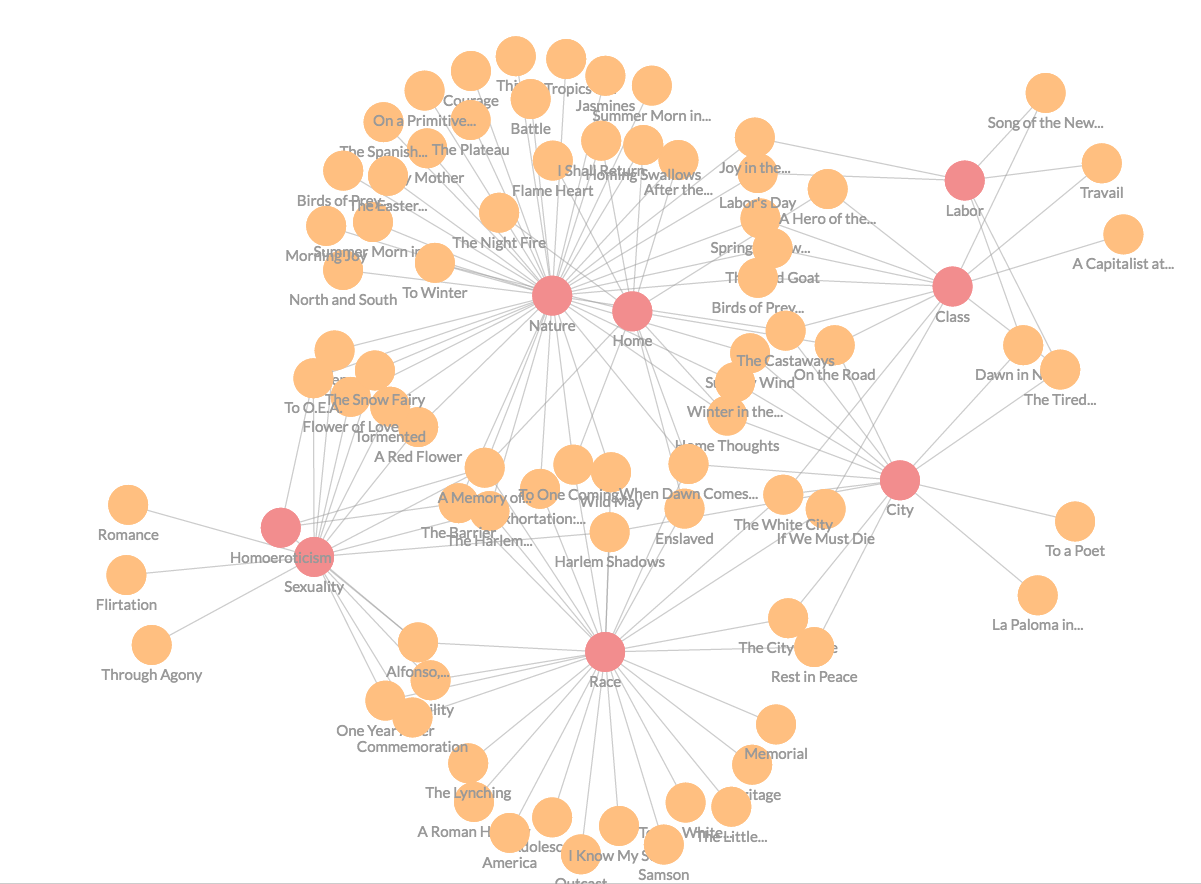
Take a look at the following network diagram showing the relations between a limited set of thematic tags, generated by Scalar using the built-in visualization application. The image below is a static image, but if you click on VISUALIZATIONS > TAG on the menu in the corner of this site, you'll get a "clickable" diagram that is also live and manipulable. The body of poems included here is comprised of all of the poems from Harlem Shadows as well as about fifteen of the early poems not included in Harlem Shadows


(See the full-size version of this diagram here)

What does this diagram show? First, we should note that the red dots show tags, while the orange dots show poems. As of November 2016, only eight thematic areas have been tagged: Race, Class, City, Nature, Home, Sexuality Homoeroticism, Labor. (More Tag information from the earlier, Wordpress version of this site is currently in the Metadata for individual poems, and is discoverable using the search function on this Scalar site. Try searching for "Birds," for instance.) 

What Can We Learn? 

1. Thematic Clusters. First and most obviously, certain themes are "clustered" together. Nature and Home have many overlaps, and thus appear clustered. Sexuality and homoeroticism also form a cluster. And finally, the tags focused on Class, Labor, and city life also form a natural cluster, though the clustering is significantly less tight than the others.

2. Centrality of Nature. An obvious discovery is that "Nature" is one of the most common tags in McKay's early poetry. This was a surprise to the students in the Digital Humanities class (given that we think of McKay as a black poet with militant/leftist politics, we might expect those themes to be more dominant). Of course, many of the poems marked "Nature" also overlap with race, class/labor, or sexual/queer themes. The surprise in finding so much discussion of Nature—and specifically McKay's interest in writing about birds—might remind us that we actually need to read a poet's poems before rushing to narrowly define them (i.e., as a black, political poet). (I would encourage visitors to look at Joanna Grim's essay exploring the "bird" theme in Harlem Shadows)

3. Home. Many of McKay's poems in this period thematize his memory of life in Jamaica. Thus, a few of the poems (for instance, "The Tropics in New York") reflect McKay's nostalgia for his pastoral upbringing from the vantage point of someone now living in a much larger, modern urban setting. 

4. Poems with three or more tags. I'm interested in the poems that presently have three or more tags: "The Barrier," "The Castaways," and "On the Road." These are poems that scholars may not have paid very attention to in the past, but diagrams like the one above might lead us to think of them as newly important as they bridge some of McKay's most important themes from this period. (Again, the number of tags is a bit arbitrary and at present an artifact of the way metadata has been tagged. At most this information might nudge readers to pay a bit more attention to some poems rather than others, not to make any sweeping conclusions about the poems as a whole.)

I would encourage users of this site to play with the live visualization tool and send me (Amardeep Singh) any screen captures that seem interesting or telling. 


B. Publication Venues

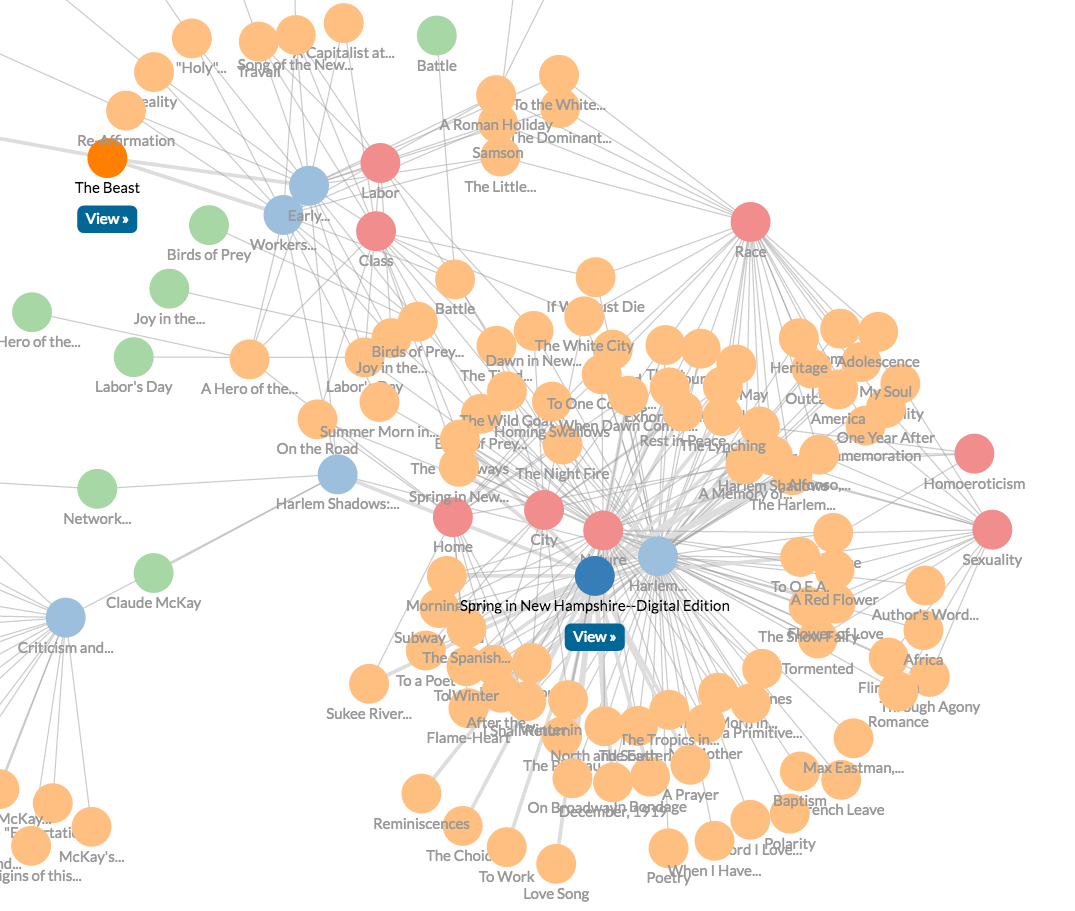
This diagram is a bit more messy. It contains nodes for publication venues (which are organized on this Scalar site using "Paths"). These appear in light blue in the diagram below.  Users can access a "live" version of the diagram using VISUALIZATIONS > CONNECTIONS in the menu in the corner above. 


(See the full size version of this diagram here)

What do we see here? (Note: the blue dots represent publication venues. The red dots represent thematic tags. The orange dots represent individual poems. The green dots are media files uploaded to this site. Readers should probably try and ignore the green dots.)

Essentially there is a larger cluster around Spring in New Hampshire and Other Poems and Harlem Shadows, and a smaller cluster around the Workers Dreadnought path and the Early Uncollected Poetry path I've constructed on this site. Perhaps not all that surprisingly, the sexuality and homoeroticism tags are mostly entirely disconnected from the labor & class oriented poetry published in magazines like Workers Dreadnought.  But there are some poems right in the middle between the two clusters that seem especially interesting to consider -- poems like "Joy in the Woods," "The Battle," "Summer Morn in New Hampshire," "Birds of Prey," and "Labor's Day" that appear with strong connections both to the "Nature" tag and to "Class" and "Labor" tags. Though few of these poems have been looked at closely by critics, they are in some ways the key to understanding the two major aspects of Claude McKay's poetry in this period. 

Digital Teaching Notes: The "Harlem Shadows" Collaborative Project

This fall, students in the Intro to DH class that Ed Whitley and I co-taught produced a pretty wonderful collaborative digital project they decided to call “Harlem Echoes,” a version of Claude McKay’s Harlem Shadows oriented to a broad, public readership. This project was produced in response to an assignment that I generated for them with help and feedback from Chris Forster and Roopika Risam along the way. The students had some technical help from staff members in Lehigh’s Center for Digital Scholarship. 

This is the project the students in the class produced:


Major features of the site include:

--Two presentations of the poems in Harlem Shadows, one version that corresponds to the poems in the order in which they were originally printed, and another version that presents the poems thematically.

--All of the poems are thematically tagged based on a set of tags agreed upon collaboratively by students in the class. The site includes a clickable “Wordcloud” of student-generated tags that leads users to lists of poems oriented around specific tags.

--A substantial number of contextual and biographical essays that help bring the poems in Harlem Shadows to life for today’s readers. 

--Students built the site themselves, including menus, graphics, and text. I directed them to use a public domain, “dirty OCR” version of Harlem Shadows derived from the Internet Archive. They proofread and corrected the OCR and produced unique pages for each poem in Harlem Shadows.

Digital Humanities and Social Justice; DH Projects and their Audience

Why Harlem Shadows? 

I am relatively new to formal involvement with Digital Humanities as a field, though I have been floating around the edges of Digital scholarship for many years. As I’ve been studying DH more intensively in recent months I’ve had two distinct observations about the field that I wanted this assignment to speak to:
    
1) While there is quite a bit of scholarship in Digital Humanities that does deal with social justice oriented themes, in its early period the field seemed to be largely oriented towards digitization and analysis of canonical, Anglo-American texts (see my essay from earlier in the fall on “The Archive Gap”). Scholars like Alan Liu have pointed out the strangeness of the fact that while DH ideas and tools were being pioneered in the 1990s, many important scholars in the field seemed not to be very engaged in the intense conversations about gender, race, and sexuality (queer theory, postcolonial theory, and critical race theory) that were also occurring in parallel during that same period of time. 
As a result of my own training and orientation as a scholar, I wanted this assignment to explicitly speak to social justice issues in some way. I believe that minority authors in the Anglo-American tradition as well as non-western authors are underrepresented or overlooked in prominent digital archives, so I had a strong interest in asking students to do a digitization project with an author in that category.


2) It’s been noted that many digital archives and digital thematic collections that tend to be posted online can have very small readerships. Is that because the texts being digitized are too obscure (I doubt it), or is it rather because we haven’t been thinking enough about issues of access and audience in designing our digital projects? What is it that the average web user might be looking for when searching online for particular texts?

My hunch is that the average reader isn’t that preoccupied with a precise digital recreation of the original printed texts they are encountering online. Rather, the interest is much more likely to be thematic (“poems about the resistance to racism”), contextual (“early black poets”), and presentist (“how does this matter today?”). In designing this assignment, I nudged students to consider these issues and build a site that might have an expansive and somewhat revisionist approach to the original material. In our DH class, we did present students with examples of digital archives that were invested in a textualist methodology (foremost being the Whitman Archive), but I at least made it a point to suggest that there might be other models for presenting digital collections to consider.


My Background

I should start by saying that I’m not an expert on the Harlem Renaissance, and indeed for most of my career teaching modernism I have focused on British and Irish modernists rather than American modernism (in my department the teaching of American materials has generally been the province of my colleague Seth Moglen). However, in recent years I have grown more interested in the transatlantic contexts of the early modernist movement (1910-1925), and one especially interesting site along those lines is the Harlem Renaissance – many of whose most important figures spent significant amounts of time abroad.

One upshot of my relative newness to these materials is that I don’t have a ‘set’ approach to teaching Harlem Renaissance literature. Indeed, this assignment emerged out of a process of exploration that I’ll briefly describe before going deeper into the assignment itself.

Genesis

The genesis for this project was my first experience teaching Claude McKay’s poetry in the spring of 2014 in an undergraduate seminar on Transatlantic Modernism. In addition to McKay, in that class I assigned Nella Larsen’s Quicksand for its depiction of Harlem cultural life in a transatlantic context (the biracial protagonist of Quicksand travels to Denmark in the middle of the novel and returns to Harlem with a clearer idea of what her black identity means to her, but without clear answers to the central quandary facing her regarding her love life and career).

As an accompaniment to Quicksand, I had initially assigned McKay’s novel Home to Harlem (1928), only to decide that emphasizing that novel was somewhat of a mistake in this class setting, for two reasons. One problem is that the novel really isn’t “transatlantic.” It does give us an example of a Caribbean intellectual and activist figure who emerges once the novel is well underway, but the novel’s primary protagonist is actually a “street” character rather unlike McKay himself. Secondly, Home to Harlem’s emphasis on street culture, slang, and nightlife could be seen as opportunistic and salacious rather than documentary. I should also add that the novel isn’t exactly a page-turner; it begins to drag around the mid-point, though the depictions of African American porters working on a railroad are interesting in part because we can assume they are derived from McKay’s own time exploring different American cities while working on the Pennsylvania Railroad in the 1910s. Some of McKay’s peers wondered at the time about whether the novel helped or hurt the cause of black literature, and we still need to raise those questions today.

A better bet seemed to be McKay’s rarely-read books of poetry, Harlem Shadows (70 poems; published in New York in 1922) and its shorter predecessor text, Spring in New Hampshire (31 poems; published in London in 1921). We did spend a session in that class looking at some of the poems from Harlem Shadows, and I was struck by both their quality and their potential relevance to a course on transatlantic modernism. Going forward, I expect that I will probably always assign these poems in future versions of Transatlantic Modernism classes I teach, rather than Home to Harlem.


The Assignment in the Context of an “Introduction To Digital Humanities” Course

Ed Whitley and I began planning the department’s first graduate level introduction to Digital Humanities in spring of 2015, and we worked on it much more intensively during the summer.

We knew that we wanted to do a unit on digital archives and thematic collections, and we also knew that this unit should have a hands-on component – a project that involved the students either contributing to an existing digital archive project, or doing a certain amount of work on something new. Because of the intense labor involved in digitizing print texts, we knew we couldn’t ask our students to do too much since we only intended to dedicate about four weeks to this topic.

I had the idea of asking all of the students in the class to produce a collaborative digital edition of Harlem Shadows as an assignment, and in the summer I discovered that Chris Forster (Syracuse U.) and Roopika Risam (Salem State U.) had already produced an elegant digital edition (though it admittedly took me awhile to find it; their site does not show up on the top of Google searches for “Harlem Shadows”). I began corresponding with these two scholars with the idea that students in our course might add materials that could eventually be added to their existing site, or perhaps build a parallel site that might look quite different. This is their site:


I have been especially interested in including biographical, historical, and literary context on any site the students might produce to help readers understand better what it is they are looking at. Thanks to projects like Google Books, the Internet Archive, the Project Gutenberg and the widespread interest in digitization amongst digital humanists, we now have a truly formidable array of digital texts available to us online -- though we still often don’t have very good ways to navigate those texts. Google Books has virtually no metadata and is actually difficult to search. As a result, we now have access to millions of texts, but we need much more infrastructure to help us know what we might actually want to read.  

As my reading and preparatory work took shape, I began to generate a list of possible contextual short essays students could research and write, for upload to the site. Eventually, I presented these suggestions to them:

--We should think about the front page and the entry to the site. Perhaps a student could write an “About” page, which introduces McKay and this book of poems and also has a summary of the new contents we are adding with links to the new content.

--Perhaps a student could write a short bio-critical essay that links to and quotes from specific poems. In order for the links to work, we first need to build a Page for each poem that has a unique Permalink.

--Perhaps students could think about a presentation of the poems in Harlem Shadows  that focuses on their historical importance and influence (esp. “If We Must Die” but also “America,” “Mulatto,” etc) rather than recreating the original presentation of the text itself (in any case, the Internet Archive edition and the Forster/Risam edition already do that).

--I would encourage students to generate tags for each of the poems that might allow visitors to the site to approach poems that focus on certain themes that are of interest to them. So we could create tags for each poem (“Race,” “Harlem street life,” “Gender,” “Capitalism,” “Lynching,” “Jamaica,” “Violence,” “Personal life,” “Family,” “Taboo Love,” “Migration” [or “Exile”], “Possible Queer Subtext,” and so on). We could then display all of the Tags on a column in the right; if the user clicks on a keyword they see a list of poems that match that tag. It may even be possible to build a widget that might dynamically arrange all poems on a given topic for the user: here are the 20 (?) poems McKay published in this period that deal with race. This could be especially useful for students or colleagues who are just looking for the poems dealing with race…

--Max Eastman’s preface to Harlem Shadows is problematic. Do we think it adds value to have the preface presented without editorial comment? Or perhaps we could add a short essay about just the Preface – including the language that some might find patronizing / insulting ? Would we prefer to jettison the preface entirely? (This would constitute a radical departure from the 1922 edition! But we are allowed to do it if we want to.) Between the two prefatory documents in the original Harlem Shadows, I prefer McKay’s own “Author’s Note”; perhaps one option might be to structure the site so that text is more prominently displayed.

--Perhaps a student might write a short essay offering a close reading of the poems that seem to allude to the complexity of McKay’s personal life – specifically his relationships with men (and often white men).

--Perhaps a student might write a short essay offering a close reading of the poems as reflective of an immigrant’s outlook. (Quite a number of the poems are reflections on McKay’s status as effectively a foreigner on American shores, still trying to digest the strangeness of American racism.)

--A student might write a short essay discussing McKay’s often tense relationship to the Modernist movement. He saw himself as a political radical who strongly embraced modernity and progress as leading to liberation and justice. But he was not interested in “modernizing” or radicalizing literary language or literary form. He liked the sonnet form.

--A student might write a short essay describing McKay’s relationship to the Harlem Renaissance movement. (He is considered one of the core members of the Harlem Renaissance group, but he is actually an outlier in some ways. A bit older than other core figures, and different in that he was an immigrant who left Harlem fairly quickly. He actually wrote Home to Harlem while living in Marseille, France!). This essay might also mention a few other major figures and benchmark’s in the advent of the Harlem Renaissance (Alain Locke’s “The New Negro,” etc).

--Images and multimedia. (There are numerous audio recordings of McKay reading poems like “If We Must Die.” We could embed those links into our own site.) Have to consider permissions and copyright.

--And in correspondence with me, Chris Forster had this suggestion:

I would add perhaps one more that folks may wish to explore. Do the poems of Harlem Shadows represent a “toning down” of McKay’s politics? The poems that once appeared alongside the poems of Harlem Shadows in periodicals but which disappear when McKay collects the poems of Harlem Shadows (which themselves are largely a rehash of poems that were first in Cambridge Magazine and then as Spring in New Hampshire… I wrote a bit about those here) are often more radical. “To the White Fiends” disappears; and where is “The Capitalist at Dinner” (a poem which is not anywhere mention in the edition right now—to my horror)? These poems strike a very different note from those published in the collection—and very, very different from the universalist spin McKay puts on “If We Must Die” when he later reflects in the reading here. (Chris Forster)

As you might see from looking at the final product, the students took me up on some of my suggestions (though not all of them); they also had their own quite fascinating ideas for topics to cover. One student focused on the different contexts and uses to which “If We Must Die” has been put (divided into three shorter essays; start here). Another focused on the possiblerelevance of McKay’s poetry to the present-day, Black Lives Matter movement. Yet another student decided to write about McKay’s use of bird imagery, especially with reference to migration and movement. Another wrote about the queer subtext in McKay’s poem, “Alfonso, Waiting at Table.” I also found the essay another student wrote on "spatial poetics" in McKay's poem "On the Road" quite compelling. 


Helping the Students Out: a Bibliography and Scanned Critical and Biographical Materials

To facilitate student research, I gave them my introductory lecture notes on McKay’s early career, with a fair amount of biographical material about McKay drawn from Wayne Cooper’s biography (these were notes I had developed for the earlier course I taught). I also scanned quite a bit of recent scholarship about McKay and made those PDFs available on CourseSite (the courseware platform we use at Lehigh).

I decided to do this because this was not, in fact, going to be a class that was centrally ‘about’ the Harlem Renaissance. I had to operate on the assumption that students would have had little or no background working with McKay prior to taking this course (this proved correct). In a class that was more focused on, say, “Digitizing African American Literature,” I might have asked the students themselves to generate these materials.

Here is the preliminary annotated bibliography that I included in the assignment as well:

Wayne Cooper, Claude McKay, Rebel Sojourner in the Harlem Renaissance. 1987 (new edition 1996). This remains the definitive biography of Claude McKay. It suffers at times from a somewhat judgmental attitude to McKay, but the bibliography is invaluable. Chapter 3 deals with McKay’s early years – and his relationships with editors like the Eastmans (which led to his breakthrough publication in The Liberator in 1919). Chapter 7 has a considerable amount of material on Harlem Shadows, including background and context (many of the poems in the collection were first printed either in McKay’s earlier book of poetry, Spring in New Hampshire, or in other magazines). There are also brief summaries and discussions of several reviews of the book that appeared at the time in both the mainstream press as well as in Afro-American magazines and newspapers.

Claude McKay, A Long Way From Home. (1938). McKay’s own memoir of these years. There’s a good deal of introductory material from the editor, Gene Andrew Jarrett, including a detailed timeline of McKay’s life, as well as a helpful biographical note.

You might also consider taking a look at various early chapters from A Long Way From Home, including Chapter 2 (“Other Editors” sets the stage for the publication of McKay’s poems in The Liberator in 1919). Chapters 7-13 (very short chapters) deal with the time period leading up to the publication of Harlem Shadows. Chapter 9 has an intriguing anecdote of McKay’s encounter with Frank Harris (editor of Pearson’s), who criticized McKay for not including “If We Must Die” in the (British-published) Spring in New Hampshire: “You are a bloody traitor to your race, sir!” Chapter 9 also has accounts of McKay’s first encounters with peers like W.E.B. DuBois. Chapter 13 has a brief account of the publication of Harlem Shadows in 1922. It was well-received, but didn’t earn very much money. Soon McKay would be off to Russia and France…

Gary Edward Holcomb, Claude McKay, Code Name Sasha: Queer Black Marxism and the Harlem Renaissance (2007). This is the first book I know of to really explore the complexity of McKay’s identity as a (closeted, at least to the public) gay black man and a Communist and apply that understanding to a close reading of his poetry and fiction. Readings of poems from the Harlem Shadows collection are scattered throughout the book. The Introductory chapter and chapter 1 might be important as an intervention in a tradition of McKay scholarship that has tended to see him as first and foremost a “heroic” Harlem Renaissance figure.

Kottis Sree Ramesh and Kandula Nirupa Rani, Claude McKay: The Literary Identity from Jamaica to Harlem and Beyond. (2006) Chapter 3 deals with McKay’s immigration to the United States and how his status as a West Indian immigrant shaped his writing and outlook. This is valuable mainly because it focuses on McKay’s status as a “colonial subject.”

Tyrone Tillery, Claude McKay: A Black Poet’s Struggle for Identity (1992). Chapter 3, “The Problems of a Black Radical,” deal with McKay’s writing during the years that led to the publication of Harlem Shadows.

Terence Hoagwood on the poem “Harlem Shadows” Brief essay in The Explicator (2010). Hoagwood talks about McKay’s appropriation of conventions from Elizabethan poetry – though this poem is actually not a regular sonnet but a “deviant” sonnet.

Adam McKible and Suzanne Churchill, “In Conversation: The Harlem Renaissance and the New Modernist Studies” (Modernism/Modernity 2013). This essay will mainly be of interest to people (if there are any) who are looking into McKay’s relationship to modernism – and the theoretical problems we tend to encounter if we think of African American writing from the 1920 and 30s in the context of transatlantic modernism.

David Krasner, review of The Scene of Harlem Cabaret: Race, Sexuality, Performance (Modernism/Modernity 2010). This is a review of a book that looks at McKay’s representation of race in Home to Harlem in light of the rather different strategy we see in WEB DuBois’s writing from the same period.

James Smethurst, “The Red is East: Claude McKay and the New Black Radicalism of the Twentieth Century” (American Literary History 2009) Largely a review essay – looking at Gary Holcomb’s book. Smethurst also summarizes the three novels that Holcomb focuses on. Not a lot here on Harlem Shadows. That said, there is a lot here for people interested in McKay’s relationship to international communism / socialism / Marxism.


Outcomes: What We Learned from Working with the Students and Listening to their Feedback

Surprise #1: The students seemed to find the assignment highly interesting and involving, and spent far more time on it than we had anticipated they would.

Some students in the class initially expressed concerns about the technical aspects of producing a serious website (as opposed to just a blog). We were able to arrange a visit from skilled digital scholars and library staff just around the time students were beginning to work on the project. This gave them a bit more confidence to start working with WordPress, though only a couple of the students in the class had used WordPress in the past. (I should also note that we decided to use WordPress for this assignment rather than something like Scalar precisely because it is so easy to use.)

I had strongly encouraged them to meet outside of class at least once, and as the students began to work they ended up meeting several times (five times in fact!) to make decisions about the intention and design of the site. It became clear that they had truly entered into the spirit of collaboration, often helping each other out with various tasks. One student took special responsibility over site design and technical features. Another student helped get the ball rolling by going through and creating her own list of thematic tags to all of the poems on her own.

Even after completing the first draft of the project, the students continued to talk about the project later, making it clear to me they were still pretty involved in the work of the project. I hope that this early experience with collaborative work will come back and pay dividends for some of the students later in their careers.

Surprise #2: They renamed it. At some point the students decided to rename the project from “Harlem Shadows” to “Harlem Echoes.” This was completely within the parameters of the assignment, though I had not suggested any such change to them nor did I expect them to do it.

I can see two advantages to the decision to change the name of the project. One is that it frees the project from the responsibility of prioritizing a digital approximation of the original text of Harlem Shadows. Harlem Shadows still forms the core of the site, but as the menu design and ordering indicates, the presentation of the poems is only one of the goals of the site the students produced.

The second advantage of the renaming might be that it allowed the students in the class to differentiate their project from the existing Forster/Risam project.

In effect, I see the project in its current form as more a digital thematic collection based on Harlem Shadows than a technical digital edition of Harlem Shadows


Surprise #3: They decided to orient the project to student users rather than specialist scholars.  This made sense to me since the students themselves are not specialists in either modernism or the Harlem Renaissance, but I still hadn’t quite expected the extremely helpful background essay one student would write describing McKay’s use of the sonnet form in Harlem Shadows.

Surprise #4: Claude McKay talks more often about “nature” than about “race.” The thematic tags the students produced led to a pretty startling observation: the largest word in the word cloud is actually "Nature” – not “Race.” Admittedly, his discussion of nature is not in a vacuum – many of those “nature” poems are also thematizing social issues such as race and migration – but it still tells us something important nonetheless, and reminds us to be careful in slotting McKay unthinkingly into the ready category of “black activist poet.”


Future Directions

We have yet to make any final decisions about what to do with the project. There is still a hope we might coordinate with Roopika Risam and Chris Forster more intensively. There is also a real idea of continuing to expand the site, possibly by adding further works ourselves (I have a couple of short essays I myself would like to contribute), and possibly by soliciting contributions from scholars who work on Mckay. 

There’s also a question about how we might revise the assignment for future iterations of this class. As I mentioned, students put this all together in the space of a couple of weeks; we had only allocated about four weeks to digital archives and collections towards the beginning of the term. We were using a final portfolio structure for the class and asked students to revise their individual essays as much as possible for that final project. But their subsequent work in the course was on different topics; in the subsequent unit, for instance, we asked them to work with data (text analysis, visualization, mapping, data mining, network diagrams, topic modeling, etc).

In our wrap-up conversation at the end, several students suggested we might coordinate the digital archive hands-on project with the hands-on project related to data. Perhaps the data segment could ask students to apply data and analytical tools to the text that they had earlier digitized and annotated? This sounded like an excellent idea in principle, though practically with such a small text (70 short poems), many data analysis tools and methods simply aren’t very useful or relevant. (Topic modeling, for instance, requires large scale corpora to produce meaningful results.) If we repeat a version of this assignment with a much more substantial primary text, however, some of those data-oriented tools could be relevant.