Tsunami and Earthquake: Educational Materials

Yesterday I was the guest lecturer/moderator in a 1-credit Environmental Science seminar being taught this fall by a colleague at Lehigh. The topic was the social and geopolitical fall-out from the Tsunami, particularly concerning India's changing role as a regional power. I referred to the following articles:

On the prospect of a regional alert system

On the UN's response

The Indonesian Government's suppression of the Guerilla movement in Aceh

More on Aceh

Ashutosh Sheshabalaya, on India's overlooked role in providing immediate military aid in Sri Lanka

I know I'm not particularly qualified to talk about these things, but it's an interesting challenge (and a nice change) to do this kind of thing every so often. The students asked good, and difficult questions, many of which involve the structure of disaster relief funding at the UN. For instance, how much do they have budgeted for this annually? What are the prospects of creating a permanent UN "Rapid response team" that is specialized for natural disasters?

It's difficult to have a discussion of the Tsunami this fall without thinking of the South Asian Earthquake, so we talked about that too -- with emphasis on the insufficient aid response. We even got into a bit of discussion on the Avian Flu vaccine issue (containing any outbreak of human to human transmissible Avian Flu would require massive international coordination).

* * * *
And I'm participating in a public seminar at Lehigh on the Earthquake at lunch today (yes -- a busy week!). For that, I'm not going to present an argument (hard to think of anything original to say), but I am offering a slideshow of photos culled from the web, some of them from News sources, and some from amateur photos Flickr.

A working draft of the slideshow is here (6 MB Powerpoint file). Educational use only, please (I will be taking the PPT file down after a few days.)

I tried to balance newsy/informative photos with more emotional photos showing people reacting to events. I was hoping to organize the photos to tell some kind of story, but there are just too many things going on at once, including: raw human suffering; rampant destruction of buildings, roads, and bridges; the large-scale relief effort; political shenanigans; as well as scenes of everyday life as it continues (and must continue) for the people in the affected region.

So the photos are a little chaotic (no single narrative), but perhaps the chaos might be useful in challenging the mass-media's approach to natural disaster -- which tends to emphasize sensationalism (look at these poor people!) at the expense of analysis.

Souad Massi


I don't know Arabic, but after hearing what Souad Massi does with the lanaguage I wouldn't mind learning.

I came across Massi's Deb by accident while browsing in the Jazz section at Borders. Massi is an Algerian folk singer -- in fact not Jazz at all -- with a light fusion touch (her songs here have a touch of flamenco). She's currently based in Paris, though she didn't move there until 1999. An interview in the Independent suggests that Massi moved to Paris after getting into a little trouble with militants in Algiers following the release of her first album. It's hard to understand why, since there are no political songs on Deb (the liner notes come with translations of the songs). But then, there's no arguing with these people, is there?

I don't want to wax too poetic about the music (you can listen to samples at Amazon or here), except to say that the production quality on Deb is simple and just about perfect, opening up space for Massi's voice. She's not trying to be a pop or cross-over hit, so she avoids the fate of singers like the Egyptian Natacha Atlas (who doesn't quite do it for me). Sometimes you just want a singer and an acoustic guitar.

This review wants to emphasize Massi's 'rebel' side, and compares her to Joan Baez and Tracy Chapman, neither of whom seem particularly similar.

And here is an interview at BBC, after she was nominated for a British World Music award in 2003. There Massi hints that life in Paris for a modern/secular Algerian woman isn't necessarily that simple either.

$100 Laptops for the Third World? (Guest Post from Suvendra Nath Dutta)

This blog's first guest post, from Suvendra Nath Dutta. Suvendra has been a frequent commentor here for some months, and emailed me with a tip on this $100 laptop initiative at the World Economic Forum.

I suggested he put it together in the form of a post, and the following is what he sent me last night (thanks, Suvendra).

Last week MIT media lab and Prof. Negroponte announced its $100 laptop initiative at the World Economic Forum at Davos. The actual initiative is called "One Laptop per Child" (OLPC). It should be noted that this is the same forum where in the year, 2000, Mr. Bill Gates announced "The world's poorest two billion people desperately need healthcare, not laptops". One presumes that those needs have not been met so dramatically as to make that observation obsolete. In fact a recent NPR program profiled just one problem facing third world children today, hookworm. One of several memorable lines in the program: "The problem is let's remember who gets hookworm: It's the poorest of the poor," says Hotez. "So although there's a huge market for a hookworm vaccine, the commercial market is zero." Putting money where his mouth is, Gates foundation is putting up $2.1 million to develop hookworm vaccines in Brazil.

So what response does the MIT media lab have to all this? As anyone who's heard Prof. Negroponte speak will attest to, it is risky to go take him on in a battle of wits. But his defense of the laptop program is nevertheless quite thin. For instance, this is all he has to say about questions like Mr. Gates statement: "Why do children in developing nations need laptops? Laptops are both a window and a tool: a window into the world and a tool with which to think. They are a wonderful way for all children to "learn learning" through independent interaction and exploration."

So lets try to visualize a use case shall we? While going through the local garbage dump in Kolkata, Sajal comes across an old watch. Unsure whether he should waste his time on it, he whips out his $100 laptop, signs on to the wide area wireless network spanning all of Kolkata (Oh, sorry, the "peer-to-peer network of these laptops cheaply connected to the internet backbone"), and searches Google images for watches. This leads him to a fascinating wikipedia article on watches. Another learning moment served up by OLPC.

Of course many people in India have thought about this at length. Dr. Sugata Mitra has been investigating community based computer access since 2001. He recently recieved the Dewang Mehta (pdf link) award in recognition of his work. Scientists at IISC (also recipients of the Dewang Mehta award), Bangalore have developed the Simputer following a conference on information technology and social development. The Bangalore Declaration that conference produced laid out their vision of where IT would fit into social development in the third world. They viewed IT as an arm in an efficient and egalitarian system of dissemination and cataloguing of information. IT is a critical part of infrastructure that would aid the local government and NGO's supply their services to the people and also allow the people to provide swift and relevant feedback to social providers. A lot of the emphasis was placed was on software that didn't rely on literacy and was regional language based. Given all this, it should be noted that the Simputer that can be bought is anything but IT for the poor people device. At $200 its hardly for the rag picker. In fact one of the items in its Amida's FAQ reads: "3. Isn't a Simputer for poor and illiterate people? It is true that the Amida Simputer is a very affordable computer, and that it is simple enough to be used by people who no prior experience with computers. However, Amida is meant for anyone who wants to work and play."

So what of the OLPC? Here's an answer from Maine. "In September 2002, middle schools in the State of Maine started an incredible journey providing every seventh grade student with his or her own laptop." Instead of the third world, perhaps the OLPC could make sure that every child in the US has a laptop. It could be one step to remove some of the segregation plaguing the US education system. Don't worry about the Third World. They've got the talent, education, technology and motivation to take care of their own. There is a desperate need in the US for a more egalitarian and universal education system. The OLPC could be a step in that direction.


I'll let Suvendra's post speak for itself, and invite readers to respond directly to him in comments. I'll add just one possibly relevant link, to a story about EBay founder Pierre Omidyar's recent endowment of $100 million to microlending programs in India and Bangladesh, which is a huge infusion of cash to a method of "social entrepeneurship" I personally support.

It's All Devanagari To Me (Language, Modernism, Culture, Chicago, Google)

I was briefly in Chicago this weekend for the Modernist Studies Association. I actually missed most of the conference, though I did catch some interesting talks, meet up with some friends, and see a solid keynote address from Hazel Carby. From amongst the panels, I particularly enjoyed Erin Carlston on W.H. Auden's connections to the "Cambridge Spies," Patricia Chu on Rebecca West, Christopher Wixson on J.M. Barrie and Noel Coward, Brian Holcomb on Anita Loos, and Dennis Allen on Ronald Firbank and the Camp tradition in modernism.

I changed the topic of my own paper to G.V. Desani's All About H. Hatterr so as to jumpstart the essay I should be writing on him (Desani also fit the topic of my panel -- Modernism and India -- just about perfectly). Though I definitely felt the (new) paper was a little rough around the edges, it was received positively (it was a small audience, and only one other person in the room had read the book).

I also got to have coffee with a couple of book-bloggers recently mentioned on this blog, Sam Jones and C. Max MaGee. Nice to hear a little about Chicago's (thriving) literary scene from these guys...

Meanwhile, the little corner of the blogosphere I keep my eye on has been quite productive -- interesting stuff on language and linguistics, postcolonial literature, etc. etc.

* * * * *

Let's start with linguistics, shall we?

You can see the reviewer's bubbling enthusiasm in this review of Nicholas Ostler's Empires of the Word (via A&L Daily). It looks like an excellent book; a passage that seemed particularly striking to me was the following:

Languages enlarge their numbers of speakers in various ways: through trade, conquest, migration, imperial consolidation, or religious proselytizing. The latter two — Spanish in the Americas and Sanskrit in Southeast Asia are instances — seem to be the most efficacious. Trade is an especially poor bet, as the examples of Phoenician, Sogdian (on the Silk Route), and Arabic (in the Indian Ocean) illustrate. Ostler comes to one of his few definitive conclusions on this point: “No community famous for specialization in trade has passed its language on permanently as a vernacular, or even as a lingua franca, to its customers.” The customer, you see, is always right, and the customer’s language is therefore to be preferred.

Aha -- that sort of explains why there's so little of Arabic on India's western coast, while traces of Portuguese are quite pronounced.

* * * * *

Devanagari. Speaking of language issues, Kerim asks a really interesting orthography question in a post on Devanagari at Keywords:

One of the cool things about the Devanagari script is that it is ordered phonologically. The sounds are listed in order of where in the mouth the sound is produced: gutturals (produced in the throat) first, and labials (produced by the lips) last, with a steady progression in between. . . I am curious when this ordering became standard. I know that the study of language and grammar has ancient roots in India, such as the famous fifth century scholar, Pāṇini, but the Devanagari script is actually much more recent, dating from the twelfth century. Some of its antecedents were the Siddham script, the Gupta script from the fourth to the eighth centuries and, ultimately, the 5th century BCE Brahmi. (I really like the way Brahmi looks!) Looking at these scripts I see that many of them listed in the same order as the Devanagari script, but it isn’t clear if this is a modern convention or if there are historical reasons for listing them this way.

Perhaps some of my erudite readers have more insight into this?

Wow, that is a really good question -- the kind of thing could easily turn into a Ph.D. Dissertation in Historical Linguistics. (Incidentally, if you click through to his blog, many of the obscure references in the paragraph have links.)

* * * * *

Google Print. Sepoy at Chapati Mystery links to a number of South Asia-related public domain texts that are online via the newly-launched Google Print service (which you have already heard all about if you read blogs). Highlights from his list from a literary perspective include Kipling's Out of India and Bankim Chandra Chatterjee's The Poison Tree.

There are many contemporary books available there (for searching) too. The overall functionality is along the lines of "Search Inside This Book" at Amazon, though the number of volumes indexed is already much higher (especially for public domain/out of print books).

I have to do a separate post (or even a series of posts) exploring the possible benefits of Google Print, but for now let me just link to the results of my search for "Hatterr," again from G.V. Desani's All About H. Hatterr. The list of sources there -- which took just a second to generate -- improved my Desani bibliography by about 1000 percent. (I probably should have run this search before doing a conference paper on the book!)

* * * * *

The Literary Saloon has also had a series of helpful posts on Indian and African literature over the past few days, including this post on the impact of Indian literature in English in Europe, a post on Pakistan's bizarre restriction on importing works of fiction from India, even when the authors are themselves Pakistani. The restriction doesn't extend to nonfiction.

And in African literature news, they also link to an interesting interview at the BBC with Chinua Achebe, where he suggests that he's not particularly concerned that the oral storytelling tradition in Africa is dying. He also speaks up for the importance of storytelling (literature) in African languages, including his own mother-tongue Igbo. Interesting, because early in his career Achebe was pretty outspoken in defending his writing in English (against the almost Stalinist condemnation of English as a language for sell-outs, expressed by critics like Chinweizu).

* * * * *

The cap to my weekend was a viewing of the cheesy/crappy/silly/entertaining Bollywood film Shaadi No. 1, a David Dhawan movie so outrageously stupid I ended up enjoying it quite a bit.
So Much For Relief Diplomacy: Delhi Blasts

Ahmed Rashid has an op-ed in the UK Telegraph that I would recommend.

He says in so many words something that occurred to me in passing when I first heard about these blasts last Saturday: so much for the thaw. Things had seemed particularly warm between India and Pakistan just a couple of weeks ago, following the earthquake in Kashmir. Then this:

On Sunday, Pakistan's president, Pervez Musharraf, had invited the media to a press conference, followed by a jovial "Iftar" dinner in the garden of his home, for the closure of the day's fast in Ramadan.

He strongly condemned "the dastardly terrorist attack" in New Delhi and offered all help from Pakistan. At the end, he casually got up, saying he was going to ring India's prime minister, Manmohan Singh, to offer him Pakistan's condolences and support.

Instead of a grateful Singh on the other end of the line, the Indian prime minister dropped a bombshell, telling Musharraf that the terrorists who carried out the attacks were linked to Pakistan. In a well-orchestrated media blitz, Mr Singh's comments were on the news wires within 30 minutes, undermining Musharraf's entire press conference.

In coming days, India will clearly try to pin the terrorist attacks on Pakistan-based extremist groups. Pakistan will demand proof. India will say the evidence is secret, and so things will steadily worsen. We will be back to the days of tensions, recriminations and shelling across the Line of Control.

I can't help but think that Rashid is right. It seems hard to imagine anyone other than a Pakistan-supported terrorist cell carrying out bombings of the size and sophistication of last week's attacks in Delhi.

I might also add (with the abject failure of the relief effort in Pakistan in mind), that it seems hard to imagine anyone more incompetent at running a country than Pervez Musharraf. (I know what you're going to say, and I agree: George W. Bush is a close second)

Reflections (and questions) on Amrita Pritam

Amrita Pritam passed away this past week. I must confess that I haven't read enough of her work to feel that I really know her oeuvre. But I have some thoughts, and questions for people who might know her stuff better.

Her most influential story -- at least in South Asian literature circles in the U.S. -- is Pinjar ("Skeleton"), a dark narrative of the cross-religious abductions of women that took place in the Partition. The protagonist, Pooro, is a Hindu woman who is abducted and forcibly married into a Muslim family. Importantly, in Pritam's novella Pooro doesn't simply become yet another female victim of religious violence. Though she remains scarred, Pooro (renamed Hamida) comes to accept her new identity, and prosper in a provisional, post-traumatic sort of way. She becomes an agent on behalf of other women whose lives are jeopardized, which is almost a happy ending.

It's a powerful basis for a narrative, and Khushwant Singh's English translation probably doesn't serve it as well as one might hope. But maybe the story doesn't quite carry us all the way. Pritam's story is somewhere between a realist (ethnographic and historical) account of a particularly nasty aspect of women's experiences of the partition, on the one hand, and a more internal psychological portrait where realism is only a secondary goal, on the other. In the end, I think the second, more psychological reading dominates (for realism, one usually goes to the real thing, and look at the testimony recorded by Urvashi Butalia in The Other Side of Silence).

Here's the opening of the novella (again, keep in mind that it's a possibly questionable translation):

The sky was a colorless grey. Pooro sat on her haunches with a sack spread beneath her feet. She was shelling peas. She pressed open a pod and pushed out the row of peas with her finger. A slimy little slug stuck to her thumb. She felt as if she had stepped into a cesspool; she ground her teeth, flicked off the slug and rubbed her hand between her knees.

Pooro stared at the three heaps in front of her: the empty husks, the pods, and the peas she had shelled. She put her hand on her heart and stared off into space. She felt as if her body was a pea-pod inside which she carried a slimy white caterpillar.

Again, it feels more like a psychological than a realistic portrait, and as such it somehow leaves me a little flat.

It might be just the translations. But I wonder if I'm simply not getting Pritam? Anyone have suggestions for Amrita Pritam stories that are real knock-outs?

I took a glance at some of the many links in Uma's comprehensive post on Pritam, but none of the stories or excerpts from stories I've read from those links really do much for me.

Perhaps Pritam is stronger as a poet? Here are some lines from "The Scar" (translated by Harbans Singh):

I am also of human kind
I am the sign of that injury,
The symbol of that accident,
Which, in the clash of changing times,
Inevitably hit my mother's forehead.

I am the curse
That lies upon man today.
I came into being
When the stars were falling
When the sun had been quenched
And the moon darkened.

. . .

Who can guess
How difficult it is
To nurse barbarity in one's belly
To consume the body and burn the bones?
I am the fruit of that season
When the berries of Independence came into blossom.

Guess who she's talking about. (Shouldn't be hard)

* * * *

One thing I did pick up on from Uma's links is an interesting biographical tidbit, from an article that describes her relationship with the Urdu poet Sahir Ludhianvi:

A bachelor to the end, Sahir fell in love with writer Amrita Pritam and singer Sudha Malhotra, relationships that never fructified in the conventional sense and left him sad. Ironically, the two ladies' fathers wouldn't accept Sahir, an atheist, because of his perceived religion. Had they seen the iconoclast in him, that would have been worse; being an atheist was worse than belonging to the 'other' religion. Sahir, perhaps, had an answer to such artificial barriers in these lines written for Naya Raasta (1970):

Nafraton ke jahan mein humko pyaar ki bastiyaan basaani hain
Door rehna koi kamaal nahin, paas aao to koi baat bane

A young Amrita Pritam, madly in love with Sahir, wrote his name hundreds of times on a sheet of paper while addressing a press conference. They would meet without exchanging a word, Sahir would puff away; after Sahir's departure, Amrita would smoke the cigarette butts left behind by him. After his death, Amrita said she hoped the air mixed with the smoke of the butts would travel to the other world and meet Sahir! Such was their obsession and intensity.

In reading this, one should probably keep in mind that Amrita Pritam (born in 1915!) was married at age 15 to her editor (she started writing young!). It's a little unclear how she could even have considered marrying Sahir Ludhianvi.

There is reference to a frustrated romantic interest of Ludhianvi's here, but it's unclear whether Amrita Pritam is the person mentioned. In fact, I don't think it's quite possible, as I gather she moved straight from Gujranwala (Pakistan) to New Delhi in 1947. As far as I know, she never lived in Ludhiana in the 1930s.

Anyone read Turkish?

A colleague in Lehigh's International Relations department stopped me in the hallway this morning and said, "Hey, you made the Turkish press!" He couldn't remember exactly what or where, but he said it was something to do with my comments on Orhan Pamuk.

I did my own restricted Google search, and I came up with this mention in Milliyet. It looks like a pretty straightforward account of what American academics are doing with Orhan Pamuk, but I still wouldn't mind knowing what it says. I think the word "Edebiyati" means literature, and the word "diyalog" is probably just dialogue. But the rest is Greek to me (and yes, the Turks would hate that euphemism).

If there are any people who read Turkish around today (that means you, Elizabeth!), I'd be grateful for a gloss.

New View, End October


Well, happy Diwali and happy Halloween.

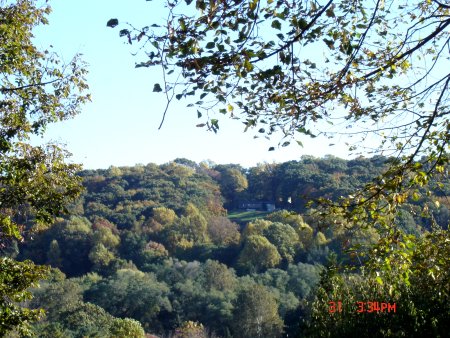
What a splendid fall day -- warm and sunny, with the fall colors near their peak in Pennsylvania.

We had a nice time driving down from New Jersey with a rented pickup truck full of sundries and a couple of articles of furniture. (The rest will follow in a couple of weeks).

Meanwhile, our temporary apartment, though humble, does come with a view of a hill, brightly lit and happy with color.

(And to my anonymous neighbor, whose wireless I'm using, thank you. Wish I could return the favor, but I'm not brave enough to leave my wireless router unsecured! )

Visions in the Yamuna: Nirmal Verma


Via the mighty Complete Review (and Uma, The Elegant Variation, and others), I hear of the death of the Hindi writer Nirmal Verma at age 76. Verma was a genuine Indian original -- a St. Stephen's graduate who decided to commit himself to Hindi (not English), and who spent the 1960s in Prague, studying Czech literature and translating it into Hindi. He returned to India, and wrote productively in Delhi for three more decades. (Though his stuff has never been widely available in the U.S., a decent sampling can be acquired in the U.S. through Amazon).

Verma embraced modernism, and created a distinctly Indian variant of the French Nouveau Roman in Hindi, the Nai Kahani ("New Story" -- essentially a direct translation of "Nouveau Roman"). Here is Amit Chaudhuri on Verma's method and literary evolution:

The stories seem to be realist enough in their mode, and, occasionally, their particulars are rendered with great beauty; but the aura of the real is an illusion; the features of their world are no more definite or recognizable than the mysterious daubs of colour that form certain Cubist paintings. Just as those daubs of colour congeal, and are translated, into a scene only once we know the name of the painting -- say, 'Night Fishing At Antibes' -- so the features of the world of these stories hang suspended in the locus of the name, 'Nirmal Verma,' and the language, Hindi, and its traditions. In his more mature years, Verma has moved to apparently less symbolist and more recognizable territory. But he has also proved, ironically, that it is possible to map, on the suburban capital city, private and nebulous quests; he writes, a publisher's note informs us, 'from a rooftop that appears in some of his stories.'

(Is it too self-indulgent to say that I would also like a rooftop of my own? My own private observation deck?) Here Chaudhuri hints that the latter Verma is softer around the edges, and somewhat forgiving of the reader's need for plot. Not an unfamiliar turn; the challenge, of course, is to grow old while still remaining visionary.

And so it appears Verma did. Another story readers might be able to readily access is 'Terminal' (1992), which shows up in Amit Chaudhuri's anthology, The Vintage Book of Modern Indian Literature. Here's a snip from the ending of that story:

When the train reached the other terminal, he gave the conductor his ticket which still carried the warmth of her hand. After he got off the tram, he slowly walked towards the bridge which he used to cross every evening on his way back hom after dropping her at her hostel. It was an ancient bridge and the red light of the setting sun was sparkling over the river that ran under it. . . . He started walking again, but stopped when he reached the end of the bridge. He watched the river, which was now partly lit by the setting sun and partly covered by the evening shadows, flowing peacefully under the bridge. Then, suddenly, in the confusion of light and shadow, he saw a face floating on the surface of the water, staring at him, gazing up at the place he was standing, and he couldn't decide if it was the face of the Empress who had drowned at the same spot under the bridge three hundred years ago or of the woman he had seen in the candlelight three hours past who had saved them from drowning.

This could be a vision from a bridge at the Seine or the Vitava. But I think it is the Yamuna, which is dense and haunted the way all rivers running through cities tend to be. It's exactly the place to stand with one's hand in one's pocket, clutching a cooling ticket to an opera one is no longer going to see.

A translation of a Verma story called "The Lost Stream" is available online at the Little Magazine (link via Uma again):

Bodhrajji is long gone — the light from the lamppost illuminates his signboard that has his name in bold letters and of course the... Philosopher, Guide and Friend. She looks at the board for a while and then is startled by something. Someone is standing near the shop, whispering. She bends to look closely and sees two men on a motorcycle… they don’t seem very grown up, more like college boys — impulsive and worldly unwise, perhaps a little scared, but happy. As if they’ve found heaven beside the wall near the shop. They’ve come here, away from all curious eyes, not knowing that they are being watched.

She can’t see them too well. One boy is standing, the other sitting on the motorcycle. The one sitting takes something out of a bag from somewhere behind his legs. She sees the glass in the other boy’s hand… She realises what they are doing here. Shopkeepers come here after closing shop, to consume in fast gulps stuff they can’t touch at home, and then disappear into the darkness. But these boys? They seem untouched by the shopkeepers’ hypocrisy. They whisper and then laugh, and hide their glasses at the slightest noise. They don’t seem to be from here. Neither from the world around her… What is it that makes them stand out? Is it their laughter? Their whispers? Their happiness? The happiness that comes from drinking?

Is this the way to happiness? A dark alley?

I hope you'll consider it worth your time to read the rest of the story (I haven't spoiled anything by quoting from the ending. Remember: modernism!). What Verma offers in "The Lost Stream" is a series of small, nuanced observations, and a self-reflexive take on the strange feeling of isolation that comes with giving oneself over to observing the world, rather than attempting to act in it. No matter how removed the artist is from the people she (in this case) watches, she is still always in some sense involved in their experience. She scrutinizes the boys drinking in an alley for some kind of clue to her own condition.

(It should go without saying that Verma's is a very different kind of Indian writing from the overblown, fantastic, chutnified, and "exotic" style associated with certain practitioners of Indian English postmodernism. Verma as Antidote to Rushdie-itis?)

And of course one has to mention that these are only translations, that reading in the original Hindi would be something else entirely. For those who can, Uma links to a story in Hindi here (you need to download a font -- damn).

* * *
Two further notices of Verma's passing:
Scotsman

Hindustan Times

And three Verma links:
South Asian Writers Literary Recordings Project (a U.S. Government project -- you can hear/download MP3s of him reading)

Lettre Ulysses Award

Interview in the Tribune

Two Bits of Good News, and A Request for Advice

1. We're moving out of New Jersey, and back to the Philly area.

S. got an internal transfer to her company's King of Prussia office, which is a huge relief: King of Prussia is much closer to Lehigh than Melville, NY. Her commute will be cut by like 95% -- no more George Washington Bridge, Cross-Bronx Expressway, or LIE -- and mine will be cut by about a quarter. That 15-20 minutes each way on my end might not sound like much, but 40 minutes a day does add up.

So we're moving in stages in the next few weeks. It's a huge amount of work, and this is a pretty bad time to have to do it. But the long-term benefits are myriad: more time to socialize, more time for exercise, the possibility of buying a house (ulp!), as well as an overall sense of normality that is lacking when you spend all your time in the car.

2. Book news. This actually happened about two months ago -- I got a contract for my academic book, Literary Secularism: Religion and Modernity in England, Ireland, and India. It's with a small British scholarly press whose name I won't give (bad luck), though I can say it's neither OUP nor CUP. The details of the print run and so on haven't been worked out yet -- I have to turn in the manuscript first -- but we'll probably have more news on that front next summer.

3. Blog posts --> essays? There are a few long blog posts I've put up in recent months that I'd like to try and convert into publishable essays, and I wonder if readers might have favorites or suggestions from among the following:

Language issues: some combination of H. Hatterr, and the Indian English posts, and maybe also the Balderdash post. That I need to write some kind of essay on this is really a no-brainer. The question is how to take it from the realm of language-play (where my blog posts are) to some kind of serious point about the function of Indian English (or slangs and dialects in general) in literature.

Orhan Pamuk, Turkish Secularism, Theater.... I really liked some of the ideas in this post, though it didn't get a lot of response from people at the time I posted it. There's so much going on in Pamuk's novel that this could easily be extended to 15-20 pages. But I don't know a lick of Turkish, and most academics avoid trying to publish on writing in translation when they don't know the original language, because any close attention to a writer's language is rendered pointless. But I wonder if that rule could be broken?

Rethinking Postcolonial Theory. This is almost an academic essay already, and I'm most definitely going to rework it. The question is whether it's my first priority.

So if you were me, which would you be most excited to pursue? Are there other posts you've seen me post here (or at Sepia Mutiny or the Valve) that seem like they could be starting points for longer essays? Philip Roth? Rumpelstiltskin? Others?

(Note: you obviously don't need to be an academic or a literature person to weigh in on this -- that's the beauty of the blog world. There's no such thing as "qualifications," only good ideas and arguments...)

Maps For Lost Lovers -- Reviews at LBC

Three of the Lit Blog Coop (LBC) bloggers have reviewed Nadeem Aslam's Maps For Lost Lovers. It's one of five books nominated for their "Read This!" series.

C. Max Magee (of The Millions)

Sam Jones (of Golden Rule Jones)

Our Girl in Chicago (of About Last Night)

If you only have time to read one of the three, the review that is the most detailed and dense is Our Girl In Chicago's. Her most thought-provoking paragraph, I think, is the following:

Aslam is great at unearthing rich psychologies like Kaukab’s in an emotionally potent way; he’s great at interiors. But that’s a bit misleading, since another distinction of his novel is the way it reflexively looks outward to see in: a great deal of what we know about the characters is divined through detailed representations of the world as they see it. The thickly descriptive style through which Aslam achieves this will, I imagine, prove overly rich for some readers. Seven metaphors and similes on the first page alone sounds alarming, doesn’t it? But—apart from the fact that many of them are stunning—metaphoric language is more than a vehicle here, and certainly more than just ornament. It’s close to being a provisional philosophy.

OGIC hints at a criticism made by some readers of Aslam that I've talked to -- his prose borders on preciosity -- while also offering him an 'out'. It's his intense interest in the interior life of his characters, she implies, that explains the high metaphorical density: there's a consistency there to be ascertained.

Or at least that's what it looks like from here. I'm a little embarrassed that I've had this book on the shelf since mid-summer, and still haven't read it. Well, I've got a conference in Chicago coming up next week, so maybe I'll get started on it while waiting in airports/on the plane.

(Incidentally, if any readers in Chicago are free that weekend and want to meet up for coffee/tea, drop me an email.)

Shirley Horn's Influence


New York on Sunday
Big city's taking a nap
Slow down, it's Sunday
Life's a ball, let it fall right into your lap


Earlier I linked to the New York Times obituary of Shirley Horn, but it's the Washington Post that really has the goods, with a jazzhead's take on Horn's music by Richard Harrington.

Horn's trademark, Harrington points out, is her slowness:

Horn, who died Thursday night at 71 after a long illness, could swing a tune with the best of them, and often surprised fans when she did, but that approach simply didn't fit her temperament. Instead, Horn did ballads and cool, understated ruminations better than anyone except her first champion, mentor and lifelong friend, trumpeter Miles Davis. Both were masters of silence and anticipation, but even Davis teased Horn about her pacing. "You do 'em awful slow!" he once said.

Slowed down, Horn songs like "Here's to life" and "Beautiful love" sound strangely dissociated: as if she's musing on something personal -- but maybe a little disconnected -- as she's singing.

The Times talks about her ability to boil a song down to the bare melody, but I don't know if that's quite it. Horn sings so slow that the listener doesn't 'hold' melody in the usual way. You're not being carried by a catchy tempo, so you're always slightly off-balance, anticipating the next phrase. Slowness intensifies the drama in the song, which sometimes gets too intense (though it never crosses over into melodrama).

But Shirley Horn isn't just going for drama; she's also interested in a minimalism that does something else entirely. In the space between jazz and the blues, Horn seems to always know what her voice can do as an instrument. So she plays it distant, like a slow trumpet riff in a minor key. Her last name, one feels, cannot be an accident.

The best way to explain Shirley Horn's style is to compare her version of "Peel me a grape" to Diana Krall's. Krall is a contemporary cocktail party staple; her version "Peel me a grape" is so popular, people might not know that other versions exist. Krall does it fast and punchy, like a Cole Porter song. She announces her (impressive) vocal skills at every step -- showbiz all the way. It's as if she's saying: listen to this and be impressed! And most of the time, one walks away duly impressed.

But sometimes one wants something a little smaller and less polished. Shirley Horn does "Peel me a grape" with no Showbiz (or showmanship) in her voice. She also sings at about half-speed, and is languorous and contemplative where Krall is sharp and to-the-point. If you'll allow a dessert metaphor, Horn is no sugar added.

For all that, Diana Krall still owes something to Shirley Horn, for the song itself (if nothing else). Harrington alludes to this as well:

Horn was at times reflective, at times wry, and on occasion caustic and cantankerous. She expressed frustration with the music business, particularly that such pianist-singers as Norah Jones and Diana Krall didn't acknowledge her as the influence she clearly heard herself to be.

Of course, some of this is the usual generational snubbing, and there's also a bit of the sometimes invisible mainstream appropriation of African American music, which will be familiar to anyone who knows the history of popular music here.

You might be able to hear a little snippet of Shirley Horn's "Peel me a grape" at Amazon (sometimes it doesn't work). A sample of Diana Krall's version is here.

Shirley Horn was also on The Connection in 2002; you can listen streaming. Even as recently as three years ago, fighting cancer and some other serious physical ailments, she sounded great.

Lit Links (In Which I Prove That Shivaji Was Shakespeare)

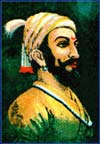
1. More Shakespeare biographies: Shakespeare wins the prize for the most biographized person about whose life almost nothing is known. (The only person who comes close is Shivaji; indeed, what if Chhatrapati Shivaji were Shakespeare? It might explain why no one has ever really agreed on how to spell Shakespeare's name. And it might also explain how we got from Shakespeare (Chhatrapati) to Thackeray (Balasaheb)!

Yes, yes, I know the dates are all wrong, but consider the pictures closely:


There's a resemblance, is there not?

2. Great post at Locana about Amartya Sen's The Argumentative Indian. Anand takes issue with Ramachandra Guha's review of the book, which he says distorts some elements of Sen's argument, and miss the point. At issue, as always, is the purchase of the past over the present. Who determines history? To what extent do events in the distant past determine social relations in the present?

It's too simple to simply promote presentism, and dangerous (especially in India) to give the past too much weight.

3. Chris Bertram at Crooked Timber linked to an interview with Orhan Pamuk in Der Spiegel over the weekend. It's a great interview. Both there and in the discussion at Crooked Timber, I get the sense that Pamuk is trying to show is that Turkey has undergone a sea-change over the past ten years. It is more open, more tolerant, and less Kemal-ist while still being secular.

Then why is Pamuk facing a trial for saying that "Armenians were killed"?

Another piece on Pamuk in The Guardian.

4. Pirates in the Indian Ocean. I know that lives are being lost and this is a very serious criminal problem, but somehow I always find it a little bit exciting that there are still pirates.


5. Ms. World meets Mumbai.After months of planning, our web-buddy Ms. World has finally landed in India. She's looking for people to have coffee with in Indian metros.

6. The Communist Party in Bengal. I hadn't browsed Delhi Belly in awhile. This time I was happy to see the text of an article Jason Overdorf published in Newsweek International, on the divide within the Communist Party-Marxist in Bengal. Apparently they are not against globalization across the board; in Bengal, for instance, the Chief Minister Buddhadeb Bhattacharjee has been quite successful in wooing foreign investors.

So they are pro-foreign investment when it's in Bengal, but against it at a national level. Oy.

7. RIP Shirley Horn. We won't forget you.

8. Coup de whaaa?. Connaissances has an interesting post on the French word "coup," which often refers to sudden or unexpected events:

Here are a few examples of the 'coup' phrases where the word 'coup' usually denotes events that happen suddenly or briskly.

Coup d'état: overthrow of a government by a small group, often being part of the same power structure. Distinct from a revolutionary overthrow of the government. Lots of examples on Wikipedia here.

Coup de gueule: Letting off steam (literally a 'blow of the gob').

Coup de main: in French this phrase means 'a helping hand'. In English, however, according to Wikipedia the phrase has the more negative significance of 'a sudden and swift attack'. How the former transformed into the latter is difficult to comprehend. (avoir le coup de main: to have the knack)

Coup de grâce: means a 'blow of mercy', or a death-blow. It refers to the mercy killing which ends the suffering of a mortally wounded creature. It can also refer to an act that brings about drastic change. There's an amusing little comment on Wikipedia concerning the mispronunciation of this phrase by English-speaking people here.

Coup de boost: what you do to increase the traffic on your blog...

Ah yes, the Coup de boost.

Incidentally Taupe is looking for more variations on "Coup de ...." in his comments.

Hanuman, the animated film; and the puzzle of the Vanaras


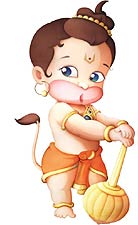
Rediff has a review of the new animated version of Hanuman that's just come out. From the stills, it looks like they're showing him not as a monkey, but as a more or less hairless human (whose adult form is quite muscular), with a monkey-ish face.

I was surprised by this, but I gather that most iconography of Hanuman follows this pattern. I find it a bit curious, though apparently it has something to do with Hanuman's mother being a Vanara ("monkeylike humanoid"). So I guess what I'm curious about is the idea of the Vanara itself -- which is different from the ancient Greek 'combinations' (i.e., centaurs or griffins). A Vanara isn't two animals grafted together (or a human grafted with an animal); rather it's a being that is essentially human (or "humanoid" as sci-fi people might say), but with limited animal features.

* * *
In general, I'm looking forward to Hanuman, which looks like it might be a winner if it ends up getting widely distributed and marketed. Since CGI films are among the most commercially successful films Hollywood produces these days, Indian studios are right to try and develop that market as well.

More stills here.

Another Desi Running for U.S. Congress?: Upendra Chivukula

Upendra Chivukula is a State Assemblyman from New Jersey.

He's profiled on today's Marketplace (an NPR radio show). He doesn't come out and say it in so many words, but it sure sounds like he's running for Congress.

In the story they say there are nearly 200,000 Indians in New Jersey (they don't talk about Pakistanis or Bangladeshis). It's still not a large number if you consider that there are 8 million people in the state. Still, he's a Democrat, which means some of us are likely to be a little more enthusiastic than we were with Bobby Jindal last year. Chivukula does have to get over the hump of his last name, which some Americans might find difficult to pronounce. In the Marketplace story he makes a little joke about it ("think 'Chevy' plus 'Cola' -- it's not so hard!").

Sreenath Srinivasan, the omnipresent Columbia journalism prof. also makes a cameo in the story.

Incidentally, Upendra Chivukula is also profiled on something called the Indian American Leadership Incubator.

And there's more on him on this Telegu-centric blog.
* * * * *
UPDATE: I randomly met Chivukula at a big Navratri/Garba fest in Parsippany three days after posting this. Seems like a nice guy. And he confirmed that he's likely to be running for Congress next year.