Sam Harris: militant atheism

I recently came across Natalie Angier's review of Sam Harris's book The End of Faith: Religion, Terror, and the Future of Reason. It has stuff like this:

''We have names for people who have many beliefs for which there is no rational justification. When their beliefs are extremely common, we call them 'religious'; otherwise, they are likely to be called 'mad,' 'psychotic' or 'delusional.' '' To cite but one example: ''Jesus Christ -- who, as it turns out, was born of a virgin, cheated death and rose bodily into the heavens -- can now be eaten in the form of a cracker. A few Latin words spoken over your favorite Burgundy, and you can drink his blood as well. Is there any doubt that a lone subscriber to these beliefs would be considered mad?'' The danger of religious faith, he continues, ''is that it allows otherwise normal human beings to reap the fruits of madness and consider them holy.''

In my view, those sorts of pot-shots don't do anyone any good.

But Angier argues that Harris is going a little further than that. The point is not his snide comments about religious faiths, but rather his right to make them. Harris feels that this right is in jeopardy:

''Criticizing a person's faith is currently taboo in every corner of our culture. On this subject, liberals and conservatives have reached a rare consensus: religious beliefs are simply beyond the scope of rational discourse. Criticizing a person's ideas about God and the afterlife is thought to be impolitic in a way that criticizing his ideas about physics or history is not.''

I don't think this is true. People in mainstream venues do criticize some religious beliefs quite openly, especially when those beliefs are seen as pernicious to human rights (for instance, the idea that God is against abortion and homosexuality can be widely and readily criticized).

Harris is worried that believers in the "metaphysics of martyrdom" (read: Muslims) will destroy the world. It is necessary to challenge their beliefs for the dangers they pose to us:

''We can no longer ignore the fact that billions of our neighbors believe in the metaphysics of martyrdom, or in the literal truth of the book of Revelation,'' he writes, ''because our neighbors are now armed with chemical, biological and nuclear weapons.''

Harris reserves particular ire for religious moderates, those who ''have taken the apparent high road of pluralism, asserting the equal validity of all faiths'' and who ''imagine that the path to peace will be paved once each of us has learned to respect the unjustified beliefs of others.'' Religious moderates, he argues, are the ones who thwart all efforts to criticize religious literalism. By preaching tolerance, they become intolerant of any rational discussion of religion and ''betray faith and reason equally.''

I'll go check out the book in the bookstore, but I am very skeptical of all this. It seems like Harris has a rather over-simplified (and Christian-centric) view of religion. I also wonder if he has any interest in whether his words will have an effect. Simply equating religious beliefs with irrationality is not going to get you anywhere, anyhow. (To loosely quote the Beatles)
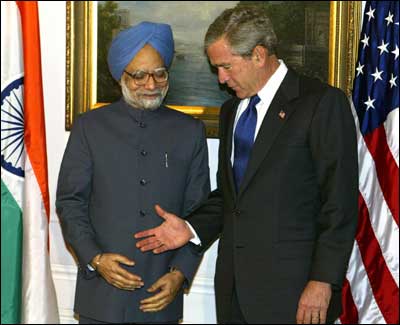
Manmohan Singh on Charlie Rose tonight

The Telegraph reports that Indian Prime Minister Manmohan Singh is sitting down for an interview with Charlie Rose while he is in New York for the UNGA.

According to the PBS website, the interview will air tonight. My local PBS channel will broadcast it at 11:30pm. You can find out when it is on here.

Provide a caption for this photo


Manmohan: "Do I have to? It doesn't even look especially clean."

Dubya: "That is my hand. My hand in. Ineluctable modality of the visible: at least that if no more, thought through my eyes. Signatures of all things I am here to read, seaspawn and sewrack, the nearing tide, that rusty boot. ... If you can put your five fingers through it it is a gate, if not a door. Shut your eyes and see."

[Image source: AFP]

Anyone got a better one?

Human Rights in India: Still a Problem

An exchange with one of the 'Gene Expression' people (think: George Will + Dartmouth Review) on Sepia Mutiny has me riled up about the question of human rights in India.

Specifically, what I have to say is this: there is a problem. It is serious. I'm not sure what awaits Paramvir Singh Chattwal, an asylum seeker in Florida who faces deportation after he failed to show up for a hearing. He may be detained by Indian police upon return to India, or he may not. He may be tortured yet further or even killed, or not. I don't know, and I don't think anyone knows.

But there are two things I think people need to remember:

1) Being detained by the Indian police is a very dangerous proposition, even to this day. A human rights activist cited in a recent Washington Post article claimed that there 1,300 people died in police custody in 2002. (I linked to that article in an earlier post)

2) The Indian police has a history of human rights violations it has never been held accountable for. Nor has it ever directly acknowledged that there is a problem.

On this note, let me offer a link to a blog produced by an acquaintance of mine named Jaskaran Kaur. Jaskaran has a Harvard law degree, and lives in Boston. Earlier she worked with an India-based activist named Ram Narayan Kumar to push through full documentation of the disappearances of Sikhs in Punjab. They performed many, many interviews with surviving family members of the 2000+ Sikh men who had been 'disappeared' in the 1980s, and kept the attempt to hold the government accountable alive. Some of the fruits of this research is available at this website. Further documentation is in a book published by the CCDP called Reduced to Ashes.

The point is, this stuff happened. Many, many people have been summarily killed in the interest of India's law and order. I don't know Paramvir Singh Chattwal from adam, and can't say whether I believe him. But if he says he was tortured and still has the scars from stab wounds on his body, I take that seriously. If he's being deported and sent back, that's a concern.

I should be clear: I am not sympathetic with those who want parts of India to secede in the interest of a dubious ethno-religious purity. I love India; I think it's an amazing country. I spend a lot of my professional energy trying to convince people -- colleagues, students, readers -- to take notice of it.

I'm only making these criticisms because I think India would be a much better place if the criminal justice system were radically reformed, if transparency were introduced, and if law-enforcement officers who've crossed the line were held to account for their actions. The first step is to admit what happened. The second is to recognize that it still happens (often for non-ideological reasons now).

But those are steps some people do not seem willing to take.

Outsourcing: further updates (but no potato)

Further follow-up from Drezner on Samuelson/Bhagwati. Drezner has now read everything on the subject, including Arvind Panagariya's response to Samuelson. BUT he doesn't indicate anywhere that he's read the article itself!

Somebody has to have the potato.

And also see the comments on Kaushik's blog. They're very helpful.

Alan Wolfe on why the Democrats lose the 'God' vote

Alan Wolfe has a piece in the September 19 Boston Globe on religion and political parties. Wolfe has been writing a lot recently on the politicization of religion in America, and claims that the Democrats could -- and perhaps should -- win the 'God' vote in America. They are not especially irreligious, especially if you consider how religious African American democrats are. And it's not like the Republican leadership is composed of church-goin' ordinary folk. No matter how often George W. Bush puts on his cowboy hat, remember: he went to Yale, he went to Yale, he went to Yale! And economically... well, readers are probably well familiar with the problem of people voting against their economic interests.

The recent history of American secularization. From the early 1960s to 1994, most liberals have believed in what I call strong secularism, which is both cultural and political. In this strong secularism, religion is supposed to play a small or nonexistent role in public life, while the government is required to uphold strong church-state separation. As Wolfe points out, liberals during this period found their views on religion in cultural life ratified and reinforced by the kinds of decisions the Supreme Court was making on things like prayer in school and (especially) abortion.

What does secularism mean in the era of Promise Keepers and Christian Rock? But strong secularism was dealt a severe blow in 1994, with the Republican revolution. For a number of reasons, liberal democrats are being forced to admit that cultural secularism has become a minority position. But secularism as a legal and judicial concept has remained very much in place. The Republicans have exploited the gap between the two concepts of secularism to great advantage, in part by blurring the line between them. The Democrats' failure to win the God vote perhaps has something to do with their failure to soften strong secularism.

The Democrats' own litmus test. The Democrats have also sometimes made poor decisions on how to respond. For instance, Republicans are often accused of having a 'litmus test' on issues like gun control and abortion. But, as Wolfe points out, the Democrats have had one too:
This secularism achieved the height of its influence within the Democratic Party at its 1996 national convention when Pennsylvania governor Robert Casey was denied a speaking role. There is some dispute about why; many conservatives say it was because his opposition to abortion made him persona non grata within the party, while others point out that he was refused a speaking role because he would not endorse the party's platform. But under either interpretation, the Democratic Party managed to marginalize the Democratic governor of a key swing state because it had made support for abortion a litmus test of party leadership. Believers who might not share the religious right's agenda, but who also worried on religious grounds that the act of abortion really did involve taking away a human life, were told that they ought to look elsewhere for a party to join.

While I agree that the Democrats made a mistake about Robert Casey, I'm skeptical about where Wolfe is going here. Should the Democrats become more receptive to pro-life members? Should it reward the conservative Democrats the way the Republicans have been rewarding high profile liberal/moderate Republicans like Schwarzenegger, Giulani, etc.?

My instinctual answer is, yes, they should. But who and where are they? And: what is the line between flexibility and hypocrisy?

Ethnic Conflict in Kenya: M.G. Vassanji's new novel

There's a positive review of M.G. Vassanji's latest novel, The In-Between World of Vikram Lall, in the September 18 Guardian. Vassanji is one of the lesser-known Indo-African/Canadian writers, but he has written consistently good novels on unique subjects. Of the books of Vassanji's I've read, my favorite has been No New Land, which is about the life of Indo-African immigrants in Canada.

Go to the actual review for a plot summary of The In-Between World. Briefly, the book is about an Indian merchant who attempts to survive -- and more than survive -- the black/nationalist Mau Mau Uprising in Kenya between 1952 and 1960.

Reviewer Helon Habila's comment on the novel's version of Kenyan history is interesting:

The book is about survival, political and personal. Vikram becomes the middleman, the moneychanger, the fixer, to ensure his place and his family's in the new Kenya. The British, to ensure the survival of their legacy, installed the new leaders - men not necessarily of the best quality, but reliable because of their greed and contempt for the people - as buffers against the rising tide of Marxism/socialism that had overrun neighbouring Tanzania. Sometimes Vassanji's image of the corrupt African politician - lugging a suitcase full of cash - verges on cliché, but his use of real political figures is daring.

Vassanji deliberately blurs the line between victim and victimiser. The new African elite suddenly begin to act more and more like their British predecessors. The Mau Mau freedom fighters who gave up everything to fight the colonialists are now hounded on the streets and arrested for the flimsiest reasons. The same colonial policemen and their African collaborators who tortured the Mau Mau and other blacks during the emergency are still in office as security advisers for the new ruling class.

Postcolonial history is always more complicated than simple accounts allow. There is no authentic Africa or India, untouched by colonial ideas of power; 'free' states are not always so free.

And there are very few people with their hands clean. As much as they were victimized in places like Uganda (when Idi Amin ejected all people of Indian descent in the early 1970s), Indians in east Africa were earlier the beneficiaries of a corrupt colonial system. Vassanji is sensitive to this role; apparently the narrator/ protagonist of the novel, who eventually leaves Kenya, describes himself as "one of Africa's most corrupt men."

Shoutcast radio; Streamripper

It's been awhile since I posted anything related to DJing or dance music. Mainly I've just been focused on teaching and writing, and the music has kind of dropped out a bit.

The one new discovery I made is the live audio streams from Shoutcast. The streams are free, and mostly run in Winamp. The nice thing about it is, it's pretty global (for instance: Thaidisco.net!). Also nice is the fact that all streams are marked according to number of slots available (so you know if the server will be too busy), as well as bitrate. Many stations provide live track info.

Bitrate is important because higher bitrates (about 128 kb -- 128 kilobits per second) sound closer to CD quality. Most Indian streams are in the 32-64 kb range, which is kind of so-so. It's much easier to find western pop dance music streams at higher bit rates.

I doubt that Shoutcast wants to make this public, but it's pretty easy to rip (capture) Shoutcast streams using a utility called Streamripper. Streamripper is a plugin for Winamp that lets you keep anything you're listening to through a Shoutcast stream. It's pretty easy to install; the only things to watch out for are: 1) download the right version of the program (more than a dozen versions are available), and 2) don't forget to set an output directory.

The coolest thing about the Streamripper utility is that it finds track information for you, and automatically saves separate MP3s for you. If you have the hard disk space, you can start ripping, walk away, and come back two hours later with dozens of new, properly labeled MP3s.

Disclaimer on Legality/Ethics. Even though it's probably perfectly legal to copy music this way, it's not really fully ethical to do it instead of buying music from musicians. I encourage people to frequent their local record stores...

In the Indian music category, I've been listening to:

Apna Radio
Punjabi Songs
Bombay Beats (128 kb; very busy)
Mast Radio (128 kb)
Desi Soundz (no track info.)
Tabla.com

Of the four, I've been happiest with the selection on "Punjabi Songs," though only the 128 kb stations are probably seriously worth ripping. But do a search for "Hindi," and try the various stations...

In US/UK dance music, I've been happy with

Bassdrive (128kb; Drum n Bass)
Radio 42 (128 kb; Lounge/Nujazz)
Digitally Imported (96 kb -- wide selection of house, trance, techno, etc.)
Passion 91.8 FM (128 kb; UK Garage, from the UK)
Deep Mix Moscow Radio (128 kb; from Russia)

In Hip hop:

Smooth Beats (128 kb; Souls of Mischief!)

In Reggaeton (the super-trendy merger of Puerto Rican dancehall reggae and American rap):

Reggaeton.net (listen for Tego Calderon -- he's the king of Reggaeton)

And in pop (even English profs. need a little pop in our lives):

Frequence 3 (128 kb; from Paris)

Anyone out there have other suggestions for free/legal things to listen to on the internet? Good MP3 blogs?

Ziauddin Sardar on Pakistan's Hudood, Reforms in Morocco

It seems like just about every day someone publishes an article on how Islam can be reformed, is being reformed, and can never be reformed.

Today's contribution is Ziauddin Sardar, who has a piece in this week's New Statesman. As for whether the substantial claim he makes ("Islam is changing...") is correct or not, I can't say, and I don't think anyone can say. But he does have some informative material on Pakistan's infamous Hudood Ordinance, as well as reforms in Morocco. Sardar summarizes Hudood, something I've never quite understood, with devastating directness:

In Pakistan, however, the mullahs are still predominantly hardline and are locked in a virtual civil war with reformers. The contentious issue here is the Hudood Ordinance, which states the maximum punishments for adultery (stoning), false accusation of adultery (80 lashes of the whip), theft (cutting off the right hand), drinking alcohol (80 lashes) and apostasy (death). The ordinance was imposed on Pakistan in 1979 by the military ruler Muhammad Zia ul-Haq, under pressure from Islamic parties. It makes no distinction between rape and adultery; thus women who are raped often end up being whipped while the rapists are exonerated. Girls who have reached the age of puberty are treated as adults. Worse, women are not allowed to give evidence on their own behalf. Among the high-profile injustices was the case in 1983 of 15-year-old Jehan Mina, raped by an uncle and his son. She was sentenced to ten years in prison and 100 lashes, reduced to three years and 15 lashes in view of her age. In 1985, a blind maidservant, Safia Bibi, was sentenced to a similar punishment. In both cases, the girl's pregnancy was used as proof that the sex act had been committed but the men were acquitted on the benefit of the doubt. Several women have been sentenced to death by stoning, the most recent being Zafran Bibi in Kohat in 2002, although that sentence was quickly overturned on appeal.

It sounds unbelievable, but that's the law in Pakistan. Musharraf, in his six years in office, hasn't done anything to improve it.

Family laws are improving in Morocco, however. Interestingly, Sardar claims they are still calling it Sharia, and justifying every reform with reference to the Quran:

Morocco retained much of the colonial legal system that France left behind, but, in family law, followed what is known locally as the Moudawana - the traditional Islamic rules on marriage, divorce, inheritance, polygamy and child custody. At first, King Mohammed VI had to abandon plans for change because, protesters claimed, he was trying to impose secular law and western culture on Morocco. In spring 2001, however, he set up a commission, which included women and was given the specific task of coming up with fresh legislation based on the principles of Islam. Given enormous impetus by 9/11 and its aftermath, it produced a report that many see as a revolutionary document. The resulting family code establishes that women are equal partners in marriage and family life. It throws out the notion that the husband is head of the family and that women are mere underlings in need of guidance and protection. It raises the minimum age for women's marriage from 15 to 18, the same as for men.

The new Moudawana allows a woman to contract a marriage without the legal approval of a guardian. Verbal divorce has been outlawed: men now require prior authorisation from a court, and women have exactly the same rights. Women can claim alimony and can be granted custody of their children even if they remarry. Husbands and wives must share property acquired during the marriage. The old custom of favouring male heirs in the sharing of inherited land has also been dropped, making it possible for grandchildren on the daughter's side to inherit from their grandfather, just like grandchildren on the son's side. As for polygamy, it has been all but abolished. Men can take second wives only with the full consent of the first wife and only if they can prove, in a court of law, that they can treat them both with absolute justice - an impossible condition.

Every change in the law is justified - chapter and verse - from the Koran, and from the examples and traditions of the Prophet Muhammad.

Obviously, some of these reforms won't go far enough for progressives and feminists based in the west. Moreover, in an ideal, fully secularized world, civil laws would be based on humanist-feminist and liberal principles of justice, rather than anyone's religious scripture.

But that's not the world we live in, yet. What is hopeful here, if I'm reading Sardar correctly, is that the reforms here are fairly uncontroversial, and have widespread support even amongst conservative clerics. I'll be curious to see whether the model can also be adapted elsewhere...

POTA Put Away

BBC Reports that the Indian Parliament is repealing the Prevention of Terrorism Act (POTA), through which many, many people have been killed in police encounters, and scores have been questionably detained.

India has problems with internal terrorism that are much more severe than anything the United States has faced. Vigorous anti-terrorist actions are required; the the state needs the power to maintain its integrity. (And indeed, there is already talk of a new bill to amend the old Unlawful Activities Prevention Act.) But POTA has been used very badly.

Good riddance.

Drezner on Bhagwati on John Kerry

Daniel Drezner has more on outsourcing, Jagdish Bhagwati, and John Kerry. (I may disagree with Drezner on many things relating to politics, but I have to say I find him an interesting blogger.)

This issue is a sticky one for those of us who are of South Asian descent and also democrat-identified. Outsourcing has generated a lot of excitement in India, and led to the creation of a lot of wealth very quickly. People in my own family are currently making pretty good money by Indian standards doing this kind of work (and I'm not talking about call-centers -- real software consulting & real business consulting).

And while its actual economic consequences within India are questionable, especially outside of the English-educated upper-middle class, most U.S.-based Indians (republican or democrat) are for it, even if they are uneasy about the jobs in the U.S. that are quickly getting "BPOed."

Bhagwati fits the pro-outsourcing Indian democrat profile pretty closely. He says he's a committed democrat, but he favors Bush on global trade and outsourcing. He has a new Op-Ed in the Wall Street Journal that only *!%$#$* elitist subscribers have access to, but Drezner excerpts three key paragraphs:

How does one forgive him his pronouncements on outsourcing, and his strange silences on the Doha Round of multilateral trade negotiations? Indeed, Sen. Kerry, whose views and voting record were almost impeccable on trade, has allowed himself to be forced into such muddled and maddening positions on trade policy that, if one were an honest intellectual as against a party hack, one could only describe them as the voodoo economics of our time.

There seem to be three arguments by Sen. Kerry's advisers that have prompted this sorry situation for the Democrats: First, that the Bush trade policy is no better; second, that electoral strategy requires that Sen. Kerry act like a protectionist, while indicating subtly (to those that matter) a likelihood of freer trade in the White House; and third, at odds with the previous argument, that the U.S. does indeed have to turn trade policy around toward some sort of protectionism (and restraints on direct investment abroad) if it is going to assist workers and reward the unions. Each argument is flawed....

In the end, Sen. Kerry cannot totally jilt his constituencies. He will have to claw his way to freer trade, making him a greater hero in a war more bloody than Vietnam. The unions, in particular, are going to insist on their reward. This is forgotten by the many pro-trade policy advisers and op-ed columnists who argue privately that we should not worry -- because Sen. Kerry is a free trader who has merely mounted the protectionist Trojan Horse to get into the White House. The irony of this last position is that it is, in fact, too simplistic. Besides, it suggests that when President Bush does the same thing, he's lying, but that when Sen. Kerry does it, it's strategic behavior! Is it not better, instead, for us to tell Sen. Kerry that his trade policy positions are the pits -- before he digs himself deeper into a pit from which there is no dignified exit?

I think Bhagwati is over-stating the case. Kerry on outsourcing is like Bush on abortion. There's a lot of noise being generated, but most of it is just there to please constituents.

Moreover, all of this name-calling distracts from a more sober consideration of the effects of outsourcing within the Indian economy, as well as its real long-term effects in the U.S.

The Maiden Voyage of the Monsoon

On a forum of Another Subcontinent, I came across this nicely-written memoir by Mahmud Rahman.

While browsing a used bookstore in Berkeley, he came across something very surprising in a book about the maritime life of 'East Pakistan' (i.e., Bangladesh). The coincidence described is almost Ghosh-ian in its crystallization of dramatically different experiences in time and space.

Manmohan Singh coming to NYC, plans to meet Bush, Musharraf

The Prime Minister of India, Manmohan Singh, will be in New York next week (September 21-26). His primary agenda is to address the United Nations General Assembly.

But he is also scheduled to meet President Bush, Prime Minister Tony Blair, President Pervez Musharraf of Pakistan (!), and, according to some reports, Vladimir Putin as well. (Funny how many old friends you run into in New York)
The PM is also planning to visit his daughter Amrit, who lives in New York and works for the ACLU (see Sepia Mutiny for more on Amrit).

Haroun goes Operatic

Salman Rushdie's Haroun and the Sea of Stories will debut as an opera at the New York City Opera in November, Rediff reports.

Hmm, might be worth checking out. The stage adaptation of Midnight's Children was a bit of a fizzle (it played for awhile in London, and then very briefly at Columbia University). Perhaps this will work better. I didn't see the Mid-Kid adaptation, but I recall seeing reviewers in the New York Times and elsewhere complain that it was trying to do too much.

I'm optimistic about the opera Haroun, however, because the story is both smaller and more fantastical. It might be easier to find ways to creatively adapt the story. This one might just sneak up on people...

Gurinder Chadha goes too far

Rediff is reporting that the actual title of the Hindi version of Bride and Prejudice is going to be:

Balle Balle! Amritsar to LA

I'm not joking, and they're not either. Read about it here.

Well, if Gurinder Chadha got away with Football, Shootball, Hai Rabba! she can get away with anything.

Or maybe she's trying too hard.