Maqbool vs. Macbeth (or, Shakespeare's Muslim play)


We finally saw Vishal Bhardwaj's Maqbool last night, thanks to the ingenious VHS piracy of our local Indian store. Now even art films are being pirated!

(Don't worry, when the legal DVD comes out I will still shell out my $10)

It's a version of Shakespeare's Macbeth, set in the Bombay underworld. Dark and moody, it reminds one of recent R.G. Varma horror movies (Ek Haseena Thi, Bhoot), though it is in some ways even darker.

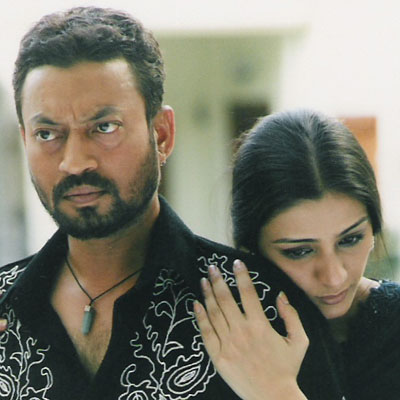
The parallels to Shakepeare are quite close, and appear throughout the film. 'Macbeth' (Maqbool) is played by a powerful actor named Irfan Khan (he also recently played the villain in Charas); 'Lady Macbeth' is played by Tabu, a big star. Irfan's performance is restrained and often understated, sometimes a little too understated I thought (or maybe I've just been watching too many melodramatic Hindi films). Tabu, also, is just naturally so likeable and charismatic that it's hard to read her as murderously evil. She is better later in the film as "mad" Lady Macbeth.

For the doomed 'King Duncan' character Bhardwaj invents a brilliant godfather figure named Abbaji (Pankaj Kapoor). Though Kapoor is borrowing heavily from Brando's Don Corleone (including the trademark mumble), Abbaji is actually a great character -- one of the best Desi Dons I've seen in recent years.

Macbeth is known as Shakespeare's "Scottish Play" because it is set in Scotland, which would have been faintly alien to his English audience -- hence the witches and surreal ambience of the play. Here the sense of alienness is represented by an intense attachment to Islam amongst the film's main characters. These gangsters don't just have Muslim names and say "Salaam" and "Khuda Hafiz" every so often (the usual Hindi film convention); they are very Muslim. They wear skullcaps, many have full beards, prayer beads, and they go heavy on the Urdu vocabulary. At some points, Bhardwaj even has his gangsters on the floor praying! In my view it's not especially offensive to Islam, since he treats it with respect. But it is kind of surreal.

Interestingly, the "witches" (played by the legendary character actors Naseeruddin Shah and Om Puri) are male Hindu cops in the employ of Abbaji. The prediction that Maqbool will succeed Abbaji comes from astrological predictions made by Om Puri's "Pandit."

I do find the Hindi film industry's obsession with the Muslim-dominated Bombay underworld generally offensive -- a nuisance rather than a reason to get up and leave the theater. The representation of Islam usually remains at a very general level, perhaps out of an awareness that more specific references would in fact cause problems. Most films aren't especially serious about religion one way or the other.

Here the image of Islam is so detailed, so over the top really, that I have to read Bhardwaj as trying to be serious. It's either more offensive, or not offensive at all(Islam is something essential to the story). Moreover, the casting of a Pandit in the role of Shakespeare's witches (though you only see the connection if you know Shakespeare's play) balances the equation a bit. For Bhardwaj, Hindu astrology is akin to witchcraft; Islam is the normative belief-system.

Overall, the Indianizations of dozens of plot-points from Shakespeare's play (including Macbeth and Lady Macbeth's numerous hallucinations, the plots involving Banquo, Malcolm, and Macduff, to mention just a few) will probably be enjoyable to people who know Shakespeare's play. People just looking for a gangster film will probably be more satisfied with something like Ab Tak Chhappan; Maqbool is much closer to horror.

India's Parliamentary Library, nice and quiet

Sheela Reddy's piece in this week's Outlook, explores the sad state of India's new parliamentary library.

The old library was just next to the Central Hall of Parliament House, and MPs and Rajya Sabha members used to go there all the time. The new building is much better -- Reddy describes it as India's "most expensive and best-equipped" library. But it's in a separate location -- so almost no one goes. There are at most 50 regular users, most of them Rajya Sabha (upper house) members. Members of the Lok Sabha (lower house), don't use the library virtually at all:

But old building or new, as both Biswas and Aiyer point out, the Parliament Library has few serious users. "There are only a handful of MPs who made good use of the library," says Aiyer. "I'd say about 50 members are serious users. Most of them are from the Rajya Sabha. This is because Lok Sabha members get caught up in local politics and very few are interested in serious debate or reading," agrees Biswas.

Which is a pity because, as Biswas says, the new library is ideal for reading. "It's more spacious, there is no noise, the books are well-organised and you can find so much material on any subject if you want to write something." Unfortunately, he adds, "few MPs have such interests."

Speaks for itself.

Fortunately, scholars can use the library in the Inter-session, but because of the bureaucratic hoops one has to jump through it is actually quite difficult to do so.

Edward Said's taste in music, W.B. Yeats's bones, Dylan Thomas's drinking problem

1. There's a new book of posthumous Edward Said essays, Humanism and Democratic Criticism. The review in Bookforum is helpful.

This looks like a good collection. As I myself drift further away from Foucault, the Foucauldian strains in Said's thought (especially in the early argument on "Orientalism") begin to seem fishy. I would be glad to see this other side of Said (i.e., Said the humanist) come to dominate.

Still, I'm not sure whether Said's personal taste in art is relevant (Matthew Price calls him a cultural conservative against conservatism). Does it really matter that he loved opera and was indifferent to popular culture? I'm also not sure whether the term "humanism" is of much use other than as the negation of theology on the one hand and Foucault and Marx on the other. To me, the emphasis on the human is a way of orienting an ethics; it makes less sense as a way of deciding questions of aesthetic value.

2. I enjoy reading reviews of biographies because they always give a capsule version of the life of the subject. This review of R.F. Foster's two-volume Yeats biography, is particularly good on that score. Volume I of Foster's bio has been out for years; Volume II: The Arch-Poet just came out last year. Yeats is a particularly tough subject, since he himself put up so much interference in autobiographical writings where he aimed to set himself up for mythologization. Ellmann was perhaps a little under Yeats' spell; Foster, Brian Phillips claims, is not:

This is especially true of Richard Ellmann, whose masterful biography Yeats: The Man and the Masks, has been since its publication in 1948 the standard work in its line; so Foster’s steady chronologies are trailblazers of a sort. Foster, who holds Oxford’s first professorship devoted to Irish history, is known in Ireland as a “revisionist” historian, a label meant to distinguish him from the “nationalist” historians who long controlled the field. The nationalists see a clear evolutionary line running through Irish history, in which the oppressed Gaelic nation, and especially its Catholic majority, gradually wins independence from English and Protestant oppressors, until at last it achieves self-rule in 1921. The revisionists, in contrast, emphasize the variety and plurality of Irish experience, including both its Protestant strains and those types of Irishness which are, in Seamus Heaney’s phrase, “alloyed with Englishness.” Foster’s exhaustive and detailed account, a miracle of interwoven sources, is his method of allowing the greatest multiplicity and range into his treatment of Yeats’s life; it is therefore its own means of analysis, arguing against simplistic reduction and in favor of a complicated wholeness. Yeats’s life, which overlaps with and involves most of the founding moments of modern Ireland—the death of Parnell, the Easter uprising, the creation of the Free State, the Civil War—provides a vast matrix of political, social, literary, military, economic, and religious contexts for Foster to explore, and is to that extent a natural subject for him, as Joyce’s life, say, would not be.

I side with the revisionists. I think it's important to talk about the Protestant contribution in Irish literature, as well as the strong English influence. But I'm not sure why Phillips feels that a contrast with Joyce is in order. Certainly, Joyce was not as personally involved with the "matrix" of historical contexts as Yeats. But Joyce's literature, especially Portrait and Ulysses, are full of references to key moments in modern Irish history. And we find from Joyce's biography (also by Richard Ellmann), that even in exile in Italy and Switzerland his attitude to British colonialism in Ireland was not irrelevant to his daily life.

Though obviously any serious Yeats scholar will have to reckon with Foster, the sheer bulk of these volumes makes me think I will continue to recommend the Ellmann bio to students and friends.

3. I was a little disturbed reading this review of a new biography of Dylan Thomas by Andrew Lycett. For one thing, some sentences in the review paint an extremely unflattering picture of Thomas the person:

In the hectic prewar atmosphere or amid the falling bombs of the London Blitz, there were always pub crawls, black eyes, broken arms and public shouting matches with Caitlin McNamara, whom he married in 1937 and who, aggrieved by her position as the stay-at-home wife, gave as good as she got in terms of loud resentful silences and foul-mouthed abuse. Caitlin was naturally belligerent, but a plea in mitigation might include the description of Dylan's working routine at the Boat House at Laugharne in Wales, a place without running water or electricity but with rats and damp: eight months pregnant with her third child, Caitlin was expected to light the stove in his working shed, then boil the water for his afternoon bath so he could sit in warm water eating sweets until it was time for the evening's drinking.

I see. Well, I hope the sweets were worth it?

Also disturbing is the fact that the reviewer (Lindsay Duguid) doesn't quote a single poem! (Compare to Brian Phillips' review of Foster's Yeats). In honor of Thomas, let me quote a poem that should have been in the review:

The Force that through the green fuse drives the flower (excerpt)
by Dylan Thomas

The force that through the green fuse drives the flower
Drives my green age; that blasts the roots of trees
Is my destroyer.
And I am dumb to tell the crooked rose
My youth is bent by the same wintry fever.

The force that drives the water through the rocks
Drives my red blood; that dries the mouthing streams
Turns mine to wax.
And I am dumb to mouth unto my veins
How at the mountain spring the same mouth sucks.

The full poem is here.

The power of a sub-title

Thanks to everyone who emailed me about the title change.

I decided to go with just my name. It's the least likely to become an annoyance of all the options I was thinking about.

Side benefit: in the process of adding in a "formerly..." message, I finally figured out how to add a little slogan under the main title in the Blogger template code. So whenever I get bored of "Amardeep Singh" I can just change the sub-title and put out a new message to amuse myself and hopefully one or two others.

So I can still use "Civilization and Disco," "The Whale," and, er, "Leonine Illumination" for a little while, without having to commit... Maybe a weekly rotation...

Time is a Lie: Before Sunset and the Power of Narrative

[We saw Before Sunset on Saturday at Bethesda Row Cinemas. It was only playing on 20 screens around the U.S. this past weekend, so unfortunately it may be hard for readers to find it.]

"Time is a lie," Jesse declares, in response to a question from one of his readers. "It's all happening all the time."

This film is somewhat Joycean; the date of the original meeting between these two characters in Before Sunrise was June 16, 1994 (Bloomsday 90); this film comes out shortly after Bloomsday 100.

But it's Joycean mainly in its emphasis on the power of immediacy to crystallize meaning. Richard Linklater (actually, read this) uses the space of Paris primarily as a kind of dry chalkboard, where nothing particularly intrudes on the intimate space of a conversation between two people who spent a night together nine years earlier. There are no noisy chattering drunks, no deus ex machina (i.e., the usual: car crashes, murders, or rain) to force the characters to a surprising end. And there is nothing particularly to smell, taste, or touch outside of the two faces that fill up the screen. In this way of telling the story, Ulysess would only be 80 pages long.

But of course a lot has changed, and the film is full of subliminal reminders — the flowing waters of the Seine, the shadows that lengthen in the golden Parisian light, the implacable movement of celluloid through the projector — that time runs in one direction, and eventually runs out. (A.O. Scott)

In the sense that narrative is always about time, maybe this film is a meditation on narrative itself. In order for an event to become a story that can be told, it has to end (one night, nine years ago, in Vienna). In this sense, we always want stories to end, even if that ending is a kind of death.

But what is a narrative's shape actually? What makes what happens (in life) special when you filter out nostalgia and sentimentality? What makes a story anything other than a simple sequence of events?

There is a myth that stories are distractions from the real, but that couldn't be further from the truth. Really good stories can have a crystallizing power, and offer a lens that a reader or viewer can continue to wear once the lights come back on. A story can then offer a clarifying perspective on the mess one struggles with every day.

Of course, the conditions have to be right. Expectations have to be moderate: just as in games that require you to put a ball in a certain place on a field or a court, you can easily psych yourself out of actively experiencing narrative by expecting too much. Also, people have to be receptive to the story they're hearing. One can't be constantly worrying about one's job, or what people sitting somewhere nearby will think. Also, one has to truly be listening, not thinking of the next clever thing to say (or: what will I write about this on my blog?). A powerful story does require a skillful storyteller, but it is equally important that the audience be both receptive and a little selfless -- open to lives lived differently, and an inexplicable flow of events.

The event may be over (romance), and even the telling of the event may be over (a conversation about an old romance), but the story continues to work as one sees the world through new eyes. Yes, this film is saying, why not? Yes.

Time for a Title Change? James Wood, Orwell, Rushdie... and Disco

It might seem odd to think about changing my title at a time when this blog is becoming a little more widely known, but that's just what I'm thinking of doing.

I originally got "No False Medicine" from an essay on Matthew Arnold in James Wood's book The Broken Estate. He used it to describe Christianity in Europe in the 19th century: "Ernest Renan and Matthew Arnold are the chief nurses of the sleep of nineteenth-century Christianity, and in their work one finds much false medicine."

But even in choosing such a combative title, I was trying to be subtle. After all, the above sentence follows a paragraph where Wood reads the secularization of western European culture in the 19th century as a bit of a tragedy:

But the moment at which Jesus became the hero of a novel, of a 'prose-poem,' he also became fictional. The old estate broke. Jesus lost his divinity, became only an inspiring fantasist. We may wonder what use Jesus is if he is a figure no different from Socrates on the one hand and Daniel Deronda on the other. Why should we heed his difficult words, what is the flavor of his command once the taste for his authority has evaporated? Secularists perhaps relish that point in intellectual history at which Christianity loses its theological prestige and begins to fall into the secular ranks. Yet, intellectually, a new pettiness was the first replacement of the old, divine Jesus, and it is hard not to lament the passing of actual belief when it is replaced with only a futile poetry. Christianity was not, of course, shoveled away, it was coaxed into sleep by nurses who mistakenly thought that they were healing it.


For Wood, people like Matthew Arnold were effectively non-believers. They wrote a species of theology (for instance, in the advocacy of maintaining the Anglican Establishment), but it did more harm than good to sincere Christian thought.

Wood is not against secularization per se, though it seems to me he would rather have what he might call real medicine than no medicine at all. Rather, he sees this moment of transition as particularly cynical, a chaotic clash between pseudosecularists and pseudo-Christians that mainly led to very little of lasting value.

That's what I was thinking about three and a half months ago when I started this blog. I still like the reference to the debates on secularization, and I see them as operating today in many different parts of the world (India, England, France, and the U.S., to name just a few). But I'm tired of the grammar of the title, which is a drag. The negation of the false (the "No..." in "No False Medicine") isn't primarily what this blog is about. It's probably more correct to describe what I do as deliberative thought than as rhetorical combat.

For a new title, I want something distinctive, but a little more open to, say, a day at the beach.

Options for a replacement title:

--Just "Amardeep Singh." Simple. Open. Many people do this; it works just fine.

In Punjabi and Hindi, my first name means "Eternal Light." My last name means "Lion." So a possible comical subtitle might be "The Illuminated Lion." Or: "Leonine Illumination."

--"SinghBlog" I'm actually taking this seriously even though it smacks of policy wonkdom. I admire the bloggers who bring aspects of their professional expertise to their blogging (especially the left-leaning law bloggers); it gives me insight into what they do and how they think. Sometimes this can lead to "boring" discussions of interest primarily to people comfortably within a field. Still, if I'm imitating "Oxblog" and dozens of others, that might not be the worst thing in the world.

--"The Fold." This is a theory reference -- to a book by Gilles Deleuze. I'm actually not that fond of the book (like much writing by Deleuze, I've never been able to make much sense of it), but I like the suggestiveness of this title. A little.

--"Civilization and Disco." A joke on Freud's Civilization and Its Discontents. I once went to a party thrown by some clever Cornell graduate students with this title, and it has stuck in my head as an example of the value of cleverness.

--"Both Sides of the Whale." This is a reference to a series of essays, by George Orwell, Raymond Williams, and Salman Rushdie. In the 1930s, George Orwell wrote an essay called "Inside the Whale," defending Henry Miller. The "whale" in the title is the sweep of current events, and "inside" and "outside" refer to differential responses to the demand for artistic responsibility. After two decades where serious artists positioned themselves radically outside of the mainstream, in the 1930 authors began to return to a more bourgeois, less oppositional approach. As Orwell put it:

Progress and reaction have both turned out to be swindles. Seemingly there is nothing left but quietism--robbing reality of its terrors by simply submitting to it. get inside the whale--or rather, admit you are inside the whale (for you are, of course). Give yourself over to the world-process . . . simply accept it, endure it, record it. That seems to be the formula that any sensitive novelist is now likely to adopt.


In 1984, Rushdie wrote a response he called "Outside the Whale," arguing passionately against what he saw as Orwell's acquiescence to quietism. Rushdie argues that intellectuals should make "the very devil of a racket":

The truth is that there is no whale. We live in a world without hiding places; the missles have made sure of that. However much we may wish to return to the womb, we cannot be unborn. So we are left with a fairly straightforward choice. Either we agree to delude ourselves, to lose ourselves in the fantasy of the great fish, for which a second metaphor is that of Pangloss's garden [a reference to Voltaire's Candide]; or we can do what all human beings do instinctively when they realize that the womb has been lost for ever -- that is, we can make the very devil of a racket.


Of course, Rushdie may be misreading Orwell: Orwell's reference to quietism is in indirect quotation. And from what we know of Orwell's lifelong political and ethical passions -- see my posts for the past week -- it hardly seems correct to accuse him of quietism. Rushdie and Orwell are in agreement far more than Rushdie thinks; really they are both outside the whale. (Or perhaps there is no whale.)

Still, if we accept that both sides have some value, the "Both Sides" in my proposed title suggests there can be a dialogue between the avant-garde (outside) and the mainstream, "realist" (inside) positions. I like that; it sounds like me.

There is of course a grammatical problem with "Both Sides of the Whale" -- whales don't have sides. I really mean something more along the lines of "The Porous Membrane of the Whale," but that sounds too precious.

Maybe just "The Whale"?

Suggestions? Email me or comment. Thanks!

Nifty Gmail features

Via Jivha (typical), I've been downloading Nilesh's list of nifty Gmail add-ons and plug-ins.

The best, far and away, is the Gmailto: feature. I'll be experimenting with the others, but slowly.

Btw, I have four Gmail invites to give away; Email me if you'd like one.

Poet Vijay Seshadri-- Interviews and Poems

An interview with poet Vijay Seshadri, in Poets and Writers. He talks about the mistake many young people make of trying to write like Beckett or Pynchon, and about the evolution of his approach to writing poetry.

See also: The Disappearances (originally appeared in The New Yorker two weeks after 9/11 -- it's actually on the Kennedy assasination). See also this online-only New Yorker interview

More Poems:

The Reappaeared (Contemporary Poetry)
Lifeline (Contemporary Poetry)
The Scholar (Dia Center)
Interview (Paris Review)
The Long Meadow (Poets Daily)
Superman Agonistes (WNYC; scroll down)

On the air:

WNYC interview

Class and Empire: George Orwell's The Road to Wigan Pier

[Let's take a break from criticizing George Orwell, in order to read him carefully, and perhaps praise him a bit.]

George Orwell published The Road to Wigan Pier in 1936, shortly before he went to Spain to fight for the Republican cause. It's a book that mainly only Orwell scholars read regularly these days, but I've found it to be an incredibly satisfying read. The first half is the more gripping from a narrative point of view -- Orwell provides detailed, first-hand accounts of what life is like in the industrial north in the 1930s (a depressing decade). The chapter on coal-mining has a visceral heft, and the chapter on housing conditions in towns like Wigan is horrifying.

The second half of the book is a challenging, self-referential meditation on socialism. Orwell's arguments are partly based on his direct experiences of people suffering under the effects of industrialized capitalism. But in another way his ideas are based on himself; class is as much about origins as it is about income. In England especially, class doesn't wash off easily; the business about accents, for instance, is still an issue today.

Orwell was from a modest background economically; his father Richard Blair worked as a low official in Burma and then in India. Orwell (real name: Eric Arthur Blair) went to school on full scholarship, and from that point on had the education, taste, and the accent of a gentleman. It colored every aspect of his life: Orwell's acquaintances recorded his scrupulosity with regards to dress and decorum, sometimes with great amusement.

Orwell begins his critique on class and socialism in The Road to Wigan Pier with a meditation on his personal experience of imperialism, an institution he felt to be profoundly evil. There are revealing passages like this:

The truth is that no modern man, in his heart of hearts, believes that it is right to invade a foreign country and hold the population down by force. Foreign oppression is a much more obvious, understandable evil than economic oppression. Thus in England we tamely admit to being robbed in order to keep half a million worthless idlers in luxury, but we would fight to the last man sooner than be ruled by Chinamen; similarly, people who live on unearned dividends without a single qualm of conscience, see clearly enough that it is wrong to go and lord it in a foreign country where you are not wanted.

This is a simple observation, but I think it's important, as it sets the stage for Orwell's turn, in his own developing intellectual life, to the matter of class. Before I get into that, I wanted to quote another passage, which speaks to the putative beneficial effects of Empire -- a subject that has recently been brought into view again because of Niall Ferguson's work (especially his book Empire). Orwell was in some way sensible to the possibly beneficial effects some of his colleagues were having on the colonies:

So far as my observation goes nearly all Anglo-Indian officials have moments when their conscience troubles them. The exceptions are men who are doing something which is demonstrably useful and would still have to be done whether the British were in India or not; forest officers, for instance, and doctors and engineers. But I was in the police, which is to say that I was part of the actual machinery of despotism. Moreover, in the police you see the dirty work of Empire at close quarters, and there is an appreciable difference between doing dirty work and merely profiting by it.

The exposure to the enforcer's side of empire gives the lie to its idealism. (I'll probably have more to say about this when I blog on Ferguson's work sometime soon.)

The thing about class -- and the same could be said, I think, of capitalism itself -- is that it's all very well to identify its pernicious effects, but it's another thing entirely to actually eradicate it as a social reality. Orwell was suspicious of revolutionaries who didn't themselves know people of the working class, and who in their thinking often reinforced their own privileged class status. As he put it,

We all rail against class-distinctions, but very few people seriously want to abolish them. Here you come upon the important fact that every revolutionary opinion draws part of its strength from a secret conviction that nothing can be changed.


I think more than a few people of the left in the U.S. would have to secretly admit that they wouldn't want to sacrifice their comfortable standard of living to ensure that people in Bangladesh, say, had access to housing, clean water, and electricity. It would be more honest to say, with Orwell, that we are actually pro-Capitalism while also being (hopefully) pro-Justice. Supporting the idea of regulated free markets doesn't preclude an emphasis on social welfare, or on the distribution of wealth. But it does require that we respond to the fact the current economic system works.

[This applies to the current conjuncture in another way: I personally find some of the more doctrinaire Marxist arguments against globalization to be insupportable. And yet, there are few on the left who are willing to say they embrace a form of globalization. I think it's time to pursue humane alternatives to Marxist models of critics like Hardt and Negri. Right now there aren't too many.]

In the 1930s revolutionary socialists and communists were quite a bit more mainstream in English and American intellectual life than they are today. Orwell knew their arguments intimately, and sympathized deeply with their goals. Indeed, the first half of The Road To Wigan Pier is a blistering attack on the harsh working and living conditions of the English working class of his day. And yet he felt that intellectualized socialism, with its emphasis on absolute mechanization and total efficiency, was somehow deeply dehumanizing. In this book, as in Animal Farm, Orwell develops no 'strong' (as in ideologically coherent) economic arguments as a counter to Marx and Engels. Rather, what replaces socialism is a kind of humanist pragmatism. That is how I read it anyways; Orwell himself continued to use the language of ideals:

The only thing for which we can combine is the underlying ideal of Socialism; justice and liberty. But it is hardly strong enough to call this ideal 'underlying.' It is almost completely forgotten. . . . The job of the Socialist is to get it out again. Justice and liberty! Those are the words that have got to ring like a bugle across the world. For a long time past, certainly for the last ten years, the devil has had all the best tunes [here he is referring to Fascism]. We have reached a stage when the very word 'Socialism' calls up, on the one hand, a picture of aeroplances, tractors and huge glittering factories of glass and concrete; on the other, a picture of vegetarians with wilting beards, of Bolshevik commissars . . . Socialism, at least in this island, does not smell any longer of revolution and the overthrow of tyrants; it smells of crankishness, machine-worship and the stupid cult of Russia. Unless you can remove that smell, and very rapidly, Fascism may win.

Despite his stated desire to "return" to the ideals of Socialism, what Orwell is really doing is criticizing the intellectual tendency to idealize. And he is doing it for a practical reason -- the urgent need to respond to Fascism.

Orwell is ideologically inconclusive; he doesn't provide a road-map even for his own times, much less our own. What he does offer, however, is an example in rigorous moral thinking. He was willing to fight for his country (and for other countries) when the cause was just. And he wasn't just playing: in Spain, he shot at the enemy, and probably personally killed some people. For that reason he's been championed by liberal hawks of the present era, most notably Christopher Hitchens (see Hitchens' book Why Orwell Matters for more on this).

But this is not the only way to read Orwell. I have to believe Orwell would have drawn back from the cynical reasoning, distortions, and padded arguments that led the Blair and Bush to the current war in Iraq. Here Orwell as an anti-Imperialist thinker trumps Orwell as a pro-Just War thinker; he belongs to the Opposition much more than he does to the Administration.

Daily Show v. Cheney; suggestion for the DNC

I've been championing Michael Moore, but this guy comes up with the goods every day.

Right click and save (via Saheli)

It's more effective than any campaign ad the Dems. will ever write. Indeed, I often wonder why they don't just steal Daily Show ideas in their ads...

Shells at Sunset, Lighthouse Point Park, New Haven

Shells at Lighthouse Point Park, New Haven CT. Some parts of the beach are entirely covered in shells.

And this one, with the water coming in.

Beat that, S/FJ.

Don't apotheosize George Orwell! (Or, more on Michael Moore)

Reader Kumar has challenged my suggestion that there might be a similarity between George Orwell and Michael Moore.

I stand by it, though I think my earlier characterization was too simple. Orwell is certainly great by a different standard than Moore ever will be: in the 1930s, Orwell put his money where his mouth was and went to fight (though not so much in actual combat) against the Fascists in Spain. He also put in his time aiding the British war effort against the Germans -- hero material, to be sure.

But he also changed his mind -- sometimes radically -- and made some mistakes. Two biographies of him have come out in the last couple of years, both apparently foregrounding his intellectual inconsistencies and contradictions. (I've read some of D.J. Taylor's Orwell: The Life, but I've heard that George Bowker's Inside George Orwell is pretty good too.) Here is a helpful summary of the crux of Orwell's transformation from the New York Times review by Benjamin Schwarz:

Yet neither succeeds in placing Orwell in the context of the fierce political atmosphere of Britain in the 1930's -- when the future of liberal democracy seemed very much in doubt -- which means that Orwell's own protean political views go largely unelucidated. Neither author, for example, notes, let alone explains, Orwell's rapid transformation from an antiwar anti-imperialist (as late as July 1939 he suggested that British imperialism was "just as bad" as Nazism) to a doughty English patriot.

Reminds one a little of the liberal hawks (Christopher Hitchens and Paul Berman) after 9/11, doesn't it? It even reminds me, in a certain way, of Michael Moore's "patriotic" turn in the second half of Fahrenheit 9/11.

But let's continue with Schwarz:

As that shift suggests, Orwell's views were, depending on one's perspective, evolving or inconsistent -- or both. . . . Bowker and Taylor each lay out Orwell's myriad -- and largely familiar -- intellectual and political contradictions. A man of the left, he turned to socialism largely because he thought capitalism was destroying the traditional decencies; as his friend Cyril Connolly said, Orwell was "a rebel in love with 1910." Although committed to the reformation of Britain's class-bound society, Orwell put his infant son's name down for Eton. This anti-imperialist former imperial policeman combined the cosmopolitan and the parochial. His mother was half French (Orwell wrote his first article in French); he fought in Spain under the banner of international socialism; he championed Henry Miller. But his intense attachment to England led V. S. Pritchett to remark that Orwell had "gone native in his own country": when venturing onto the Continent, he was gripped with fear at the prospect of being unable to find "proper" tea. And, as both biographers keenly emphasize, Orwell the devout nonbeliever held that the loss of faith had left modern man spiritually bereft and ethically bankrupt. (Orwell, who always displayed an intricate knowledge of ecclesiastical matters, left instructions in his will that he be buried according to the rites of the Church of England.)

But perhaps the most important thing:

In 1949 Orwell gave to an object of his affections who worked at the Foreign Office the names of Communist sympathizers who couldn't be relied on to write pro-British propaganda. (The complete list was revealed only a few months ago.) Bowker and Taylor point out that Orwell wasn't advocating state suppression or harassment of the people on his list; he merely, and sensibly, suggested that they shouldn't be asked to write for the anti-Communist cause. Moreover, another crucial (and alas still not yet obvious) distinction should be remembered: as Orwell consistently stated, leftist progressivism and a commitment to social justice are not the same as -- are, in fact, the very opposite of -- Communism. Orwell believed the people he named (usually correctly, occasionally erroneously, seldom recklessly) served or sympathized with a murderous state and an ideology that was rotten to the core. (In the early days of World War II Orwell kept a list of those he suspected of being Nazi sympathizers. How many critics today would hold that had Orwell shared that list with the Foreign Office he would have acted wrongly?)

This is the part where one's jaw drops open. The author of 1984 ... and he's naming names? Granted, it's not evil like Elia Kazan and the Hollywood Blacklist -- no one, as far as I know, lost their source of livelihood due to Orwell's list. And I don't particularly hold it against him given his two great novels and many wonderful essays ("Killing an Elephant," "Homage to Catalonia," "Politics and the English Language," "Inside the Whale"). The balance comes out overwhelmingly pro-Orwell. But the incident reminds me that Orwell was all too human -- his ideology led him to some serious moral errors.

Ok, I've hopefully brought Orwell down to size a bit (though I realize everything I've said may be arguable). But how to raise Moore, who is by anyone's estimation a bit of a clown?

If you read recent history the way I do, Moore has stepped in to deflate a state of 'manufactured consent' gone horribly awry. In this case, the hysteria following 9/11 enabled the Blair and Bush to start a preemptive war in Iraq on spurious grounds. WMD and the Saddam-Al Qaeda 'link' were lies that managed, through constant propaganda, to attain the status of truth. Moore is adding up all the contrarian evidence (especially from Richard Clarke and the 9/11 Commission hearings), and torn a great big rip in the mainstream consensus on the war.

[Note: In my view, we should throw out the Bush/Saudi conspiracy stuff in the film. What is important is the way the administration has milked the terrorist attacks to justify the invasion of Iraq.]

And Moore has done it without the aid of a political party apparatus or other institutional (read: academic, journalistic) credentials -- basically just a video camera and the $30 million he made on his last splendidly muckraking pseudo-mentary. It's because of that that I feel he is a remarkable public intellectual -- an 'everyman' against the war machine.

Sanjay Subrahmanyam on Nandy: secularism, convivencia, millet system...

Read this Sanjay Subrahmanyam piece on Ashis Nandy. It's yet another rejoinder to Nandy, who didn't help his case much with his recent rejoinder to the rejoinders.

It should be no surprise that I place myself on the pro-secularism side of the fence, and I agree here with Subrahmanyam that Nandy has been essentially repeating the same idea for 15 years, without much increase in depth or breadth. I also feel strongly, contra Nandy, that "secularism" is very much an essential Indian word, and an essential Indian political strategy. The use of the term is by no means a sell-out to British colonialism. If anything, it is a bow to the reality of modern India.

That said, there are a couple of moments in Subrahmanyam's essay that raise questions for me. The first problem comes with Subrahmanyam's characterization of secularism in the west:

In point of fact, the term 'secularism' has very little purchase in most European or indeed other western societies as a part of normal political vocabulary. Even today, no one in the political sphere much talks about 'secularism' in the United Kingdom, Germany, Italy, France, Spain or Portugal or in the United States, Argentina, or Brazil. Neither Tony Blair nor Mrs Thatcher has ever used the word in a speech that I can remember. The only Europeans who use some sort of term like that are the French, with their idea of laïcité. But the French did not mean this term to be one that mediated between religious groups. Rather, it had to do with separating the state from one particular religion, Catholicism, in the French Revolution and its aftermath, leading up to the well-known Separation Act of 1905. This is not quite the same thing as 'secularism'.


Here Subrahamnyam is attempting to question Nandy's alignment of "secularism" with Europe. To begin with, I have a quibble with his characterization of laicité in France, which was undoubtedly implemented in its final form in the 1905 Constitution as a way of reducing the influence of the Catholic Church. But it occured as a result of Catholic anti-Semitism -- the Dreyfuss Affair -- and as such, ought to be understood as the state's recognition of the rights of non-Catholics. It is, after all, a way of "mediating" between religious groups.

Secondly and more substantially, while it may be true that western leaders today don't use the word "secularism" that often in their speeches, it's simply untrue that the concept is irrelevant to western politics. In fact, secularism (specifically understood as separation of church and state) is one of the hot-button political issues here in the U.S., with the Supreme Court's recent "Under God" ruling as the most prominent recent example. Also, the Hijab ban in France -- where a different definition of secularism is operative -- is spreading. Similar bans are being introduced in the Netherlands and Germany; the Hijab is likely to become a pan-European issue. And secularism has been an issue in the E.U. debates about whether there should be a reference to God in the E.U. Constitution.

Subrahmanyam's basic point that Nandy is oversimplifying secularism in the West is certainly correct, but his support for that claim is misplaced. Secularism in the West is still being ironed out. For new religious minorities, it is in fact still in the process of emerging. Therefore, the real reason to de-link the west from "secularism" is that the concept is constantly being revised, and the new meanings of the term have very little in common with the meaning of the term in India.

Secondly, I have a question about Subrahmanyam's rejection of Nandy's idea that India substitute the Spanish convivencia for "secularism":

Nandy appears at his worst when he wishes pompously to hand out lessons. He wants others to learn from "the concept of convivencia that apparently existed in medieval Islamic Spain. Did anybody in Islamic Spain ever use this "concept"? So far as I know—and I have studied the history of Spain in that period unlike him—no one did. This idea was imposed on the Spain of that period by romantic modern historians, and it is no more indigenous to it than 'secularism' is to Mughal India.


While I can't claim to be as knowledgeable about this as Subrahmanyam, I have seen references to religious tolerance in medieval Spain in many different books. (A good, lay introdution to the topic is Maria Rosa Menocal's The Ornament of the World. It's a pleasure to read.) Again, while Subrahmanyam may be right that substituting "convivencia" (living together) for "secularism" is absurd, he doesn't need to bother with Nandy's terminological speculations, which are irrelevant.

The real reason the medieval Islamic model of tolerance isn't sufficient is that the Umayyad dynasty in Spain and the Ottoman empire's millet system were not designed to rule democratic nation-states. "Tolerance" might work in a loosely organized empire, where the rulers care mainly about tax and tribute. But secularism is necessary for a nation-state, where there is a requirement that the state protect the civil rights of its citizens. (This argument is made in Michael Walzer's book On Toleration.)

New site: Shobak.org ("Outsider Asians")

I was happy to discover this site this morning: Shobak.org.

I especially like this piece by Amit Rai on the representation of Muslims in Bollywood. Rai is an acquaintance of mine -- he has a particularly impressive ability to decode the 'weird' stuff in Hindi films. His essay here also extends the discussion introduced in Farah Naqvi's response to Dev in the Times of India (see my earlier post on this here)

There are many other essays on the site worth checking out...

New Haven block party -- Ninth Square street mural

There was a small block party outside my apartment on Saturday.
There was a good band (I didn't catch their name).
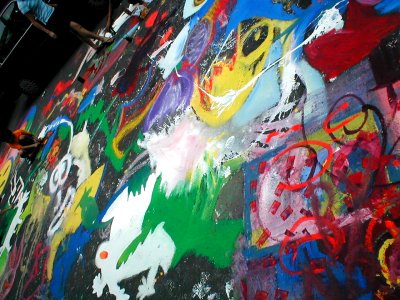
Also, people made a big mural out in the middle of the street:

Expressionist chaos!

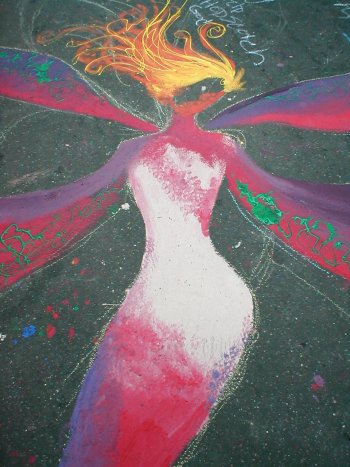
And I also liked this figure: