A Non-Encounter With Salman Rushdie

Amitava Kumar is currently at Vassar College, and Salman Rushdie was recently scheduled to be a guest speaker. (We had him at Lehigh ourselves about four years ago.) Amitava, as an accomplished critic and essayist, was suggested by the college to introduce Rushdie, but Rushdie apparently vetoed it [**see update]:

Salman Rushdie came to Vassar College earlier this week to deliver a lecture for the Class of 2010–but he made it clear to the organizers that he would cancel if I was involved in his visit. I had earlier been asked to introduce him, and then, well, I was disinvited. Mr Rushdie and I have never met, although I have heard him speak several times. I presume his dislike of me has to do with essays like these that I have written about him in the past. (link)


The essay Amitava links to is a long, partly sunny and partly sour critique of Rushdie, ending with a review of Shalimar the Clown. I think Amitava's best point is probably the following:

The trouble is that despite all his invention and exuberance Rushdie remains to a remarkable extent an academic writer. He is academic in that abstractions rule over his narratives. They determine the outlines of his characters, their faces, and their voices. Rushdie is also academic in the sense that his rebellions and his critiques are all securely progressive ones, advancing the causes that the intelligentsia, especially the left-liberal Western intelligentsia, holds close to its breast. This is not a bad thing, but it should qualify one's admiration for Rushdie's daring.(link)


It's true, many of Rushdie's best, most memorable lines are actually socio-historical commentaries, or nuggets of cultural criticism that could very well come from a professor (though they wouldn't sound as nice). Of course, Rushdie isn't alone in this, and it might be unfair to be overly harsh about academicism, since academic ideas about the fragmentation of the self and problems of nationhood and nationalism have been widely and generally influential. Lots of novelists are discussing issues that are also being discussed at academic conferences. (Indeed, more than a few well-known novelists are themselves academics, to pay the bills -- writing don't pay that well.)

But one can contrast Rushdie's nuggets of cultural criticism (which are especially prevalent in his later fiction) with deeply felt characterization or a personal, human touch. Vikram Seth, who is sometimes named as a protege of Rushdie, has perhaps gone beyond him, both in A Suitable Boy, and in the marvelous personal memoir Two Lives (a much riskier thing to write and publish than a topical novel like Shalimar). Rushdie is still pretty much Mr. Postcolonial, but is he necessarily Mr. India? (Are there term-limits?)

Despite the criticisms, no one can take away from what Rushdie has accomplished as a writer and as a principled public figure over the years, and Amitava acknowledges this at points in his essay as well as in the introduction he had planned to give:

I guess I would be speaking for a lot of readers, particularly in those parts of the planet that used to be called the Third World, who saw Mr Rushdie as having fought and won against, and made an ally of, the English language, the alien language that had come to us with our colonial rulers. Mr Rushdie has had to fight many other battles since; he has made many friends and enemies; and we (I’m speaking as an Indian here) we, as his readers and as writers, have followed his actions, his songs, his mannerisms, and even when we have chosen not to follow him into the sunset, we’ve always had to define ourselves, and our rebellions, against this image we have had of him, looking down at us from giant billboards at each street-corner of our past. (link)


Perhaps a bit passive aggressive? At any rate, nicely put.

[**Update: it appears that Rushdie himself has shown up in the comments to Amitava's post. Rushdie claims that the decision to disinvite Amitava was the college's not Rushdie's, though he affirms that he "refused to share a stage."]

A Research Project: Hinduism in Fiction

I was recently invited to write an essay on "Hinduism in Fiction" for a big Hinduism anthology that is being put together by comparative religion scholars.

It's a difficult topic because it's so broad, and one has to divide the focus between Hinduism in the abstract (as a set of religious practices and beliefs), and Hinduism as an evolving social identity in the context of historical phenomena: British colonialism, the nationalist movement, various reform and revival projects (Arya Samaj and Brahmo Samaj), Partition, and the rise of contemporary Hindu nationalism post-independence. Most representations of "Hinduism in fiction" tend to be in novels and short stories that are most concerned to engage those historical events, especially the reform movements, the partition, and contemporary communalism. Fewer Indian novelists have aimed to consider Hinduism in theological terms (though some have). That's pretty much as it should be -- prose fiction only came of age in India after British colonialism and Christian missionaries had made their presence felt -- but it might not be the whole story.

Here are some of the authors it seems appropriate to talk about in the essay:

19th Century and early 20th century:

  • Bankim Chandra Chatterji (Chattopadhyay)
  • British colonial writers like Kipling and Forster (these writers had a major impact on how Hinduism was perceived by both the broader world and often by Indians themselves; many Indian writers wrote in response to Forster, for instance).
  • Rabindranath Tagore (Gora stands out as a book where competing
    definitions of Hinduism are discussed in the context of the rising nationalist movement in the Swadeshi era)
  • Mulk Raj Anand
  • U.R. Anantha Murthy (Samskara)
  • Premchand (Godaan, short stories like "Sujan the Devout")


Contemporary and Postmodern:

  • Salman Rushdie's Midnight's Children
  • Ashok Banker's Prince of Ayodhya fantasy novels
  • William Buck's re-imagining of the Ramayana
  • Githa Hariharan, In Times of Siege
  • Manju Kapur, A Married Woman
  • Diasporic representations of Hinduism: especially V.S. Naipaul.


I'm curious to know whether people would suggest other authors who might be good, or have favorite passages or books that have interesting things to say about Hinduism, either as a social identity or as theology/philosophy. (If I use your suggestion you'll get an acknowledgment in the essay and a copy of it when it's published.)

"Imagining South Asia" -- a journal CFP

I'm co-editing a special issue of South Asian Review with Kavita Daiya of George Washington University, and I wanted to throw it out there in case any readers have an interest in submitting something. The topic is "Imagining South Asia," and the goal is to look critically at the tension between regionalism and nationalism in South Asian literature, film, and the arts. Do people really mean "South Asia" when they use that term, or is it a tokenistic kind of regionalism? It's a kind of update on the Imagining India Ronald Inden wrote about some years ago. Here's the actual call for papers:

The South Asian Review, the refereed journal of the South Asian Literary Association, is soliciting essays for the 2007 Special Topic issue, volume 28, Number 1, devoted to “Imagining South Asia.” It examines the category of “South Asia” as a theoretical concept in literary and cultural studies. “South Asia,” an Area Studies term that came into wide usage during the Cold War, has wide purchase in the social sciences, but is sometimes questioned in studies of both modern and pre-modern literature and arts of the Indian subcontinent. Is the Area Studies term obsolete? Is it possible that many contemporary writers in India have more in common with their postcolonial peers in Kenya, South Africa or England than with those in Pakistan, Bangladesh or Sri Lanka? Do postcolonial writers imagine “South Asia” as a viable construct with the same degree of intellectual focus and creative energy as applied to particular national contexts? One could argue that the value of the term “South Asia” seems to be closely tied to diasporic writing and the recent spurt in such cultural artifacts as movies that have achieved success around the world in recent years. To what extent might "South Asian culture" be a product of diasporic consciousness?

SUGGESTED TOPICS: Some suggested topics (by no means exhaustive) that could be explored include the issue of India-centrism and the use of “South Asia” as a tokenizing category; the perspective of writers from South Asia's smaller countries on the category; the construction of national literary canons and South Asian Literature, in the subcontinent and/or diaspora; the history and politics of “South Asia” in literary and cultural studies, and/or in diasporic lives; the use of “South Asia” in the context of the Partition, uneven globalization and the “War on Terror;” the challenges and politics of “Imagining India” vs. “Imagining South Asia.”


If you're even remotely interested, we would love to hear inquiries and proposals from you. (Send me an email and I will forward it to Prof. Daiya) Also, even if you don't think you could submit, I would be curious to hear any comments or suggestions on the topic.

The deadline is January 30, 2007.

Sikh Art @ the Rubin Museum

I've been getting lots of tips today about the early Sikh art exhibit opening today at the Rubin Museum of Art in New York. There is a surprisingly effusive review of the exhibit by Holland Cotter up at the New York Times:

But what about Sikhism itself? Few Westerners have even basic information.

How many people are aware that it was conceived as a universalist, open-door religion?

Or that its view of society was radically egalitarian? Or that its holy book, the Adi Granth, far from being a catalog of sectarian dos and don’ts, is a bouquet of poetic songs, blending the fragrances of Hindu ragas, Muslim hymns and Punjabi folk tunes into a music of spiritual astonishment?

This is precisely the information delivered by the small and absolutely beautiful show titled “I See No Stranger: Early Sikh Art and Devotion” at the Rubin Museum of Art in Chelsea. Vivid but concentrated, it presents, mostly through paintings, a culture’s version of its own origins, the image of history shaped far more by hard work, pluralistic politics and mysticism than by militancy.(link)

All very admirable and correct. The only thing I find a little odd is that the review is less an evaluation of the art in the exhibit than it is a summary of the basic points about Sikhism covered. For Cotter, the art is more a vehicle for acquiring knowledge than beautiful in its own right. Not a great tragedy, perhaps; in fact, even this short article is pretty informative. But still, it might have been interesting to hear more about how or whether this art fits into the broader picture of religious art in the Indian subcontinent during this historical period. (Call me an academic, but the question crossed my mind.)

The other slightly odd moment is this:

The painting is paired in the show with the workshop drawing, produced by a master artist, that served as its model. The contrast is striking. In the drawing the prince, far from being restrained, practically levitates from his saddle with ardor and leans toward Nanak as if drawn to a magnet. Mardana plays and sings with fervor of a contemporary bhangra star. It is in the drawing, rather than in the painting, that the Nanak Effect, so evident in poems and songs, comes through. (link)

Bhangra, huh? Not quite, Cotter-saab. Bhangra is secular, festive, and pro-intoxication. Nothing at all to do with Bhai Mardana. Still, this is a forgivable slip; Holland Cotter is a dedicated art critic, and as far as I can tell this is the first time he's ever written on Sikh-related art.

Incidentally, the Rubin Museum is doing an extensive array of programs to coincide with this show, including Sikh-related film screenings (organized through the Spinning Wheel Film Festival folks) as well as lectures.

Section 377/ Homosexuality in India

The writer Vikram Seth, along with a group of activists, recently signed an open letter directed to the Government of India and the Delhi High Court, asking it to repeal Section 377 of the Indian Penal Code. This is the section that prohibits sexual relations between men as well as other "unnatural" acts. Amartya Sen has put out a follow-up open letter with dozens of prominent Indian intellectuals and celebrities signing on.

Human Rights Watch put out a report in 2002 criticizing the law because it weakens efforts to mobilize against AIDS. In the NYT Somini Sengupta mentions that the government's own National AIDS Control Agency has stated that the law hampers AIDS prevention and treatment programs.

The key actor in all this a group called the Naz Foundation India Trust, which sued the government in 2004 to request the repeal of the law. The case was initially refused by the Delhi Court, but the Indian Supreme Court required the Delhi Court to examine the case on its merits. The next hearing is scheduled for October 4. The recent agitations seem to be oriented to influencing the outcome of these particular hearings.

For reference, here is the text of the 1861 law:

Whoever voluntarily has carnal intercourse against the order of nature with any man, woman or animal, shall be punished with imprisonment for life, or with imprisonment of either description for a term which may extend to ten years, and shall also be liable to fine.

Explanation- Penetration is sufficient to constitute the carnal intercourse necessary to the offence described in this section. (link)

This is a very bad, outmoded law. It is, for one thing, euphemistic to the point of absurdity. Who exactly defines what is "against the order of nature"? I believe the earlier versions of the Penal Code didn't include the "explanation," so one obvious question is whether it includes, to be quite direct, everything but the heterosexual missionary position. (The term "sodomy" once included oral sex as well as masturbation; it is still only euphemistically defined as "any sex act that does not lead to procreation".)

More generally, the law has many deleterious effects that its critics have explored. Let's have a look at some of these arguments, as well as the government's response to them so far.

Here are some quotes from a speech given Aditya Bondyopadhyay (of Naz Foundation) which makes many good points:

Very few cases on this law have actually reached the upper courts level in all this time, but the law continues to be a potent tool of oppression. It provides the impunity to a venal police to extort money, blackmail, indulge in violence, and extract other favors, including sexual favors, by dangling this law on homosexual males and hijras, a traditional social group of transvestites and transsexual persons. It impedes sexual health promotion activities like HIV/AIDS Interventions amongst same sex attracted males. It discourages reporting of male rape, and therefore encourages such rape, often by police. In sum, it disrupts the social existence of all same sex attracted persons, erodes their dignity and self respect, and reduces them to a sub-human level of existence.


Aditya Bondyopadhyay also quotes from the government's initial response to the case:

After a few initial paragraphs of legal arguments, the government goes on to reveal its real face by saying in paragraph 9: "deletion of the said section can well open flood gates of delinquent behaviour and be misconstrued as providing unbridled licence for the same.”

In Paragraph 31 of the reply the Government goes on to state: “law does not run separately from society. It only reflects the perception of the society. Public tolerance of different activities, changes and legal categories get influenced by those changes. The public notably in the United Kingdom and the United States of America have shown tolerance of a new sexual behavior or sexual preference but it is not the universally accepted behavior.“

In paragraph 32 of the reply the government states: “In fact, the purpose of this section 377 IPC is to provide a healthy environment in the society by criminalizing unnatural sexual activities against the order of nature.” And then goes on to add in Paragraph 33: “If this provision is taken out of the statute book, a public display of such affection would, at the most, attract charges of indecent exposure which carry a lesser jail sentence than the existing imprisonment for life or imprisonment of 10 years and fine. While the Government cannot police morality, in a civil society criminal law has to express and reflect public morality and concerns about harm to the society at large. If this is not observed, whatever little respect of law is left would disappear, as law would have lost its legitimacy”.(link)


This reasoning is flawed in any number of ways, one of which being the reference to "new sexual behavior or sexual preference." The behavior is not "new," or it wouldn't have been outlawed in 1861; it is the recognition of it as a fundamental human right that is new. One could also argue that since the law isn't often enforced, it already doesn't have much legitimacy. And third, sexual acts between consenting adults in private pose no harm for anyone, whereas the existing law has been shown to cause harm to large numbers of people -- including many people who are not gay (i.e., the large number of heterosexuals with HIV/AIDS in India).

The old argument that the majority of Indians would probably support this law doesn't hold water either. The majority of Indians probably still support the practice of dowry, but no one would argue that that is a good reason to reinstitute it. Justices of the court, as non-elected officials, are in a unique position to do what is right rather than what is going to be popular.

Also, supporters of this law (along with supporters of the old anti-Sodomy laws in the U.S.) often claim that removing it would legalize pedophilia. That simply isn't true; existing laws would continue to protect children from sexual predators.

Importantly, it's not just lefties who are on board with this campaign; among the original signatories to Seth's letter is Soli Sorabjee, the former attorney general and a BJP official, according to the New York Times.

One final thought: before Americans liberals get on their (our) high horse about the barbaric nature of these laws, we should keep in mind that the Supreme Court's ruling in Lawrence v. Texas, which struck down the remaining anti-Sodomy laws in 12 American states, only came down in 2003. Then again, Section 377 applies to all Indian states equally. In my view, it is time to erase this relic of Victorian morality.

The Genre of This Book Is Legally Binding

James Frey is giving people their money back.

James Frey, the author who admitted making up portions of his best-selling memoir, “A Million Little Pieces,” and his publisher, Random House, have agreed in principle on a settlement with readers who filed lawsuits claiming they had been defrauded.

Neither Mr. Frey nor Random House are admitting any wrongdoing, but consumers who bought the book on or before Jan. 26 — when both the publisher and author released statements acknowledging that Mr. Frey had altered certain facts — will be eligible for a full refund, said a person familiar with the negotiations, who spoke on condition of anonymity because the settlement still has to be approved by a judge.

Readers in several states, including New York, California and Illinois, filed lawsuits saying that Mr. Frey and the publisher had defrauded them by selling the book as a memoir rather than as a work of fiction.

In June the cases were consolidated to the United States District Court for the Southern District of New York. Under the terms of the agreement, which has been accepted by 10 of the 12 plaintiffs who are part of the consolidated case, both Mr. Frey and Random House will pay out no more than a total of $2.35 million, which includes the cost of refunding customers, lawyers’ fees for both sides and a yet-to-be-specified donation to charity. (link)


It would have been interesting to see this go to court. Frey could actually make a good poststructuralist defense: "your honor, since as Paul de Man has pointed out, no autobiography is ever truly authentic, no memoir can ever be required to be verifiably, absolutely 'true.' The truth claimed by the generic category 'memoir' is simply a dubious extension of the Foucauldian 'author-function,' in which the book stands in metonymically for its 'author.'"

It's also intriguing that Random House has devised an elaborate system of authentification to make sure that only "truly deceived" patrons can file for reimbursement for the fake book: from the hardcover, send back only page 162 and your receipt from the bookstore, verifying that you bought it before January 26, 2006. I'm thinking of forging my own page 162 of Frey's book and sending it in, with a letter indicating that it is in fact a forgery of a lie, but I still want my money back. I will also point out that I always knew James Frey was a fake, and that Bruce Willis was actually a ghost.

p.s. Please forgive me for my title.

Susan Sontag's Diaries: on the Need for Egotism

Excerpts from Susan Sontag's journal were in this past Sunday's New York Times Magazine. The highlight for me was the following section from early in the portion of the journal (1958) included in the NYTM:

Why is writing important? Mainly, out of egotism, I suppose. Because I want to be that persona, a writer, and not because there is something I must say. Yet why not that too? With a little ego-building — such as the fait accompli this journal provides — I shall win through to the confidence that I (I) have something to say, that should be said.

My “I” is puny, cautious, too sane. Good writers are roaring egotists, even to the point of fatuity. Sane men, critics, correct them — but their sanity is parasitic on the creative fatuity of genius. (link)

The "creative fatuity of genius"; I think she might be thinking of Norman Mailer. Here one can't help but think Sontag is criticizing the discourse of "genius" even as she's aspiring to join the club. I also find it intriguing that Sontag writes about discovering and reading the diary of her friend (and lover, I believe), Harriet Sohmers -- where she's found a very unflattering post entry on herself:

Confessions, I mean sincere confessions of course, can be more shallow than actions. I am thinking now of what I read today (when I went up to 122 Bd. St-G to check for her mail) in H’s journal about me — that curt, unfair, uncharitable assessment of me which concludes by her saying that she really doesn’t like me but my passion for her is acceptable and opportune. God knows it hurts, and I feel indignant and humiliated. We rarely do know what people think of us (or, rather, think they think of us).. . .Do I feel guilty about reading what was not intended for my eyes? No. One of the main (social) functions of a journal or diary is precisely to be read furtively by other people, the people (like parents + lovers) about whom one has been cruelly honest only in the journal. Will H. ever read this? (link)


In short, no "confession" is ever sincere. And diaries are always meant for other eyes: either to be discovered by the subjects under discussion, or (since the diarist presumes she will be famous, and in this case she will be) the general public. Anonymous blogging is somewhat similar, I think: one unconsciously wants to be found out.

Sarai Reader 06: Taussig, Prakash, Sengupta, Farooqui

The new Sarai Reader is out, and articles are available online in PDF format. It's issue #6, and the theme is somewhat abstract: "turbulence."

I've only read a few articles so far, but I've liked what I've read. Michael Taussig's "Cement and Speed" (PDF) is a typically Taussigian work of experimental ethnography and theory:

Cement is intimately related to water. It needs water to harden. This seems counterintuitive. The 1st century Roman architect and builder Vitruvius understood stone as composed of four elements: air, earth, fire, and water. As a builder, he wanted a substance like stone but malleable. When you stop to think about it, this is like something out of a fairy tale: like stone but malleable. Smashing up limestone into small particles and mixing them with sand was not good enough, for there was neither unification nor hardening. That could only come with intense heat, which left the stone porous...


Gyan Prakash has a contemplative piece on the flooding in Mumbai that took place last July. He went to some of the city's poor neighborhoods five days after the flooding took place:

Driving away from this scene of devastation and decay, we passed by tarpaulin-covered hutments standing along giant water pipes. The electric blue tarpaulin roofs of the shanties shone brightly and defiantly in the rain. When I remaked that it was extraordinary that the poor had bounced back so quickly when they must have borne the brunt of the devastation, the taxi driver shook his head. It did not matter whether you were rich or poor, he said. Water washed away all differences, bringing the whole city to its knees. As it turns out, the flood did not devastate the entire city; South Bombay, the old core of the city, escaped largely unscathed. Nor is it the case that the rich and poor suffered equally. Yet the taxi driver was not alone in his belief that the experience of wreckage was that of the city as a whole This discourse was pervasive.


Mahmood Farooqui has translations of various Urdu writings from the 1857 Mutiny/ Rebellion/ Ghadar. These were referenced in a recent article by Dalrymple I had blogged about earlier in the summer. They are previously unpublished, and so should be of interest to Indian historians.

And Debjani Sengupta, whose essay on Early Bengali Science Fiction I summarized back in May, has an archival piece on the "Direct Action Day" riots that took place in Calcutta in 1946.

If anyone has read other articles from this issue of Sarai and would recommend them, I would love further suggestions.

A Closer Look at Dean Mahomet (1759-1850)

Though I've known about Dean Mahomet for a long time, it wasn't until recently that I actually read through the free online version of edition of The Travels of Dean Mahomet, for a class I'm teaching. For people who haven't heard of him, Dean Mahomet is the first Indian writer to have published a book in English, The Travels of Dean Mahomet (1794). Having moved first to Cork, Ireland, and then London and finally Brighton, Mahomet opened first the first Indian restaurant in England, The Hindoostanee Coffee House, and then started a profitable business doing "shampoo baths" at the shore resort town of Brighton. He married an Anglo-Irish woman, and was treated with respect by English and Anglo-Irish society around him.

In what follows, I'm not so much interested in celebrating Dean Mahomet as a "hero" (I don't think he necessarily is one), nor would it mean much to condemn him as some kind of race-traitor. Rather, the goal is simply to think about how we might understand his rather unique book, The Travels of Dean Mahomet, in historical context. What can be learned from it?

* * *

In literary terms, it's probably fair to say that The Travels of Dean Mahomet isn't the greatest book. For one thing, the story Mahomet tells is of his life while he was still in India, and it often seems that the most interesting part of the story is actually Dean Mahomet's life after India and Ireland -- it was only then that he separated from his patrons in Cork, and moved to England and started a series of businesses. Dean Mahomet left a lasting legacy in his trans-culturation of "shampoo" (Hindi: "champna"), and it appears that the word and concept of shampooing (transformed somewhat from his usage, of course) came into widespread usage in the west through him. Fortunately, in Michael H. Fischer's edition of the Travels, there is a substantial account of Mahomet's English experience (click on Part 3).

As a literary text the Travels pales in comparison to, say, The Interesting Narrative of the Life of Olaudah Equiano, which was published just five years earlier, and which may have inspired Dean Mahomet to try his own hand at writing an autobiography. Equiano is a spirited autobiography with carefully poised arguments against the transatlantic slave-trade, and indeed, against slavery itself. The author of Equiano cleverly used Biblical references and deployed western/Christian values to force his readers to confront their blindness regarding slavery ("O, ye nominal Christians!").

By contrast, the historical reference points of Dean Mahomet's narrative avoid any negative judgment of British colonial expansion in India whatsoever. In fact, Dean Mahomet clearly marks his perspective as directly aligned with the East India Company's point of view with regard to its military opponents. (His point of view on Indian culture was inevitably different, and his own, or nearly so.) Perhaps it's inevitable that he supported the Company Raj: Dean Mahomet was himself aide-de-camp and then a soldier with the British East India Company's army. He was born in 1759, and left India around 1783 in the company of his "master" (and later, patron), Captain Godfrey Evan Baker, an Anglo-Irish Protestant from a wealthy family in Cork.

Not only was Dean Mahomet associated with the East India Company, but his father was a Sepoy, and died in combat when Dean was about 10 years old. Dean was effectively "adopted" by Baker, and became attached to a European-only regiment. This is really where he mastered the English language, and learned to read and write well enough to be able to think of publishing a book. He certainly did not receive much (or any) formal schooling.

His military association may make us uneasy, but Dean Mahomet's unique status as the only 18th century Indian writer in English was only achieved because of that association. For what it's worth, one notes that Dean Mahomet actually saw very little action during the first decade or so he was associated with Captain Baker. For several of those years, he was a child. And as Michael Fischer points out, even as early as the 1780s, it was the Sepoy regiments that were doing the heaviest fighting in the First Anglo-Maratha War and the Second Anglo-Mysore War. Fischer speculates that Baker and Mahomet, once they were assigned to a more active combat role, may have found their involvement in the subjugation of various opponents of British rule less pleasant. Also, Fischer mentions that Mahomet's patron and friend, Captain Baker, resigned from military service in disgrace in 1782 -- after being convicted of embezzling funds. (Not exactly an uncommon activity for British soldiers at the time; what was less common was to actually be court-martialled for it.)

* * *

Within the book itself, one finds generally two different types of chapters. One type of chapter is more action-based, and tells the story of specific military encounters, experiences, and travels. The other chapters are more essay-like, and in those Mahomet describes in close and appreciative detail aspects of Indian society, religion, and geography for English readers.

On the question of culture, one thing that strikes one immediately in Mahomet's account is that he doesn't seem at all defensive or apologetic about, say, the practice of Purdah, nor does he comment on matters of "race." The former question would be commented on by many later British travelers in India, and would become a key sign of the radical difference of "Oriental" culture in the European imagination -- see how they treat their women! But Dean Mahomet is either unaware of all that, or because he's writing before the exoticism of "Purdah" had been established as a staple of Anglo-Indian writing, he overlooks it:

It may be here observed, that the Hindoo, as well as the Mahometan, shudders at the idea of exposing women to the public eye: they are held so sacred in India, that even the soldier in the rage of slaughter will not only spare, but even protect them. The Haram [Harem] is a sanctuary against the horrors of wasting war, and ruffians covered with teh blood of a husband, shrink back with confusion at the apartment of his wife. (Letter XIII)


In vividly describing how strict gender segregation works, I think Mahomet is supporting the practice. But note the graphic allusion to violence in the last sentence -- doesn't it seem to play into a colonial stereotype? That type of language sometimes makes an appearance in the more military-oriented chapters. For instance, in the passage below Mahomet echoes some of the key tropes of colonial discourse when he uses words like "savages" to describe the hill-dwelling tribes in Bihar:

Our army being very numerous, the market people in the rear were attacked by another party of the [Paharis], who plundered them, and wounded many with their bows and arrows; the picquet guard closely pursued them, killed several, and apprehended thirty or forty, who were brought to the camp. Next morning, as our hotteewallies, grass cutters, and bazar people, went to the mountains about their usual business of procuring provender for the elephants, grass for the horses, and fuel for the camp, a gang of those licentious savages rushed with violence on them, inhumanly butchered seven or eight of our people, and carried off three elephants, and as many camels, with several horses and bullocks. (Letter IX)


Such language is disconcerting -- the word "savage" is an extremely loaded pejorative -- but thankfully, rather rare in The Travels. It's clear that Dean Mahomet values the urban and established northern Indian culture he comes from; it's only the people we would today refer to as "tribals" that get called "savages." (The Marathas, who are often mentioned in the book as military opponents, are never called by that name.)

More common are the chapters in Travels were Mahomet directly describes cultural matters such as Muslim rituals (marriage, circumcision, death), the Indian cities he visits (Calcutta, Delhi, Allahabad, Madras, Dhaka, etc.) and the pomp and pageantry of Indian Nawabs. He liberally uses Persian or Hindi words in these passages, though every so often he finds unusual ways to describe things (Ramadan [he says "Ramzan"], for instance, is described as a "month-long Lent"). A good example might be the following passage on a local Nawab in Calcutta:

Soon after my arrival here, I was dazzled with the glittering appearance of the Nabob and all his train, amounting to about three thousand attendants, proceeding in solemn state from this palace to the temple. They formed in the splendor and richness of their attire one of the most brilliant processions I ever beheld. The Nabob was carried on a beautiful pavillion, or meanah, by sixteen men, alternately called by the natives, Baharas, who wore a red uniform: the refulgent canopy covered with tissue, and lined with embroidered scarlet velvet, trimmed with silver fringe, was supported by four pillars of massy silver, and resembled the form of a beautiful elbow chair, constructed in oval elegance; in which he sat cross-legged, leaning his back against a fine cushion and his elbows on two more covered with scarlet velvet, wrought with flowers of gold. (Letter XI)


As I'm looking over this language, it doesn't seem exactly "neutral" or merely appreciative. It actually seems to ply the language of exoticism to excess. Is that really what Dean Mahomet thought as he watched the Nawab's procession, or is this simply an attempt to create a certain aura of mystery and power for his English readers?

* * *

One of the difficulties in reading Dean Mahomet's rhetoric about India during the early Company Raj is the fact that he apparently plagiarized a number of descriptive passages from British travel writers, especially John Henry Grose's Voyage to the East Indies (1766). That's right -- here we have a very early Indian writer born and raised on the Gangetic plains, plagiarizing descriptions of key Indian cultural matters from a British writer! According to Michael Fischer (see his comments in Part 3), about 7% of the text of The Travels actually comes from other sources. Why Mahomet chose to do this is open to speculation -- perhaps he simply hadn't encountered certain things, and used Grose to fill in certain gaps (for instance, he knew a lot about Muslim religious practices from personal experiences, but actually knew surprisingly little about Hinduism; he gets some key things wrong in his account of caste in the book). Or it's possible that he simply liked the way Grose and others put things, and borrowed the language out of sheer laziness. Who knows? (One might also note that modern ideas about copyright and copyright law were still in a formative phase in the late 18th century.)

The plagiarism issue brings us back to Equiano, albeit somewhat obliquely. In a 1999 article in the journal Slavery and Abolition, Vincent Carretta argued (I think, convincingly) that Gustavus Vassa was in fact not born in Africa at all, as he states in The Interesting Narrative, but rather South Carolina (see this article in the Chronicle of Higher Ed, and this follow-up colloquy). According to Carretta, some of the text from the first three chapters of Equiano's book, describing Equiano's life as a child in Nigeria, and subsequent capture by slave traders, are in fact taken from a Quaker traveler named Anthony Benezet. Equiano probably invented a different early life to strengthen his point about the evils of slavery and the slave-trade: the disruption of the idyllic African childhood makes a better story than being directly born into slavery, which is what probably happened. Carretta also shows that nearly everything Equiano describes as happening to himself in his adult life can be verified by historical documents.

One thing I get from both of these "plagiarism" cases is a distinct sense that, while both books are remarkable and surprising in their own ways, neither author was fully in command of an individualized "voice" as he wrote. Both Gustavus Vassa/Equiano and Dean Mahomet were always in some sense writing within the existing conventions of English travel literature of their day. The fact that they even borrowed aspects of their own self-description from English writers only reinforces how precarious their respective authorial positions were.

Tahar Ben Jalloun on Naguib Mahfouz

One great Arab novelist eulogizes another:

Like the characters in his novels, Mr. Mahfouz found himself at times trapped between tradition and modernity. His 1959 book “Children of the Alley,” which was not anti-Islamic but took liberties with the histories of the founders of the three monotheistic religions, was condemned by clerics, and after they complained to President Gamel Abdel Nasser, Mr. Mahfouz promised to not allow its future publication. (To Mr. Mahfouz’s dismay, a pirated edition of the book showed up on the sidewalks of Cairo.)

His relationship with Islamic militants continued to be an uneasy one. In 1994, they tried to stab him to death. Still, he had no hatred for them. He knew that their actions were dictated by ignorance, and as he said from his hospital bed, they had nothing to do with Islam. He hated conflict and supported the 1979 peace accords with Israel, a stance that led to boycotts or bans of his books in some Arab nations.

Mr. Mahfouz tried all styles of writing, including experimental novels. This amused him. His language, classical and conservative at first, became more inventive, incorporating what he heard in his neighborhood, which he never left. He didn’t travel. It’s said that he left Cairo once or twice, no more. He was an immobile voyager, an explorer of the human soul seated in a cafe.


I like the line, "This Amused him." I'm also a bit instinctually supportive of Mahfouz for the simple reason that religious fundamentalists tried to kill him and failed.

I myself haven't read as much Mahfouz as I would like -- I've never had the chance to sit down with the famed Cairo Trilogy, for instance. But I have read some of Mahfouz's later, more experimental writing. I liked Akhenaten enough to teach it to first-year students a few years ago, and the densely allegorical critique of religious fundamentalism in that book actually went over quite well: the students got it. I also read The Day The Leader Was Killed and Arabian Nights and Days, and enjoyed both.

Any impressions on Mahfouz? Favorite books, or anecdotes? (I know this post is a few weeks late!)

Fall Courses: More Travel Writing, and "Secrecy and Authorship"

Today was the first day of classes in the fall term, which means I've been wrapping up end-of-summer writing and preparing new courses. It's been a busy time, so I've been falling a little behind on the blog. (Thanks for your patience, if you're still here!)

This fall, my graduate seminar is called "Beyond East and West: Travel Writing and Globalization." It has some overlap with the South-Asia oriented course I did last spring, and mentioned here. But this course is broader in scope:

This course explores the genre of the travel narrative, a key site of cross-cultural encounter. The travel narrative has often been linked to colonialism, with the familiar figure of a European traveler who sets out to observe and classify exotic native "others," to shock and impress his readers back home. But even as early as the 18th century, the "others" were also traveling, and Indian writers like Dean Mahomet wrote about their experiences in the west even as writers like J.S. Mill catalogued India -- and this course will aim to study both, as well as the interaction between the two. Second, we will explore the long tradition of travel narratives by women, which challenge the conventional notion of travel writing as a masculine genre. And finally, the genre continues to run strong even in our current era of globalization, albeit with new voices in play, and often a new sense of humility about the limits of one's position as an observer. This class will begin with early travel writing by writers like Daniel Defoe, Olaudah Equiano, and the aforementioned Mahomet, before moving on to narratives written in the
twentieth century. Modern writers will include Pandita Ramabai, Mohandas Gandhi, Rabindranath Tagore, Joseph Conrad, Katherine Mayo, Amitav Ghosh, Rattawut Lapcharoensap, Pankaj Mishra, and Tayeb Salih.

Through the course, we will enter into a serious inquiry into the ethics of travel, associated as it is with a host of theoretical concepts, including cosmopolitanism, Imperialism (old and new), universalism, hybridity, and globality.


And here are some links:

Michel de Montaign, "On Cannibals"
Peter Hulme, excerpts from Colonial Encounters (a review)

Dean Mahomet
Olaudah Equiano
Pandita Ramabai (excerpts from her travels in America)

Rattawut Lapcharoensap, Sightseeing
Amitav Ghosh, The Glass Palace
Pankaj Mishra, Temptations of the West
Joseph Conrad, Lord Jim
V.S. Naipaul, Enigma of Arrival
Tayeb Salih, Season of Migration to the North
Upamanyu Chatterjee, English, August
Nelofer Pazira, A Bed of Red Flowers

* * *

My other course is an introductory undergraduate course called "Secrecy and Authorship":


What do we make of authors who are not who they say they are? There have been a number of recent front-page controversies about authors who misrepresented themselves, fooling publishers and readers alike. But such controversies are not new; they have, in fact, been going on for as long as we have had the modern concept of authorship. The concern over the role of the author provokes discussions of anonymous and pseudonymous authors, racial and sexual "passing," as well as plagiarism. This course will explore controversies of authorship in literary works, contemporary and historical, fictional and nonfictional, analyzing what it is that makes an author an Author. Why do some authors conceal their identities? Where does originality come from? What kinds of borrowings (or influences) are considered legitimate? How might authorship be changing in the digital age?


Oscar Wilde, Picture of Dorian Gray
Virginia Woolf, Mrs Dalloway
Michael Cunningham, The Hours
Colm Toibin, The Master
Vladimir Nabokov, Despair
Vladimir Nabokov, Speak, Memory

Thomas Mann, “Felix Krull” (short story)
Henry James, “The Aspern Papers” (long short story/novella)
Nella Larsen, “Passing” (novella)
On the life of Thomas Chatterton (photocopies from a biography)
Michel Foucault, “What is an Author?”
Roland Barthes, “The Death of the Author”

* * *

Anyone out there want to share their own syllabi? What are you teaching? If you're a student, what books are you going to be reading this fall? (And no, you don't have to be in English -- I'm still interested!

Frank Zappa, ca. 1963


File under: random jazz archives.

This is Frank Zappa on the Steve Allen Show in 1963. Though the Free Jazz movement was well underway by the time this appearance/performance took place, what Zappa was doing here was actually really on the edge as far as live television went -- as Allen's constant joking around and the audience's nervous laughter shows.

Also watch Part 2.

What I like about Zappa is the way he quite unassumingly asks the host of the show, the musicians in the band, and the technician in the control booth to join him in the performance. He's directive the way a scientist performing an experiment might be, and clearly the music has formal planning principles. But the sound that comes out is essentially completely random, almost not worth listening to. At this early point, Zappa himself is utterly nondescript, and it's what he says and the way he talks (which are definitely a part of the "performance") that interests me most.

Anish Kapoor @ Rockefeller Center

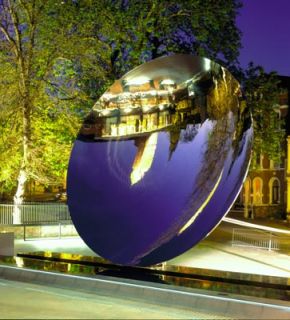
anish kapoor kenn.600 small.jpg The Indian born artist Anish Kapoor has a major sculpture going up at Rockefeller Center in New York next month, and there's a detailed profile of him in the New York Times (thanks, Tamasha).

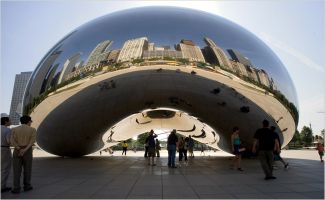
The sculpture is called "Sky Mirror," and it's essentially a large, convex piece of highly polished stainless steel, roughly in the shape of a contact lens. From the image at the Times (which is computer generated) as well as images of the same sculpture at other sites, I have a feeling this piece is going to be a bit of a tourist sensation.

This high-profile placing of one of Kapoor's sculptures is a coup for the artist, but hardly the first time he's been given pride of place in the western art world. Major pieces of his are on display in the MOMA and the Tate Modern in London, the most famous of which might be Marsyas, a massive construction that filled the Tate's vast Turbine Hall four years ago. Kapoor is one of the most important and influential practitioners of a movement in abstract sculpture called either minimalism or post-minimalism, depending on how exact we're being.

It's a long way to come for a Doon School boy.

Let's get into the art a bit more. Here is the Times:

Both works are extensions of Mr. Kapoor’s almost career-long interest in sculptural incorporeality. Borrowing ideas from Minimalist and post-Minimalist predecessors like Donald Judd, Bruce Nauman and Eva Hesse but using deep matte colors, reflectiveness and other illusions, he makes boundaries seem to disappear with an effect that is often overtly sensual and spiritual. Mr. Kapoor, who first rose to prominence in the mid-1980’s and won the Turner Prize in Britain in 1991, calls them nonobjects. (link)


anish kapoor cloud gate kenn.4.650.jpg Minimalism came of age in the 1960s, and was displaced somewhat by postmodernism and conceptual art, though it never really went away. For the most part I tend to prefer more congenial, conversational art, but a number of Kapoor's pieces do something for me that Donald Judd's roomfuls of black cubes don't really do. Kapoor's best works clearly are social objects, even if they operate in the same general mode as minimalism does.
A bit more from the same article:

Though his public work is unabashedly crowd-pleasing, Mr. Kapoor’s intentions are often deeply philosophical. His mirrored piece might be thought of as a sculptural twist on the ideas of the German philosopher Johann Fichte, who wrote about self-consciousness being possible only through the resistance an individual encounters from external objects; in other words, something defined by what it is not. (link)


anish kapoor sky8lge sky mirror.jpg What I like about the "Sky Mirror" piece and a related piece now installed at Millenium Park in Chicago called "Cloud Gate" is the way they present a kind of prism through which to view the world. They are solid, stainless steel, and point at the monumental architecture around themselves -- and in that sense they are completely of a piece with the modern American city. But in that they have the general look of liquids, they resist the sense of fixity of massive public sculptures, which are sometimes more in the vein of decorative buildings than art objects that inspire contemplation. As the Times notes, in the convex mirror of "Sky Mirror," the towering buildings facing the sculpture are vertically inverted -- another kind of anomaly.

Incidentally, many of Kapoor's early works made oblique references to Indian religious rituals -- some of his minimalist forms from the 1980s, for instance, were coated in bright red powder in the manner of Hindu religious shrines (see this piece, for instance). The tie back to India seems to be less evident in Kapoor's recent 'big' works, though many art critics draw on Buddhist concepts of space and being (or non-being) in attempting to analyze Kapoor's work. So it might still be there.

South Asian Poetry "Bleg"

A friend of mine is working on an anthology of "contemporary" world poetry (where "contemporary" means from the 1950s on). He's an Indian-American scholar, and he knows the literary traditions of some parts of India well, but obviously not all of them. His particular need here is poetry written in Indian languages.

As a single Punjabi poem to include in the anthology, I gave "Waris Shah Nu" as a suggestion, though my editor friend also indicated he was curious to know what the readers of this blog would suggest:

[A]s my "sphere of influence" in this project is South Asia, I'm trying my hardest to provide as wide and disparate a representation as I can of the many voices in India and in diaspora. I recently realized that my selection, not surprisingly, was skewed toward Indian-English poets and that I was lacking many of the other major languages. Indeed my representation of Bodo, Kashmiri, Manipuri, Konkani, Gujarati, Sindhi, and Punjabi poetry is precipitously low, if even existent (that's not to mention a host of other languages, such as Santali or the Bihari languages, which I'm going to have to give up on I fear). Anyway, I wonder if you could point me to some especially good Punjabi poetry in translation, or the most important poets in said language (or any of the other languages, including ones I didn't mention such as Assamese, Malayalam & Urdu).


Does anyone have a favorite Shiv Kumar poem they could point us to, for example-- with an accompanying translation? (Panini, this means you.) For the purposes of this anthology (since only the translations will be printed), the quality of the English translation is quite important, though I believe the quality of the poem in its original language is paramount.

And needless to say, this goes beyond Punjabi. Above, my friend mentions several other languages as currently deficiently represented. But he does want to keep things "contemporary."

Finally, it would be especially helpful if you could suggest links on the internet, or to previously published translations in English in books. (The project does not have the budget to hire translators of its own. And unfortunately, few scholars working today can compete with the likes of A.K. Ramanujan, who translated many of the poems he included in the Oxford Anthology of Modern Indian Poetry himself.)

Thanks in advance.

Indian Ocean On Tour in U.S.

I saw a group called Indian Ocean last night at World Cafe Live in Philadelphia -- and they rocked. I'll review the concert in some more detail below, but before going any further I wanted to mention that they are doing a small North American tour right now. Upcoming venues include Stamford, Chicago (this weekend), New York (early next week), Houston, Phoenix, Minneapolis, and Missisauga, Canada. If you live in one of those cities, go buy tickets!

Indian Ocean are based in Delhi, and have been together since the early 1990s. Though they've flirted with crossover commercial success, the band has built up a devoted underground following without selling out to the demands of the market. (The audience at last night's concert seemed to know all of their songs.) They play a unique style of music that fundamentally defies categorization. A phrase on the Indian Ocean Wikipedia site takes a stab at it: "Indo-rock fusion with jazz-spiced rhythms that integrates shlokas, sufism, environmentalism, mythology and revolution." Another phrase they use is, "organic fusion." Whatever it is, it works.

What I liked most about the band's performance last night was the sense of personality each of the four musicians brought to the table. They work together quite well as a band, but they are also highly individualized players, each quite different from the others. Indian Ocean isn't quite a jazz band, where one often gets the feeing that the players are "putting in time" until they get to do a solo. And it's also not really a rock or pop band either, where the lead singer dominates and the musicians are for the most part subject to the demands of the song. In Indian Ocean, three of the four band members sing, and no one seems quite to be the "band leader" (the standout vocally is Asheem, who plays tabla, and sings for the most part sitting down). There is no generic formula for how these four very expressive and distinctive musicians create harmonious -- and yet improvisational -- music; they simply seem to know what to do.

There is a hardcore musicians' interview at All About Jazz, but some of what Susmit Sen talks about there goes over my head. For the lay, non-Jazzhead reader, the best description of who Indian Ocean are and what they're up to musically is probably this article in the sadly-defunct magazine SAMAR. First, let's tackle the fusion question:

At a time in which the "fusion" label has been rendered meaningless, the band vehemently asserts that about the only things fused about them are their brains. According to them, fusion is a band like Shakti -- great people trained in completely different styles who come together. "We are uneducated technically" they say, "and are representative of a modern Indian urban setting where one is exposed to all sorts of music from day one. So lets say the fusion, if any, has happened in our head. And the influences are every single thing you have ever heard -- rock, western pop, Indipop, classical, ghazal and qawwali, and a hundred different types of Indian folk music..."


Susmit's distinctive guitar style based on intricate Hindustani classical scales has been a founding influence along with Asheem's soul riveting voice and imaginative layering of rhythms on the tabla tarang (a set of tablas tuned to different notes). Meanwhile, Rahul's deep brooding basslines syncopated to Amit's intelligently improvised drumming provides the essential backbone to the group's sounds. The rhythms employed are not the regular 4x4 rock beats, but the more leisurely 8ths, 12ths and 16ths frequently employed in traditional music from the subcontinent. These longer cycle patterns allow for more improvisation, and force drummers to not just play in beat but also keep with the flow and the roundness of rhythm. "A good tabla player will fill every single crack and do it differently each time" says Asheem, "you're using fingers not sticks, so you can do a lot more stuff." (link)


Fusion here is not an attempt to make traditional music hip or fashionable, nor is it an attempt to keep some element of "Indianness" in pop music. With Indian Ocean, it's something entirely different. They acknowledge that they are part of the "Indipop" movement that started in the mid-1990s, to describe popular music that wasn't written for films. But while most Indipop ended up getting drawn into the Indian film industry (witness the demise of Lucky Ali), Indian Ocean seems to have gotten more deeply invested in "roots." They have matured and grown more proficient, while their filmi counterparts have seemingly withered.

The SAMAR article also has some details on the content of Indian Ocean's songs:

From "Hille Le Jhagjhor Duniya," based on a poem written by a Bihari revolutionary poet called Gorakh Pande, which urges its audience to throw away the old order and replace it with the new, to "Ma Reva," a eulogy to the Narmada river, a tune Rahul learnt from local communities engaged in the struggle for self determination against the large, ecologically unfriendly Sardar Sarovar dam, to "Kandisa," a soul stirring 2nd century Aramaic mass that used to be sung by the Syrian Christian community in Kerala. But even though they borrow freely, Indian Ocean distance themselves from others who use copyright laws to exploit folk music. "These songs belong to everybody," they claim, "and more specifically to the people who sing them. How can anything that has been sung for hundreds of years be anybody's copyright?"


My favorite song from last night's performance was also derived from the folk tradition -- Kabir's "Jhini".

Since this is a Youtube age, I should point out that the music video for "Jhini" is viewable here. It's not the greatest music video ever, but you can get a sense of who these guys are musically from it. There's also a video that seems to have been shot on a cell phone at a live concert in Mumbai; it gives you somewhat of a sense of what they are like live.

A few more links:

A decription of the band and the musicians at a U-Minn website

Another article at AllAboutJazz

Streaming audio to their album "Black Fridya"

Streaming audio to their album "Kandisa"