Whiplash (Cited at the MLA)

MLA was fun this year; it was great to finally meet many Valve people in the flesh, as well as Clancy Ratcliff, Charlie Bertsch (check out his pictures of Dupont Circle), and Michael B&#233rub&#233. Also pleasant to run into many old friends along the way (and make a couple of new ones).

The following comments are full of non-sequiturs, digressions, and random bits. But that is the nature of MLA, a great whirlwind of schmoozing intermixed with seriousness. Incidentally, the following shouldn't be taken as representative. I was only there for two of the four days, and made it to about eight panels -- about 1 percent of the total panels occurring at MLA.

--With regard to literature panels, let's start at the end, with a paper on Sapper's Bull-dog Drummond novels -- British thrillers from the 1920s and 30s with a know-nothing hero. Listening to this paper on one of his novels, I tried -- and failed -- to see what is so interesting about "Sapper" or his Bull-Dog Drummond novels. What is Ian Fleming without the camp-factor, or Kipling without the weighty epigrams? Merely Sapper, it seems.

--Richard Wright's Native Son was actually censored (editorially, not legally) upon its initial release. Sexually explicit passages were toned down, and a masturbation scene was entirely removed. You can get a sense of the kinds of changes made here (though the article, I'm afraid is not very good). Given the vulgarity of the uncensored passages, I almost prefer the censored version (but then, that was the version I first read, back in high school). And Wright did author the altered passages (which are not omissions, but actually totally different passages), so it's probably not quite right to say whether the uncensored version is the 'authoritative' text.


--I saw a paper on Conrad's Secret Agent, which piqued my curiosity to finally sit down and read that novel. It's a spy novel written in 1907, focusing on a group of leftist/anarchist terrorists. (The etext is here). A nice sample paragraph might be this one:

The knob of his stick and his legs shook together with passion, whilst the trunk, draped in the wings of the havelock, preserved his historic attitude of defiance. He seemed to sniff the tainted air of social cruelty, to strain his ear for its atrocious sounds. There was an extraordinary force of suggestion in this posturing. The all but moribund veteran of dynamite wars had been a great actor in his time - actor on platforms, in secret assemblies, in private interviews. The famous terrorist had never in his life raised personally as much as his little finger against the social edifice. He was no man of action; he was not even an orator of torrential eloquence, sweeping the masses along in the rushing noise and foam of a great enthusiasm. With a more subtle intention, he took the part of an insolent and venomous evoker of sinister impulses which lurk in the blind envy and exasperated vanity of ignorance, in the suffering and misery of poverty, in all the hopeful and noble illusions of righteous anger, pity, and revolt. The shadow of his evil gift clung to him yet like the smell of a deadly drug in an old vial of poison, emptied now, useless, ready to be thrown away upon the rubbish-heap of things that had served their time.

Conrad is at his best when characterizing people he loathes.

--At John Holbo's "Zizek and Christianity" panel, the most oft-cited literary text was Brideshead Revisited, which might seem to be an improbable choice. But apparently Waugh's novel is referenced by Zizek in On Belief as providing a powerful example of his (incoherent) neo-Christian-socialist ethics. The novel is full of passages like this one:

"But, my dear Sebastian, you can't seriously believe it all."
"Can't I?"
"I mean about Christmas and the star and the three kings and the ox and the ass."
"Oh yes, I believe that. It's a lovely idea."
"But you can't believe things because they're a lovely idea."
"But I do. That's how I believe."

--Poets are using multimedia technology to transform the reading experience, and comment on the "materiality of the text." An example is the "Cave" at Brown University (read the PDF white paper here). A well-known practitioner and critic of "new media poetry" is John Cayley; he was cited by two of the panelists at a panel I went to on New Media and Literary Theory. I'm not sure what to make of this genre yet; my initial response is skepticism. Check out John Cayley's website; what do you think? Is there something to this?

--At the "Rethinking Rhyme" panel, the literary allusions were flying fast and thick. Jonathan Culler recited lines from Bob Dylan's "Subterranean Homesick Blues" to illustrate rhyme's capacity to coordinate random images and bits of narrative.

Ah get born, keep warm
Short pants, romance, learn to dance
Get dressed, get blessed
Try to be a success
Please her, please him, buy gifts
Don’t steal, don’t lift
Twenty years of schoolin’
And they put you on the day shift
Look out kid
They keep it all hid
Better jump down a manhole
Light yourself a candle
Don’t wear sandals
Try to avoid the scandals
Don’t wanna be a bum
You better chew gum
The pump don’t work
’cause the vandals took the handles

Culler also quoted John Hollander, as well as Robert Frost's "On Desert Places":

They cannot scare me with their empty spaces
Between stars—on stars where no human race is.
I have it in me so much nearer home
To scare myself with my own desert places.

In Culler's view, the desolation of the image here is belied by Frost's vaguely comical choice to rhyme "spaces" with "race is." I tend to agree; it's not one of Frost's stronger efforts (but there are many problems with the poem).

In the same panel, David Caplan quoted quite a number of rhyming poets, including Missy Elliott ("Work it": "Boy, lift it up, let's make a toast-a /
Let's get drunk, that's gon' bring us closer / Don't I look like a Halle Berry poster?"), Harryette Mullen, and Justice Mike Akin of the Pennsylvania Supreme Court:

A groom must expect matrimonial pandemonium
when his spouse finds he's given her a cubic zirconium
instead of a diamond in her engagement band,
the one he said was worth 21 grand.

This was the actual text of the judge's dissenting opinion in a divorce case where a woman claimed the pre-nuptial agreement she had signed was nullified because her ex-husband had given her an engagement ring made of cubic zirconium. (Why this is being quoted in a paper at MLA is a long story...)

At the same panel, J. Paul Hunter cited Alexander Pope:

True ease in writing comes from art, not chance,
As those move easiest who have learn'd to dance,
'Tis not enough no harshness gives offence,
The sound must seem an echo to the sense.
Soft is the strain when Zephyr gently blows,
And the smooth stream in smoother numbers flows;
But when loud surges lash the sounding shore,
The hoarse, rough verse should like the torrent roar.
When Ajax strives, some rocks' vast weight to throw,
The line too labours, and the words move slow

Note how Pope's use of sounds (rhyme, but also consonant clusters and vowels) illustrates exactly the point he's trying to make. This website calls it "Pope's mimetic precept." I hadn't heard the term before (and the speaker didn't use the term), but it might be a useful way of describing this kind of self-instantiating argument.

--Finally, I saw Frances Ferguson enthusiastically reference Norman Mailer's The Executioner's Song. I'm not quite sure I followed the substance of her argument (about the role of the news-media in mass-culture; and the interaction between journalistic truth and the conventions of narrative fiction), but her talk certainly made me want to read Mailer's book.

I also came across an interesting short essay by Ferguson on the mass-media here.

Whiplash, anyone?

Yet Another Article on BPO (Washington Post)

There's an article on call centers in yesterday's Washington Post.

Nothing terribly surprising -- mostly lifestyle oriented. The one newish feature for an article in the U.S. media is the new awareness of the backlash against the industry within India (i.e., it's good pay, but not necessarily good work).

We spotted one possible error/exaggeration in the following:

The Long Island iced tea plus an order of fish and chips totaled $13, a bit more than the average weekly income in India. But Pundir, the daughter of mango farmers, earns about $20,000 annually. "It is good money at the end of the day," said Pundir, who abandoned her MBA studies because she saw a better career path in call centers. "In 4 1/2 years, I've risen through the ranks."

My understanding was that the starting salary for a call-center worker is about Rs. 40,000 a month (about US $12,000 a year), so this seems a little high.

Still, she's been there for 4 1/2 years -- a lifetime in the BPO world -- so it's probably not impossible that she's making Rs. 70,000 per month. If so, good for her, I guess (the Talking Heads' song Once in a Lifetime" comes to mind...)

Quick conference notes


So it seems like the conference I co-organized came off quite nicely today and yesterday.

--One talk dealt with M.F. Husain's "Mother Teresa" series of paintings from the 1970s, which I find to be particularly interesting (see the image above). I like the article by Shyamal Bagchee here, where he does a reading of both Mother Teresa's iconic blue-bordered Sari and the fact that Husain never pictures her face.

--We had a whole panel on secularism-related questions in Bollywood and contemporary Indian art cinema. The most salient films discussed were Gadar, Mr. and Mrs. Iyer, and an old Yash Chopra film I've never seen, called Dharamputra (which you can read about a little here). I tend to think that the era of communalized popular films might be over -- we aren't seeing many films like Gadar these days -- but I couldn't get the panelists to say much along those lines in my question.

--In the same panel on secularism in Indian cinema there was an interesting discussion of the actress Khushbu, a Punjaban who made it big in the Tamil cinema some years ago, becoming a kind of icon of a particular kind of feminine beauty. But just this October she came to be seen as distinctly un-Tamilian traitor after making some controversial comments regarding the double-standard over pre-marital sex in Indian society. No real point; I just find the story interesting.

--One presenter I saw made very good use of the term "Glocalism", which I hadn't really understood earlier: it is the production of the local for a global audience. This presenter was talking about the use of Amritsar in the film Bride and Prejudice, but I think one could also see it in something like Swades. Does anyone out there actually use the word "glocal"? (Is it a necessary term, or is it more "space" theory jargon?)

--Suvir Kaul gave a dymamite keynote, focusing on three texts, The Shadow Lines, a short story by the Hindi writer Swayam Prakash ("Partition"), and a poem by Agha Shahid Ali from The Country Without A Post Office. It was a learned talk, with well-positioned quotes from George Eliot ("If we had a keen vision and feeling of all ordinary human life, it would be like hearing the grass grow and the squirrel's heart beat, and we should die of that roar which lies on the other side of silence."), Tacitus ("They made a desolation and called it peace"), and even Northrop Frye. The Swayam Prakash story Kaul referred to in particular sounded really interesting; it appears one can get a translation of it in a recent anthology called Image and Representation: Stories of Muslim Lives in India, put together by Mushirul Hasan.

I've been reading through Kaul's anthology Postcolonial Studies and Beyond, which has essays that make some really trenchant critiques of the blind spots in postcolonial studies (and even in some instances call the field as a whole in to question), so perhaps there will be more on Kaul's work here soon.

(But I keep promising posts that I'm unable to deliver!)

Save the tired cliches for the end of the article

Another article on Indian engineers who are returning home. Best quote:

His neighbor Mr. Swamy is immersed in building a Silicon Valley-style team in Bangalore, but with some local adjustments. When he learned that the company routinely received calls from prospective fathers-in-law of employees, asking to verify their ages, titles and salary details, Mr. Swamy wrote a memo titled "HR Policy on Disclosing Employee Information to Prospective Fathers-in-Law."

"While I want to be entirely supportive of ensuring that our confidentiality agreement does not result in your missing out on the spouse of your dreams," Mr. Swamy said, "I don't want competitors to use this as a ploy to get at sensitive information."

Ah, business-speak -- that uncharming conglomeration of tired clichés ("spouse of your dreams") and bad Latinate jargon.

Who To Root For?


I grew up in Washington, DC, but now I live in Philadelphia. Who to root for? I don't know; it's hard to leave behind one's regional pride (Washington), and this year it isn't really very rewarding to root for the Eagles, who had a major meltdown about two months ago. Still, the pressure one feels from constant media bombardment in Philadelphia is hard to withstand: radio, television, and newspapers cover football nonstop, and it's hard to ignore that steady temptation to 'convert'. (Who says America is a secular country?)

So who knows who to root for? And can anyone explain how Sourav Ganguly is back on the Indian Cricket team again? People are saying it has more to do with politics (i.e., Somnath Chatterjee) than Ganguly's likely contribution to the team. Aren't we glad that American politicians generally stay out of sports controversies? (Oh, wait!)

Look at the above image again: notice the Sikh fan in the middle of the picture: we know who he's rooting for, at least, with a burgundy pagri to match the Redskins' jerseys...

It's notable, because the image above is blown up large on the front page of today's Washington Post -- not something you see every day. The player in the picture, incidentally, is Santana Moss.

Intriguing Films, Mostly French


(Oy, a tough week for writing: we're trying to buy a house, I'm in the midst of a huge stack of grading, and I'm in the middle of Jonathan Strange and Mr. Norrell. The first two things are hellish, while the third is immensely enjoyable -- but all three have been distracting me from blogging...)

Over the past couple of weeks I've caught part or all of the following films, mostly on the Sundance Channel.

Paris Blues. This cross-racial jazz buddy film doesn't have the greatest script, but it has great music (the score is by Duke Ellington, and Louis Armstrong shows up as a character and musician in the film itself). It also introduced me to Diahann Caroll, one of the few black actresses who had a successful career in Hollywood in the 1960s and 70s. (See images of her in a series of roles at this fansite). Somewhere on the Internets (I can't find the link) I discovered that Caroll and Sydney Poitier (both married to other people) had had a raging affair before this film was shot, which threatened to undo their respective marriages. But they agreed to work with each other anyways, mainly because their roles in the film are progressive and quite natural (i.e., they are playing people who are more or less ordinary, not criminals or servants). So alongside the (slightly boring) didactic progressivism of the film and its brilliant music, there is a nice gossip element to Paris Blues. One other thing: the shots of Paris are stunning, especially Montmartre and the Seine.

8 Women. This is a very funny French murder-mystery with an ensemble, all-female cast, including Catherine Deneuve, Isabelle Huppert, and Emmanuelle Beart (to name only the three I had heard of). The best parts were the periodic eruptions into song by each of the 8 characters. Francis Ozon seems to have borrowed a page from Bollywood here, though the campy, ironic feel of this film as a whole is very un-Bolly. (Still, it might be interesting to imagine a slightly tweaked Bolly-version of this film... I know Rekha would be up for it...)

The Housekeeper. This is an unapologetic middle-aged man's (misogynistic) fantasy universe: a guy, divorced by his wife, hires a young, attractive housekeeper -- who subsequently throws herself at him. It's a little degoutante as a story, but the film has good performances from both leads and takes an understated, intelligent approach to its subject: they really want to convince you of the plausibility of this affair. Both S. and I were carried along by the film, but annoyed at it as well: just because it's a sophisticated French art movie doesn't mean the premise isn't fundamentally sexist! (Why aren't there more women screenwriters in French cinema?)

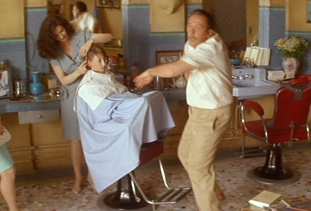
The Hairdresser's Husband. This film is a really just a trifle, but it's worth watching chiefly for Jean Rochefort's strange, manic dances to Arabic songs inside his wife's hair salon. You've never seen anything quite like it...

Diamonds and Rust. This Israeli film seems like an unlikely topic for an interesting documentary: the crew of a diamond trawler off the coast of Namibia. But it's all in the material, and these filmmakers have really good stuff. This is worthwhile viewing to anyone interested in how race, language/culture, and money collide in a small space. It's also just interesting to see how a diamond trawler works. (Click on the link for a good summary of the film)

Torture: The Dirty Business. Andrew Gilligan is a controversial figure in British journalism, mainly for his involvement in an Iraq pre-war intelligence scandal that led to the suicide of a government informant (see the full story at Wikipedia). He's also a ferocious left-leaning critic of the British and American governments. This documentary does feel biased at times, but it also has first-hand interviews with numerous victims of the U.S. government's "Extraordinary Rendition" program -- whereby people suspected of involvement in terrorism are flown on private Gulfstream airplanes to places like Syria and Egypt, where they are tortured. The most damning example is Maher Arar, a Canadian citizen who was tortured by the Syrians, kept in a brutal kind of solitary confinement, and then released after a year without charge.

Incidentally, the director of the film, Sarah MacDonald, has an interesting connection to India.

Amrik Badnaam Goes To The Library (a short story)

Inspired by Laura's post at The Valve

----------------------
Amrik Badnaam Goes To the Library

Professor Amrik Badnaam liked to spend his days during the long semester breaks in the libraries of other universities. His own university's library was somewhat distant from home, and was at any rate a rather dismal space: something undefinable was off about the library, which made it an unpleasant place to work. Many of his students felt the same way, and tended to avoid the place.

Since Amrik and his wife had recently moved to a new town within driving distance of the university, there was now a need to find a new library to haunt while he continued to work on his schlarly project, on the function of quoted dialogue in early novels. Amrik didn't need much in the way of resources from the library itself; for several years he had had in his own personal collection all the texts he required. But owing to certain changes he had made in the methodology of the project Amriknow found himself mired in an exhausting re-reading of most of his primary materials. Amrik's primary task this winter would be to skim through about 30 volumes by a prolific French writer named Marcel Broodthaers (a Victorian ancestor of the well-known contemporary artist of the same name), scanning for irregularities in the use of quotation-marks.

In truth, it was boring work, and the professor often wandered the stacks of the local library for interesting books to sample during breaks. Sometimes it might be a volume on the Peloponnesian Wars; on other days it might be a radically hostile biography of Mohandas Gandhi. In the past two years of work at various university libraries, such random sampling had come to occupy more and more of Amrik's time.

The new library he had selected was the main library at Blue Bough County Community College (also known as "BB3C"). Though he quickly ascertained that the library's primary selection was limited (Pamela, but no Shamela), he noted with satisfaction the congenial design of the library after a quick walk-through: this was a space in which he could actually get some work done. It was generally bright and spacious, and had a pleasing contemporary roundedness to it. Clearly a great deal of money and thought had gone into the construction of the building, much more than one might expect from a community college.

On the first day of work during what would turn out to be his last winter break as a faculty member at Prussian State University in eastern Pennsylvania, Amrik sat down at a suitable carrel near the Pxxxx section of the stacks at BB3C, opened his materials, and began to work. But he was only able to focus on Broodthaers for about half an hour before he found his mind wandering a bit. Amrik decided to browse the BB3C literature stacks a little, just to see what was there.

The Collected Works of Randall Jarrell caught Amrik's eye, and he thumbed through to find his favorite poem from his undergraduate days, "The Snow-Leopard." But the poem did not seem as exciting to him now as it had in college; indeed, it seemed curiously limp and certainly devoid of magic, as did many of the other bits and pieces of Jarrell poems he glanced at while standing in the book stacks. Next, Amrik picked up a volume of Amy Lowell, Pictures of the Floating World, of which the BB3C library copy was, surprisingly, a first edition from 1919 (how could this little community college even have existed in 1919?). Though the volume was handsome, the poems, Amrik quickly realized, were quite odd.

Amrik glanced back at his carrel but felt he needed to do a little more browsing before sitting down again to work.

That was when it happened: while browsing the literature shelves, he saw a small volume with an impossible title, Amrik Badnaam Goes To The Library. It was a slender volume with white binding and gold-embossed lettering on the spine. Upon opening the book, Amrik was shocked to find the following title page, written (rather than printed) in ink calligraphy:

Amrik Badnaam Goes To The Library

By Kalla Jadoorani

Wassahickon, PA: Blue Bough County Community College Press
December, 2005

The text that followed was, like the title page, written in ink rather than printed. The paper was a heavy bond, not often used in printed books, and seemed to be cut somewhat irregularly. The handwriting was a smooth and regular cursive script, quite legible but obviously made by an actual human being.

That the story narrated in Amrik Badnaam Goes To the Library appeared to be identical to his own life story was somewhat frightening to Amrik, but also in a certain way thrilling. Who is Kalla Jadoorani, and why has she hand-written an entire book (even a slim volume) consisting of my life story? After reading the first few pages in astonishment, Amrik quickly flipped to the back of the book to see where this Kalla Jadoorani had decided to end the story. Nearly the entire second half of the book was blank; the last written paragraph was on page 53, and read as follows:

That the story narrated in Amrik Badnaam Goes To the Library was his story was somewhat frightening to Amrik, but also in a certain way thrilling. Who is Kalla Jadoorani, and why has she hand-written an entire book (even a slim volume) consisting of my life story? After reading a letter-perfect account of his birth in Queens and his first years of life (including the blizzard of '77 and his early surgery), Amrik quickly flipped to the back of the book to see where this Kalla Jadoorani had ended things. He noticed that nearly the entire second half of the book was blank; the last written paragraph was on page 53 . . .

Amrik stood there, astounded and just a little bit annoyed that the book had ended at exactly the present moment. If this were some kind of trick, it wasn't especially original!

That was when he noticed a small Indian woman dressed entirely in black staring at him. She was standing at the far end of the stacks, and the only very noticeable thing about her were her thickly-rimmed, oddly shaped spectacles, which were either extremely out of fashion or extremely fashionable -- depending on how current one happens to be in the latest phase of retro fashion recycling. She seemed to be about forty, though that was in fact somewhat hard to establish in the middling light of this particular location in the stacks.

"Yes?" he finally said. She didn't say anything, or move. Indeed, she continued to stare at him with the same intense look.

"Wait, are you---?"

"Yes," she said, quickly. Then: "Listen, I haven't got a lot of time. Go back to your carrel and read the book, now, from beginnning to end exactly in sequence, and without skipping, skimming, or pausing for any reason. If you do it right, and the book works, you'll come back here and put it back on the shelf where you found it. Also, don't worry about the ending. I haven't finished writing it yet, obviously. I'll take it home and finish it tonight; it's important that I write the ending for everything to work. As for everything else, I'll explain what you need to know tomorrow." And before he could say anything, she was gone.


To be continued

The Conspiracy Against Ganguly (and other brief notes)

There are protests in Kolkata about the sacking of Sourav Ganguly from the Indian cricket team. Ganguly is a Bengali; some left politicians in Bengal have also complained of a dark political conspiracy against the cricketer.

I think we should send ex-Eagles running back wide receiver Terrell Owens to India to see if he can learn the ins and outs of cricket. And maybe invite Ganguly to Philadelphia? The Eagles could use a new running back...

* * *
Express India also has a piece about a new book that has come out, exploring the status of women in India's IT sector. It seems women are doing well in this industry overall; there is a disproportionate representation of women in IT, and the women interviewed for the study report being satisfied with the work as well as the power it gives them. The book is called Gender and the Digital Economy - Perspectives from the Developing World, edited by Cecilia Ng and Swasti Mitter,

* * *
There's been a lot of publicity this week about a recent case of a forged Wikipedia article, but in fact Wikipedia is pretty accurate -- as accurate as the Encyclopedia Britannica, according to Nature. An article in the Washington Post on the subject.

I must say I've been using Wikipedia quite a bit as a 'first' reference. Sometimes if I need to check something quickly before class -- say, the different Arabic meanings of the word 'Jihad' -- Wikipedia can be a quick way to bone up.

* * *
Turkish writer Orhan Pamuk's trial for speaking against the Turkish state is starting this week in Istanbul. There's a story about it in the BBC. There was also a brief statement on the impending trial in this week's New Yorker, though I 'm not finding a link to that statement online.

* * *
Salam Pax on voting in Baghdad, for the third time in 11 months. The Guardian suggests this may be the last in his series for the paper.

* * *
In the New Yorker, a review of a new biography of Lawrence by a writer who published a three-volume bio of him in the 1980s. I dunno, though I find certain of Lawrence's novels fascinating, stories about his life are a bit depressing: everything he tried to do (outside of writing novels) was a disaster.

Two Odd Crime-Related Stories

Last week, a Lehigh university sophomore decided to rob a Wachovia in north Bethlehem. He issued the bank teller a note claiming that he had a weapon (it's not clear that he had one), and walked off with about $3000. But he didn't do a great job with the getaway car: someone caught the license plate of his SUV, and within a few hours the police showed up at his fraternity with handcuffs. The icing on the cake? The student in question is the Sophomore Class President, and the guy who drove him to the bank is the University Student Senate President! (The latter student, a senior, says he didn't know what his friend was going to do at the bank.)

I was somewhere between a- and be-mused by this news last weekend, with the story in The Morning Call (the local paper). But yesterday CNN picked up the story, giving Lehigh national exposure for all the wrong reasons.

* * * *
Also in the Morning Call last weekend, police caught up with a robber in Lansdale when they followed his footprints in the snow straight to his house.

Note to robbers: when committing robberies in fresh snow, remember to first walk to someone else's house before going home with the loot!

Aniruddha Bahal Strikes Again: Question-Gate (updated)

All over today's news: A pair of Cobrapost and Aaj Tak TV reporters secretly taped 11 Indian MPs taking bribes in exchange for asking questions in Parliament. There is detailed information on how the meetings were conducted, and what, specifically, the MPs agreed to do here.

It's unusual that parties not in power get seriously corrupt, but six of the 11 MPs are members of the BJP, already on the outs. One member was from the Congress party, while others were from the BSP and RJD parties. (The RJD, Lalu Prasad Yadav's party, is an ally of the Congress; the BSP is a caste-based party that had been involved with the BJP government.)

The six BJP MPs, 3 BSP MPs, and the Congress MP have already been suspended by their respective parties. No word on the fate of the RJD member.

The moral: corruption does not follow party lines.

The other moral: the BJP is a glutton for punishment. You would expect these MPs to think twice before taking bribes from people in places where there could be video cameras rolling!

Does India have an equivalent of a Pulitzer Prize? I would nominate Aniruddha Bahal and Aaj Tak TV.
* * * * *
Update: Apparently, blogging has played a part in the scandal, as one of the Cobrapost writers planted the following blog-related question in an MP's mouth for 35,000 Rupees:

"Is it true that while NRI firms such as India Uncut of USA, Sepia Mutiny of Britain and AnarCap Lib of Netherlands have been allowed to invest in Indian SSIs, the reputed German investment firm Desipundit has been denied permission? If so, the reasons thereof? Is the Union Government of India planning to make automatic the long procedure of permission for SSIs to import new technologies such as Trackbacks, Pingbacks, Blogrolls, Splogs and Hitcounters?"

Check out the details at Sepia Mutiny. Also of course, Cobrapost.
And certainly the 'firms' involved are thrilled to be a hilarious footnote in the unfolding story of this scandal (see Desipundit and India Uncut).

Three Naive Statements About "The Snow Man"

In honor of the snow, end of the semester office hours, and the endless winter of the mind, here are some very brief observations on Wallace Stevens' "The Snow Man." These are naive responses, because, well, it's a blog. And of course, the many intimidatingly good close readings of this poem (several of which are excerpted at UIUC) threaten to leave one with nothing of one's own to say. The trick is to write first (naively), then compare notes with the published critics.

The Snow Man
by Wallace Stevens

One must have a mind of winter
To regard the frost and the boughs
Of the pine-trees crusted with snow;

And have been cold a long time
To behold the junipers shagged with ice,
The spruces rough in the distant glitter

Of the January sun; and not to think
Of any misery in the sound of the wind,
In the sound of a few leaves,

Which is the sound of the land
Full of the same wind
That is blowing in the same bare place

For the listener, who listens in the snow,
And, nothing himself, beholds
Nothing that is not there and the nothing that is.

1. Verbs: For a poem that is essentially about standing still, there are quite a number of active verbs, suggesting a play between activity and passivity. Through his verbs, Stevens makes the visual and aural perception of nature (which might well be understood as passive) into a highly intentional act. The poem opens with the observer in the snow, taking in the sharp visuals of a snowy winter day. But there is a shift after the semi-colon in the third stanza (the poem’s grammatical and conceptual hinge), first towards the land, and then back to the speaker. The last stanza has two verbs, one associated with sound (“listens in the snow”), and the second with sight (“beholds”), even as it negates (twice) the object on view (“nothing that is not there and the nothing that is”).

2. Nature described: There are parallels running throughout the poem in the descriptions of nature, which are first positive if remote (“crusted with snow”; “shagged with ice”), and then associative and negative (“sound of the wind”; “sound of a few leaves”; “sound of the land”; “same wind”; “same place”). The “sound of…” and “same…” phrases in the third and fourth stanzas are all in some sense echoes or reverberations of events that are never directly described in the poem. They are like pronouns without an antecedent, and they are all versions of one another (the “sound of the land” must logically also be the sound of the wind, since nothing else in nature on a still winter day would make noise).

3. Human mood/being/nothingness: As is relatively common in some of Stevens’ more famous poems, there is a play in “The Snow Man” between a feeling human consciousness (who experiences winter as “misery”), and a purely abstract perceiving entity that is utterly free of any emotional distortion (i.e., that sees "nothing that is not there"). The perceiving self and nature in its bareness and remoteness reflect each other directly: both as stillness and “nothingness.”

There is a grammatical trick of the poem in its double-negatives, and a conceptual trick involving a doubling of the observer (especially in the second half of the poem). One must have a “mind of winter . . . not to think/ of any misery . . . in the sound” of the snow and the nothingness of winter. The poem has so many subordinate clauses that it’s a little unclear whether listener in the last stanza is the same as the observer who first appears in the first. But of course they are – they must be – one and the same “snow man.” (Incidentally, it makes little sense to me to read the "snow man" in the poem as literally a snow man made of three big balls of snow. The snow man is a sentient being cogitating on the snow. I read the title of the poem as a comment on the human imaginative tendency to anthropomorphism, our tendency to populate the nothingness of winter with crude sculptural images of ourselves.)

* * * *
Those are the naive statements. As mentioned above, UIUC has excerpts from about a dozen relevant critical takes on "The Snow Man," many of which cover similar ground. Check them out; I was impressed by Anthony Whiting and Kenneth Lincoln. The opening of the Lincoln excerpt is especially sharp and compelling:

"The Snow Man" is one long sentence in five oddly rhymed tercets, crystallized as verse. Like Frost's image of ice melting on a stove, the poem reveals itself as it slides along, warmed dangerously by human touch. The lesson is clear: leave a snow man alone, and it exists for itself, unchanged; touch the snow, and the artifice goes away, as it goes along. An object measures differently in motion than at rest, variously cold and hot: watch it disappear. Instead of the expected iambic opening ("I placed a jar"), the poem begins impersonally, with a tentative trochee, almost spondaic, "One must have a mind of winter." Right away, reverse field, the poem catches us in metric crux ("the trochee's heave," Pound said). A leveling cold serves to brace entry and numb stresses into anapests, even spondaic trochees: "and the boughs / Of the pine-trees crusted with snow."

And it just goes from there, all good.

[Cross-posted at The Valve]

Lehigh in the Snow


Yes, I did too make it into work this morning. I'm glad I did; the first decent snow of the year is always a spectacle.

A larger size version of the above is on Flickr.

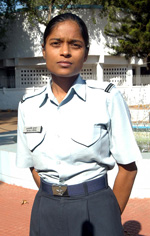
Anjali Gupta vs. Indian Air Force

Don't even think about claiming sexual harassment if you're a woman in the Indian Air Force. First, your charges will be dismissed. Then, you'll be put in jail, "for your own protection." And finally, you'll be court-martialled on trivial charges, and convicted by a jury that, to add insult to injury, includes two senior women officers (one of whom is Air Marshal Padmavati Bandyopadhyay, the highest-ranking female officer in the Indian military).

Here's the back-story from Mumbai's Mid-Day:
“She refused to play ball with senior officers who wanted her to ‘co-operate’ with them in various ways including participating in collecting bribes for recruitment of cooks and others. (Apparently the going rate for a cook in the force is Rs two lakh),” he reveals.

Jitender claims Gupta was forever being harassed for illegal favours. “The more she refused to join them at parties in the night, the more she was harassed.

In fact, Anjali had earlier complained to her seniors about the drunken behavior of Sq Ldr Choudhary who was even issued a Form10 by the IAF.

Every time she complained to higher authorities about malpractices in her department, she would be moved to another department. She was moved around 6-7 times in the last one year,” he states.(Mid-Day)


And here's today's news:

An Indian Air Force court martial has recommended that Flying Officer Anjali Gupta be cashiered from service. Gupta and her family contend that she is being framed because she brought charges of sexual harassment against superior officers and because she blew the whistle on corrupt deals.

In armed forces’ parlance, “cashiering” is a more severe punishment than “dismissal”. A cashiered officer is denied the privileges of rank and post-service benefits. The five-member jury’s proposal in the court martial headed by Group Captain Ganesh in Bangalore has to be confirmed by Air Chief Marshal S.P. Tyagi.

The court martial has found Gupta guilty of five of seven charges brought against her. She was charged on five counts of financial embezzlement (amounting to Rs 1,080), insubordination, indiscipline, irregularity and conduct unbecoming of an officer. (Calcutta Telegraph)

Oh no, she embezzled 1080 Rupees! (approx. US $25). And let's see, insubordination (because she says her superior officers were hitting on her?) and indiscipline (because she refused to go along?).

If the Air Force can explain why they found her sexual harassment charges to be false, they really need to do so ASAP. Otherwise, this case case stinks to the high heavens.

Sami Al-Arian: quick thoughts

Sometimes it seems there are an awful lot of "terrorists" but not a lot of convictions. Sami Al-Arian and his co-defendants join the ranks of the acquitted.

The basics of the case are these:

The trial, lasting more than five months, hinged on the question of whether Mr. Arian's years of work in the Tampa area in support of Palestinian independence crossed the threshold from protected free speech and political advocacy to illegal support for terrorists.

Prosecutors, who had been building a case against Mr. Arian for 10 years, relied on some 20,000 hours of taped conversations culled from wiretaps on Mr. Arian and his associates. Officials said he had helped finance and direct terrorist attacks in Israel, the Gaza Strip and the West Bank, while using his faculty position teaching computer engineering at the University of South Florida as a cover for his terrorist activities.

20,000 hours of conversations -- and not a single guilty verdict! It seems that the guy is not a terrorist.

The Times has also made the text of the indictment available (PDF), and I've been reading through it. The government makes many specific accusations against Al-Arian and his colleagues, but the broadest one is that he was the U.S. head of an organization called Palestinian Islamic Jihad (PIJ), which engaged in a conspiracy to support people committing acts of terrorism.

Over the course of the indictment, the government describes its version of what the PIJ was doing between 1991 and 2002. Interestingly, the longest indictment by far is a charge of conspiracy to commit racketeering, not terrorism. This charge mostly reads like committee meeting minutes for what could be any small activist group, punctuated occasionally by references to suicide bombers overseas (notably: no specific references to any direct involvement in a bombing). And Counts 5-44 are "Travel in Interstate or Foreign Commerce or Use of the Mail in Any Facility in Foreign Commerce." The actual "material support for terrorism" indictments are relatively brief, though the government does claim significant evidence in each case.

For the government's case to fall through with this much evidence, there really must be substantial doubt about their basic version of what the PIJ was doing, who it was associated with, and when. Are they making it up?

Read it and see. Perhaps it all is, as Al-Arian's defense lawyer has said, "a work of fiction." But the indictment is specific enough to seem more than plausible to me.

The next question is, will he be deported? Will he try to get his job at the University of South Florida back?

"Whitelists" and "Snail-Mail": Analogical Formations

Didn't William Safire retire? Oh well, I guess not: his latest piece at the New York Times Magazine delves into a class of words referred to by linguists as analogical formations. These are terms, generally involved with technology, that come into being as a logical necessity after a given term in widespread usage demands an opposite term. For example, once the word "blacklist" became a relatively common way of describing a function to stop unwanted emails or software applications, the word "whitelist" was coined to describe senders or applications that are, if you will, pre-approved.

Other examples he gives:

underwhelming
software (the word "hardware" came first)
hotfix
copyleft
blamestorming
multislacking (from "multitasking")
rightsizing (management)
dumbsizing (labor)

I might add "snail-mail" for conventional mail, which only became commonplace after email became the standard method of written communication.

Another rather crude analogical formation is "meatspace," which refers to the flesh-and-blood world, as opposed to "cyberspace." It was coined after "cyberspace" became a widespread term. I should add that while I've never actually heard "meatspace" spoken aloud, Google turns up 326,000 hits for it, so I gather it has started to stick.

Like snow... Or egg?

Any other analogical formations you can think of?