Background for this study
 |
| Pathways in Kim. (Just for illustration) |
The idea for the present project came out of an earlier project called The Kiplings and India. In that project, I found myself growing frustrated with the writings of the primary focus of the digital archive, namely the Kipling family, and wanted to explore a broader conversation about colonial India that would include more Indian/South Asian voices as well as other British voices.
The current project is an attempt at modeling the broader conversation. Historically, it has been easier to think of these as two parallel but separate bodies of work – the world view and experience of writers like the Hindi/Urdu progressive Munshi Premchand or the Bengali writer Saratchandra Chattopadhyay was so different from that of a Rudyard Kipling that they aren’t really of a piece. However, here, I was interested in putting them together in a single corpus, in order to look for connections between them as well as points of divergence.
To do that, one can take traditional qualitative (thematic and formal) as well as quantitative approaches. Thematically, a typical line of inquiry might be: British writers in India were famously fond of ghost stories – what about their Indian peers? (Quick answer: yes! Tagore, for example, wrote quite few ghost stories, though they were a little different from the kind written by writers like Kipling or Alice Perrin; see ghostly reincarnation.) Also, British writers tended to write a fair bit about their summer escapes to hill stations like Simla and Darjeeling. What about their Indian peers? What was their imaginative geography? The Tags on the Scalar site might provide an opening into some of these qualitative points of connection between the British and the colonial South Asian texts.
Below, I also want to open up some preliminary quantitative inquiries, specifically on geographic references in the corpus.
I’ve learned a lot from reading scholarship by Matthew Wilkens and Elizabeth Evans, particularly their co-authored book, Gender and Literary Geography (2025), and their co-written articles, especially “Nation, Ethnicity, and the Geography of British Fiction” (Journal of Cultural Analytics, 2018), and I wanted to briefly explore their methods and conclusions before giving my own analysis from the corpus described above.
For non-DH readers, this type of work relies on software that extracts geographic information from texts using Named Entity Recognition (NER). Essentially, software can figure out from context that if you say, “We are going to Simla this summer to escape the heat of the plains,” that “Simla” is a geographic place entity (GPE). (It is generally not simply looking up words from a list [i.e., dictionary] of previously recognized places.) There are several software packages that do this kind of analysis; the two I have been exploring are SpaCy and Stanford University’s Stanza. Both are relatively easy to use if you can run a Python environment like Google Colab.
Are we making a map? (Not so much) It's probably important to note that what we're aiming for is not quite a map, but geographic data. Maps, as Wilkens and Evans point out, can be helpful at visualizing geographic information in a single novel or small group of novels. But if we are looking at a corpus of 100 or more texts, there will be so much data that any maps we produce will look like noise. So what we are actually trying to do here is collect and analyze geographic data.
In Gender and Literary Geography, Wilkens and Evans devised analytics to study “geographic mobility,” “international attention,” and “spatial range” in modern British fiction. First, generally speaking, modern British literature was remarkably mobile and international – Wilkens and Evans find that roughly two-thirds of all geographic references in their corpus were to places beyond British borders (this is much higher than the number found in American fiction). This makes sense given the proximity to Europe and the importance of European travel to British people in the upper classes. It also makes sense given the scale and scope of the British Empire throughout the 19th and early 20th centuries.
They are also interested in the gender breakdown – it’s been traditionally assumed that writers who are men are more mobile than women, so there should be greater evidence of mobility and spatial range. However, Wilkens and Evans find that character space (the gender of characters in a novel) is actually a bigger predictor of mobility than author gender.
One analytic they use that I find especially helpful and relevant in the South Asian context is “geographic intensity.” Geographic intensity speaks to the frequency of mentions of geographic place-names; certain writers tend to constantly mention place names when their characters are traveling; others not so much. One finding Wilkens and Evans have right off the bat is that nonfiction texts tend to show much higher geographic intensity than do works of fiction – so there’s no point comparing them. (Nonfiction books are much more likely to be instructional in some way, or structured as reference texts.) My own experiments with the present corpus lend support to that distinction – a book like Cornelia Sorabji’s nonfiction memoir India Calling has a much higher geographic intensity than do the same author’s fictional texts, so we should really bracket off the nonfiction works.
My hunch going into this would be that British writers would have a much higher degree of geographic intensity in their accounts of colonial India than their Indian peers. To begin with, Anglo-Indian writers traveled back and forth quite a bit (between England and India), and with their assumed English readership they might be inclined to announce all of the exotic places their characters might visit in the course of a novel. But what will the data show?
Measuring Geographic Intensity. Wilkens and Evans have a sophisticated way of measuring geographic intensity, though in my own experiments so far, I take a relatively straightforward approach – I ask NER software like Spacy or Stanza to extract a list of place-names (including duplicates), and then create a ratio based on the total number of words in a text. A geographic intensity score of 0.72% -- what I found for Rudyard Kipling’s Kim using SpaCy -- means that just under 1% of all the words in the novel are place-names. (Note: another software package, Stanza, gives a rather different result for Kim here – just 0.38%. I’ll talk more about what might be going on below)
In Kim, the SpaCy software finds a list of place-names that looks like you might expect. Here is a selection:
Most of these are familiar names, though many use archaic or idiosyncratic spelling (Dacca instead of Dhaka; Cabul instead of Kabul; Gunga instead of Ganga/Ganges). Idiosyncratic spelling could be challenging, especially if one plans to feed the output list into software that might produce a map. That said, at least one platform I have worked with -- Pelagios's Recogito -- does do a good job of standardizing archaic place names. When I ran Kim through their system, it successfully located "Dacca" in "Dhaka." (See Recogito's version of Kim here).
However, SpaCy also finds a fair number of false positives – for some reason, SpaCy thinks “Mahbub” is a place-name (though readers of the novel would know that this is part of a character name, Mahbub Ali). Those false positives throw off the score – for some books, I found the false positive effect to be as high as 20% – so the final number should not be taken as an accurate one. Along with false positives, I noted a fair number of false negatives – locations that I see as clearly evident in the text, but which Spacy missed. These could be as high as 10%.
SpaCy vs. Stanza. Stanza is better. If one compares the SpaCy results against the Stanza results, the Stanza results seem much better. The false positives are much lower (<5%) and the false negatives are also much better (also <5%). Based on those results, ideally one would just use Stanza. However, the downside of Stanza is that it is considerably slower and more resource intensive than Spacy – so running a small corpus of 20 novels on a basic Windows laptop could take two hours or more to complete.
As of now, I have not run all of the fictional texts I have in my corpus through the system, though I hope to do that sometime when I have access to a GPU. For now, I have just done two small tests with ten texts each.
Here is my geographic intensity data for ten relatively random texts by mostly British writers set in India (Sara Jeannette Duncan was Canadian), with both Stanza and Spacy results.

There is not a lot we need to say about this chart, though it is worth noting that the writers who are women here (B.M. Croker, Sara Jeannette Duncan) are ranked at essentially the same level as the men. Kim seems like an outlier using Spacy, but with Stanza its results are roughly comparable to others in this small corpus.
And here is comparable data for geographic intensity in ten random texts by Indian authors from this period

Preliminary observation. One notable result: the numbers for these Indian writers – again, a fairly random selection of ten works of fiction – are slightly lower than the percentages for their English peers, though not by very much. It is also worth noting that the books by Tagore and Bankim Chandra Chatterjee were translated from the Bengali, while the books by S.M. Mitra and Cornelia Sorabji were originally published in English by British publishing houses. From looking at the texts themselves, it is clear that these two books were primarily written with English readers in mind.
An Anomaly. In the chart above, there is a rather anomalous result for a relatively obscure book called Hindupore by S.M. Mitra. This is a travel narrative and political commentary, only thinly fictionalized, with an Irish Member of Parliament traveling to India with an Indian Maharajah. Mitra on the whole is a bit of an odd bird – he was essentially a supporter of British rule, who made a career of explaining Indian culture for English readers in often simplistic ways. I am keeping the text on the list for the present, though in terms of geographic intensity it behaves more like a nonfiction travel narrative than a typical work of fiction.
A case could be made that for Indian writers who lived permanently abroad, like Mitra (or, in the U.S. context, Dhan Gopal Mukerji), their texts should be in a different category than texts by Indian authors who lived in India itself -- and maybe excluded from a corpus of "Indian fiction" in future tests.
Preliminary Observations: In short, at least with these small test corpora, there does appear to be a slightly higher geographic intensity result for the British colonial texts than for the Indian ones. That said, the difference is not major -- I now want to go back to basics and re-read (with my eyes, not with a computer) texts like The Home and the World with an eye to how places are described. Also, as Wilkens and Evans concluded with a different corpus, there is also not a vast difference between men and women authors with respect to geographic intensity (on the British side at least).
In the next few weeks I will also aim to expand the study to the full corpus to confirm these results, while also studying the granular results from various software packages. (What are the false positives and false negatives in each set of results?)
The current project is an attempt at modeling the broader conversation. Historically, it has been easier to think of these as two parallel but separate bodies of work – the world view and experience of writers like the Hindi/Urdu progressive Munshi Premchand or the Bengali writer Saratchandra Chattopadhyay was so different from that of a Rudyard Kipling that they aren’t really of a piece. However, here, I was interested in putting them together in a single corpus, in order to look for connections between them as well as points of divergence.
To do that, one can take traditional qualitative (thematic and formal) as well as quantitative approaches. Thematically, a typical line of inquiry might be: British writers in India were famously fond of ghost stories – what about their Indian peers? (Quick answer: yes! Tagore, for example, wrote quite few ghost stories, though they were a little different from the kind written by writers like Kipling or Alice Perrin; see ghostly reincarnation.) Also, British writers tended to write a fair bit about their summer escapes to hill stations like Simla and Darjeeling. What about their Indian peers? What was their imaginative geography? The Tags on the Scalar site might provide an opening into some of these qualitative points of connection between the British and the colonial South Asian texts.
Below, I also want to open up some preliminary quantitative inquiries, specifically on geographic references in the corpus.
Analyzing Geography in Colonial South Asian Fiction: Experiments with SpaCy and Stanza
I’ve learned a lot from reading scholarship by Matthew Wilkens and Elizabeth Evans, particularly their co-authored book, Gender and Literary Geography (2025), and their co-written articles, especially “Nation, Ethnicity, and the Geography of British Fiction” (Journal of Cultural Analytics, 2018), and I wanted to briefly explore their methods and conclusions before giving my own analysis from the corpus described above.
For non-DH readers, this type of work relies on software that extracts geographic information from texts using Named Entity Recognition (NER). Essentially, software can figure out from context that if you say, “We are going to Simla this summer to escape the heat of the plains,” that “Simla” is a geographic place entity (GPE). (It is generally not simply looking up words from a list [i.e., dictionary] of previously recognized places.) There are several software packages that do this kind of analysis; the two I have been exploring are SpaCy and Stanford University’s Stanza. Both are relatively easy to use if you can run a Python environment like Google Colab.
Are we making a map? (Not so much) It's probably important to note that what we're aiming for is not quite a map, but geographic data. Maps, as Wilkens and Evans point out, can be helpful at visualizing geographic information in a single novel or small group of novels. But if we are looking at a corpus of 100 or more texts, there will be so much data that any maps we produce will look like noise. So what we are actually trying to do here is collect and analyze geographic data.
In Gender and Literary Geography, Wilkens and Evans devised analytics to study “geographic mobility,” “international attention,” and “spatial range” in modern British fiction. First, generally speaking, modern British literature was remarkably mobile and international – Wilkens and Evans find that roughly two-thirds of all geographic references in their corpus were to places beyond British borders (this is much higher than the number found in American fiction). This makes sense given the proximity to Europe and the importance of European travel to British people in the upper classes. It also makes sense given the scale and scope of the British Empire throughout the 19th and early 20th centuries.
They are also interested in the gender breakdown – it’s been traditionally assumed that writers who are men are more mobile than women, so there should be greater evidence of mobility and spatial range. However, Wilkens and Evans find that character space (the gender of characters in a novel) is actually a bigger predictor of mobility than author gender.
One analytic they use that I find especially helpful and relevant in the South Asian context is “geographic intensity.” Geographic intensity speaks to the frequency of mentions of geographic place-names; certain writers tend to constantly mention place names when their characters are traveling; others not so much. One finding Wilkens and Evans have right off the bat is that nonfiction texts tend to show much higher geographic intensity than do works of fiction – so there’s no point comparing them. (Nonfiction books are much more likely to be instructional in some way, or structured as reference texts.) My own experiments with the present corpus lend support to that distinction – a book like Cornelia Sorabji’s nonfiction memoir India Calling has a much higher geographic intensity than do the same author’s fictional texts, so we should really bracket off the nonfiction works.
My hunch going into this would be that British writers would have a much higher degree of geographic intensity in their accounts of colonial India than their Indian peers. To begin with, Anglo-Indian writers traveled back and forth quite a bit (between England and India), and with their assumed English readership they might be inclined to announce all of the exotic places their characters might visit in the course of a novel. But what will the data show?
Measuring Geographic Intensity. Wilkens and Evans have a sophisticated way of measuring geographic intensity, though in my own experiments so far, I take a relatively straightforward approach – I ask NER software like Spacy or Stanza to extract a list of place-names (including duplicates), and then create a ratio based on the total number of words in a text. A geographic intensity score of 0.72% -- what I found for Rudyard Kipling’s Kim using SpaCy -- means that just under 1% of all the words in the novel are place-names. (Note: another software package, Stanza, gives a rather different result for Kim here – just 0.38%. I’ll talk more about what might be going on below)
In Kim, the SpaCy software finds a list of place-names that looks like you might expect. Here is a selection:
Afghanistan, Aminabad, Amritsar, Bengal, Bhotiyal, Bikaner, Bombay, Cabul, Dacca, Delhi, Lahore, England, Ferozepore, Gunga, Hindustan, India, Indus, Karachi, Kotgarh, Kurdistan, Ladakh, Lahore, Lucknow…
Most of these are familiar names, though many use archaic or idiosyncratic spelling (Dacca instead of Dhaka; Cabul instead of Kabul; Gunga instead of Ganga/Ganges). Idiosyncratic spelling could be challenging, especially if one plans to feed the output list into software that might produce a map. That said, at least one platform I have worked with -- Pelagios's Recogito -- does do a good job of standardizing archaic place names. When I ran Kim through their system, it successfully located "Dacca" in "Dhaka." (See Recogito's version of Kim here).
 |
| Another map of Kim from Voyant Tools |
However, SpaCy also finds a fair number of false positives – for some reason, SpaCy thinks “Mahbub” is a place-name (though readers of the novel would know that this is part of a character name, Mahbub Ali). Those false positives throw off the score – for some books, I found the false positive effect to be as high as 20% – so the final number should not be taken as an accurate one. Along with false positives, I noted a fair number of false negatives – locations that I see as clearly evident in the text, but which Spacy missed. These could be as high as 10%.
SpaCy vs. Stanza. Stanza is better. If one compares the SpaCy results against the Stanza results, the Stanza results seem much better. The false positives are much lower (<5%) and the false negatives are also much better (also <5%). Based on those results, ideally one would just use Stanza. However, the downside of Stanza is that it is considerably slower and more resource intensive than Spacy – so running a small corpus of 20 novels on a basic Windows laptop could take two hours or more to complete.
As of now, I have not run all of the fictional texts I have in my corpus through the system, though I hope to do that sometime when I have access to a GPU. For now, I have just done two small tests with ten texts each.
Here is my geographic intensity data for ten relatively random texts by mostly British writers set in India (Sara Jeannette Duncan was Canadian), with both Stanza and Spacy results.

There is not a lot we need to say about this chart, though it is worth noting that the writers who are women here (B.M. Croker, Sara Jeannette Duncan) are ranked at essentially the same level as the men. Kim seems like an outlier using Spacy, but with Stanza its results are roughly comparable to others in this small corpus.
And here is comparable data for geographic intensity in ten random texts by Indian authors from this period

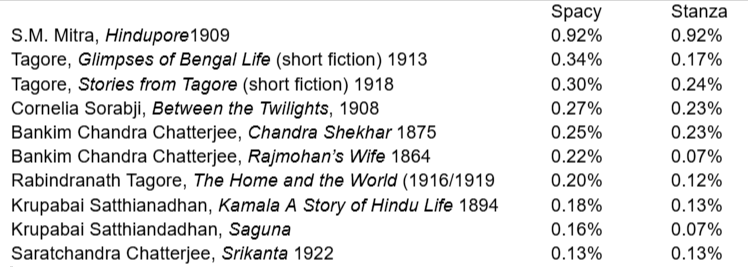
Preliminary observation. One notable result: the numbers for these Indian writers – again, a fairly random selection of ten works of fiction – are slightly lower than the percentages for their English peers, though not by very much. It is also worth noting that the books by Tagore and Bankim Chandra Chatterjee were translated from the Bengali, while the books by S.M. Mitra and Cornelia Sorabji were originally published in English by British publishing houses. From looking at the texts themselves, it is clear that these two books were primarily written with English readers in mind.
An Anomaly. In the chart above, there is a rather anomalous result for a relatively obscure book called Hindupore by S.M. Mitra. This is a travel narrative and political commentary, only thinly fictionalized, with an Irish Member of Parliament traveling to India with an Indian Maharajah. Mitra on the whole is a bit of an odd bird – he was essentially a supporter of British rule, who made a career of explaining Indian culture for English readers in often simplistic ways. I am keeping the text on the list for the present, though in terms of geographic intensity it behaves more like a nonfiction travel narrative than a typical work of fiction.
A case could be made that for Indian writers who lived permanently abroad, like Mitra (or, in the U.S. context, Dhan Gopal Mukerji), their texts should be in a different category than texts by Indian authors who lived in India itself -- and maybe excluded from a corpus of "Indian fiction" in future tests.
 |
| Global interconnections in S M Mitra's Hindupore |
Preliminary Observations: In short, at least with these small test corpora, there does appear to be a slightly higher geographic intensity result for the British colonial texts than for the Indian ones. That said, the difference is not major -- I now want to go back to basics and re-read (with my eyes, not with a computer) texts like The Home and the World with an eye to how places are described. Also, as Wilkens and Evans concluded with a different corpus, there is also not a vast difference between men and women authors with respect to geographic intensity (on the British side at least).
In the next few weeks I will also aim to expand the study to the full corpus to confirm these results, while also studying the granular results from various software packages. (What are the false positives and false negatives in each set of results?)